
Download
3D Flyover
Add to list
More
10.0 km
~1 hrs 59 min
0 m
Point to Point
“From Pijnacker Centrum to Delft, a flat polder ramble: big skies, birdsong, and lakeside calm.”
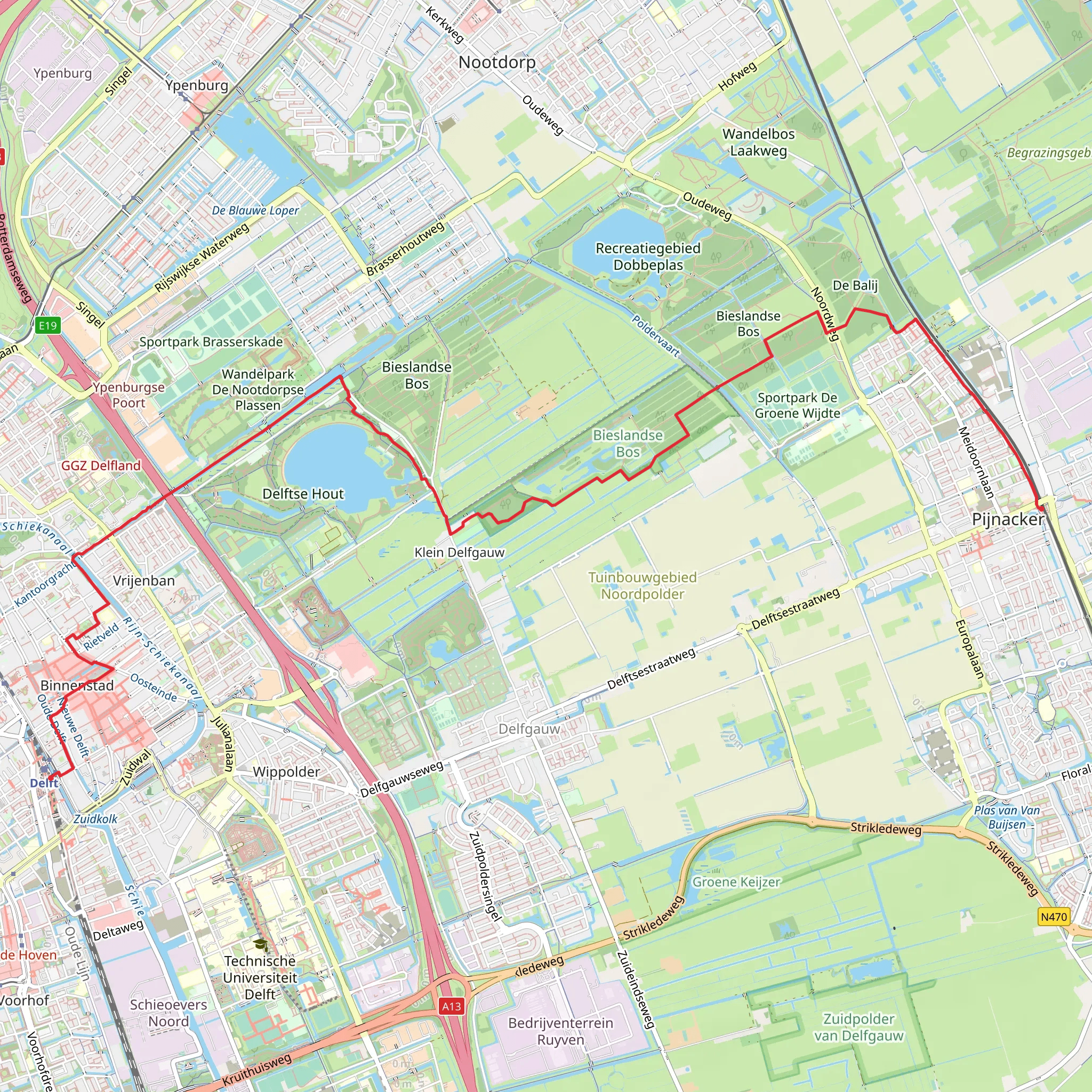
Starting near Pijnacker Centrum (RandstadRail/Metro line E) in central Pijnacker—by the Oostlaan corridor—you’ll head south toward the open polder edge, then thread into the Buytenhout green buffer and finish with a relaxed circuit past Delftse Hout and De Grote Plas before reaching Delft. The whole walk is about 10 km / 6.2 mi with essentially 0 m / 0 ft of elevation gain, so the effort is mostly about steady pacing, wind exposure in the open sections, and choosing the driest paths after rain.
Getting to the start (public transport or car)
- Public transport: Take RandstadRail/RET Metro line E to Pijnacker Centrum (station in the center of Pijnacker, near Oostlaan). The station itself has frequent service along the Den Haag–Rotterdam corridor. (en.wikipedia.org)
- By car: Aim for parking in central Pijnacker near the station area (Oostlaan is the key approach street). If you want a simple “pin,” Oostlaan (2641 DK), Pijnacker is the immediate station neighborhood to navigate to, then park where permitted and walk to the platforms/entrance. (en.wikipedia.org)
What the route feels like underfoot (and why it’s so flat)
This is classic South Holland polder walking: reclaimed, engineered lowland where paths follow dikes, drainage lines, and field edges. Expect long, level sightlines, big skies, and a mix of: - Paved cycle paths leaving town - Hard-packed gravel and farm tracks through the green buffer - Lakeside footpaths around Delftse Hout/De Grote Plas
Because the terrain is essentially level, the “difficulty” comes from surface changes (muddy edges in wet weather), wind (especially across open grassland and water), and shared-use traffic (cyclists).
Pijnacker’s edge to Buytenhout (about 0–4 km / 0–2.5 mi)
Leaving Pijnacker Centrum, you’ll quickly transition from residential streets to the green buffer zone that locals collectively refer to as Buytenhout—a connected patchwork of young woodland, open grassland, and water between Delft, Zoetermeer, and Pijnacker-Nootdorp. Much of this landscape has been developed as recreation/nature area in the last few decades, so you’ll notice planted woods and managed edges rather than “ancient forest” character. (nmpijnacker.nl)
What to look for here: - Open polder meadows where you can often spot (and hear) birds well before you see them - Reedier, wetter corners and small marshy strips that attract waterfowl - Young woodland blocks that provide brief shelter from wind (staatsbosbeheer.nl)
Wildlife is one of the main rewards. Buytenhout is specifically described as a place with open polder landscape with meadow birds, plus woodland with small mammals and marsh where many birds thrive—so bringing binoculars is genuinely worthwhile even on a short 10 km outing. (staatsbosbeheer.nl)
Navigation note: the path network here can be surprisingly “braided” (multiple parallel tracks, cycleways, and farm access lanes). If you’re building or following a GPX, keep HiiKER handy so you don’t accidentally drift onto a faster cycle corridor or a dead-end farm spur.
Through the Delft fringe: Delftse Hout and De Grote Plas (about 4–9 km / 2.5–5.6 mi)
As you approach Delft’s northeast side, the landscape becomes more park-like and water-focused. Delftse Hout is the recreation district that contains De Grote Plas, a prominent lake that originated from sand excavation used for building new neighborhoods—so the shoreline and slopes can feel “sculpted” rather than naturally eroded. (en.wikipedia.org)
De Grote Plas is the centerpiece: - Expect wide water views, picnic lawns, and busy warm-weather edges. - A popular, family-friendly atmosphere in good weather; quieter on weekdays and in colder months. - If you choose to do a fuller lakeside arc, the commonly referenced walk around the lake is roughly **
Surfaces
Unknown
Asphalt
Gravel
Wood
Concrete
Comments and Reviews
User comments, reviews and discussions about the Pijnacker Centrum to Delft via Buytenhout and De Grote Plas, Netherlands.
5.0
average rating out of 5
1 rating(s)
