
Eelde-Paterswolde to Zuidlaarderveen via Meerweg, Zuidlaarderweg and Pollseweg
Download
3D Flyover
Add to list
More
22.1 km
~4 hrs 29 min
36 m
Point to Point
“A big-sky Dutch lowland drift from lakeside reeds to peat meadows, where wind sets the mood.”
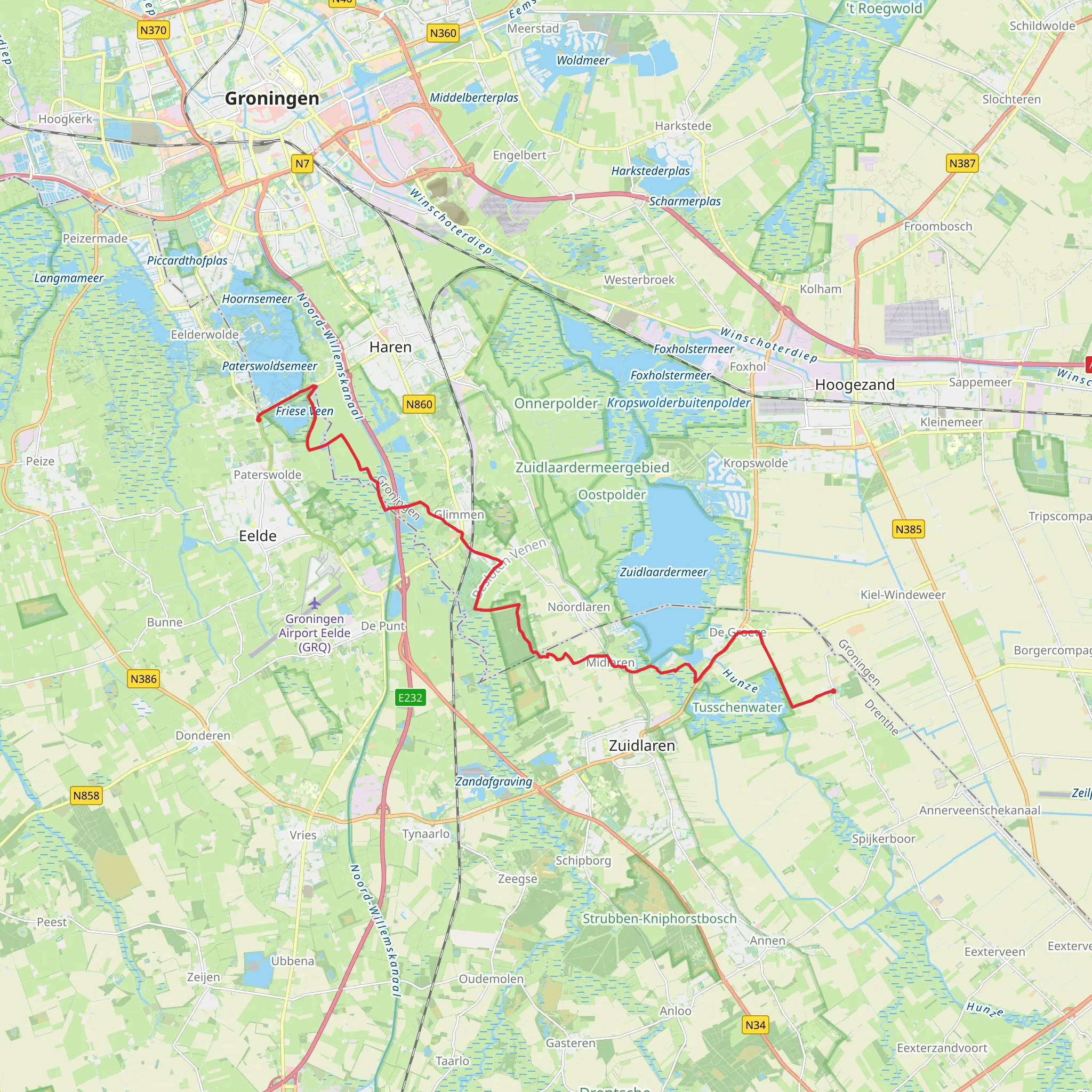
This is a long, very flat point-to-point walk across the northern Dutch lowlands, linking the village edge of Eelde‑Paterswolde with the peat-and-meadow landscapes around Zuidlaarderveen. At roughly 22 km / 13.7 mi with about 0 m / 0 ft of climbing, the effort comes less from hills and more from steady distance, wind exposure, and long straight farm roads.
Getting to the start (Eelde‑Paterswolde area)
By public transport: The easiest approach is to route yourself to Eelde or Paterswolde via buses running between Groningen and the surrounding villages. Aim for a stop near the built-up area on the Eelde/Paterswolde side of the Paterswoldsemeer corridor (a well-known local landmark and common access point to the area’s paths and lanes). From there, you can walk a short distance to pick up Meerweg.
By car: Park in or near Eelde‑Paterswolde village streets where local parking is permitted, or near public access points around Paterswoldsemeer (a prominent lake just south-west of Groningen). Choose a spot that won’t inconvenience residents or farm access; many of the roads you’ll use are working routes for agricultural traffic.
Navigation: This route is best followed with HiiKER, especially because the area has multiple parallel farm lanes and drainage ditches that can make “it looks right” navigation misleading on overcast days.
What the terrain feels like (and why it’s so flat)
Expect a classic Drenthe/Groningen border lowland: reclaimed fields, straight roads, drainage channels, and wide skies. The “around 0 m” elevation gain is realistic—any rises are subtle road crowns, bridge approaches, or dike-like edges along waterways. Underfoot is typically paved lane, compacted gravel, and short stretches of firm farm track. After rain, the unpaved bits can hold water, and the shoulders can be soft.
Wind is the main “difficulty multiplier.” With little shelter in open polder-like sections, a calm forecast can feel easy, while a headwind can make the same 22 km feel much longer.
Along Meerweg: lakeside edges, reedbeds, and birdlife (first ~6–8 km / 3.7–5.0 mi)
Starting out on Meerweg, you’ll be moving through the transition from village outskirts to water-and-field country. Near the Paterswoldsemeer area, look for:
- Reedbeds and wet margins that attract waterfowl
- Open water views and small marinas/boat access points depending on the exact line you take
- Willow and alder along wetter edges and ditches
Wildlife is often most noticeable early: coots, mallards, grebes, and in migration seasons, mixed flocks of geese. In spring and early summer, you’ll hear a lot of song from hedgerows and field edges; in wetter pockets, amphibians can be active.
What to watch for here: - Cyclists: these lanes can be popular commuter/recreation corridors. - Narrow verges: step off carefully—ditch edges can be undercut. - Sun/wind exposure: even cool days can feel intense with reflective water and open sky.
Zuidlaarderweg and Pollseweg: big-sky farmland and long straight lines (middle ~8–16 km / 5.0–10.0 mi)
As you swing onto Zuidlaarderweg and later Pollseweg, the character becomes more agricultural and linear. This is where pacing matters: the scenery is spacious rather than varied, and distances between “obvious” landmarks can feel longer than they are.
You’ll pass:
- Drainage canals and field ditches laid out in tidy grids
- Farmsteads and barns set back from the road
- Occasional tree lines that mark property boundaries or shelter belts
This region sits in a landscape shaped by centuries of water management and land use. The broader area around Drenthe and Groningen includes long histories of peat extraction and reclamation, and many place names ending in “-veen” point to former peatlands. Even when you’re walking on modern roads, you’re effectively crossing a cultural landscape built from drainage, cultivation, and settlement patterns that expanded as wetlands were managed and converted.
What to watch for: - Agricultural traffic (tractors, wide implements) that may take up most of the lane. - Limited shade: bring sun protection even if temperatures are mild. - Crosswinds: keep a steady, conservative pace so you don’t burn energy fighting the wind.
Approaching Zuidlaarderveen: peatland traces, wetter ground, and quieter lanes (last ~6 km / 3.7 mi)
Near Zuidlaarderveen, the “veen” identity becomes more apparent in the feel of the land: slightly wetter margins, more frequent ditches, and a sense of moving toward former peat-working country. Depending on the exact alignment of Pollseweg and connecting lanes, you may notice:
- More saturated field edges and seasonal standing water
- Rougher verges where grasses and reeds take over
- A quieter, more rural soundscape—less through-traffic, more birds and wind
Birdlife can shift here toward meadow and wetland species. In open grassland, keep an eye out for lapwings and other field birds (seasonal), and along wetter lines, herons are common.
AI Planner
Days planned around your pace, with somewhere to stay each night.
Surfaces
Unknown
Asphalt
Sand
Concrete
Gravel
Grass
Wood
Paved
Comments and Reviews
User comments, reviews and discussions about the Eelde-Paterswolde to Zuidlaarderveen via Meerweg, Zuidlaarderweg and Pollseweg, Netherlands.
average rating out of 5
0 rating(s)


