
Download
3D Flyover
Add to list
More
60.1 km
3 days
29 m
Multi Day
“Circle the Dutch delta’s dikes and reedbeds, where wind rules and engineered waters meet.”
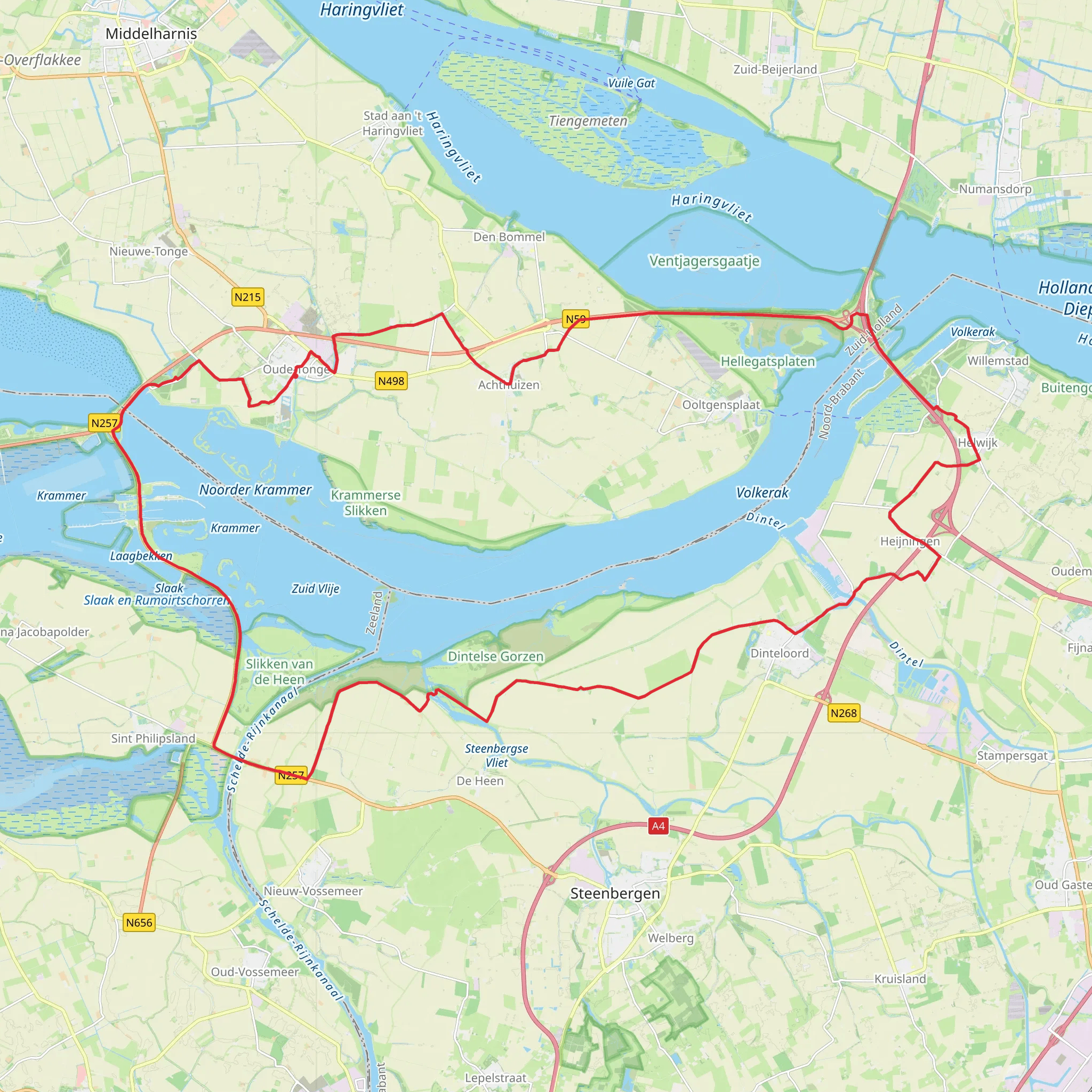
This is a big, flat, water-dominated loop through the southwest Dutch delta landscape—long dikes, wide horizons, reedbeds, and engineered “edges” where freshwater and saltwater systems were deliberately separated. At roughly 60 km / 37 mi with about 0 m / 0 ft of climbing, the challenge is less about elevation and more about wind exposure, distance management, and long stretches without services.
A practical start/finish landmark for this loop is Hellegatsplein (the major road junction on the Volkerak works where the A29 and N59 meet), near the Volkerakdam/Hellegatsdam structures. Another convenient access point on the north side is Ooltgensplaat (village on Goeree-Overflakkee), which sits right by the Hellegatsplaten birding area. The route name points to three connected waters/areas you’ll keep circling: Noorder Krammer, Volkerak, and Hellegatsplaten.
Getting to the start (car + public transport)
By car
- Aim for Hellegatsplein (A29/N59 interchange) as the most obvious “significant landmark” start. It’s a well-known node in the Delta Works road network on an artificial island, and it naturally fits a loop that touches Volkerak/Hellegat waters. (en.wikipedia.org)
- If you prefer a village-based start with easier amenities, start in/near Ooltgensplaat and walk out to the dike and birding viewpoints along the Hellegat–Ventjager “vogelboulevard” corridor.
By public transport - The most realistic approach is to bus in from a larger hub (Rotterdam area). A commonly used connection is via the Rotterdam Zuidplein bus station toward the N59 corridor (operators and exact stops vary by day/time). Plan the final leg to Ooltgensplaat / Den Bommel (N59 P+R) area and then walk/taxi to your chosen start. Check current schedules before you commit. (rome2rio.com)
If you’re building the route in HiiKER, set your start at Hellegatsplein or Ooltgensplaat and verify any dike-top access points and footpath legality—some nature cores here are intentionally closed, with viewing points provided instead. (staatsbosbeheer.nl)
What the walking feels like (surface, exposure, pacing)
Expect a lot of hard, fast surfaces: dike-top asphalt, compacted gravel, and service roads. That makes the distance doable at an “easy” grade, but it can be tough on feet over 60 km/37 mi—consider cushioned footwear and plan blister prevention early.
Wind is the real variable. With open water on multiple sides, there’s often no shelter. A calm day can feel effortless; a headwind can turn flat terrain into a grind. Bring a windproof layer even in mild forecasts.
Water and food resupply can be patchy depending on your exact line. Villages like Ooltgensplaat are your best bet for reliable services; the dike sections and waterworks areas are more about views than shops.
Landmarks and engineered history you’ll be walking through
This loop sits inside the story of the Delta Works, the vast Dutch flood-protection and water-management program that accelerated after the 1953 North Sea flood. Several of the structures you’re skirting are part of the “compartmentalisation” approach—closing and separating basins to control storm surge risk and manage salinity. (en.wikipedia.org)
Key features you’ll notice: - Volkerakdam / Volkerak Works: not a single dam but a system of dam sections, locks, and connections that created major road links and controlled water movement. The works were built in stages (mid-20th century into the 1970s), and Hellegatsplein sits right in the middle
AI Planner
Days planned around your pace, with somewhere to stay each night.
Surfaces
Unknown
Asphalt
Concrete
Cobblestone
Paved
Comments and Reviews
User comments, reviews and discussions about the Noorder Krammer, Volkerak and Hellegatsplaten Loop, Netherlands.
average rating out of 5
0 rating(s)



