
Download
3D Flyover
Add to list
More
12.2 km
~2 hrs 27 min
14 m
Point to Point
“Wander Veluwe’s pine-scented tracks to wind-brushed heath, where soft sand slows the stride.”
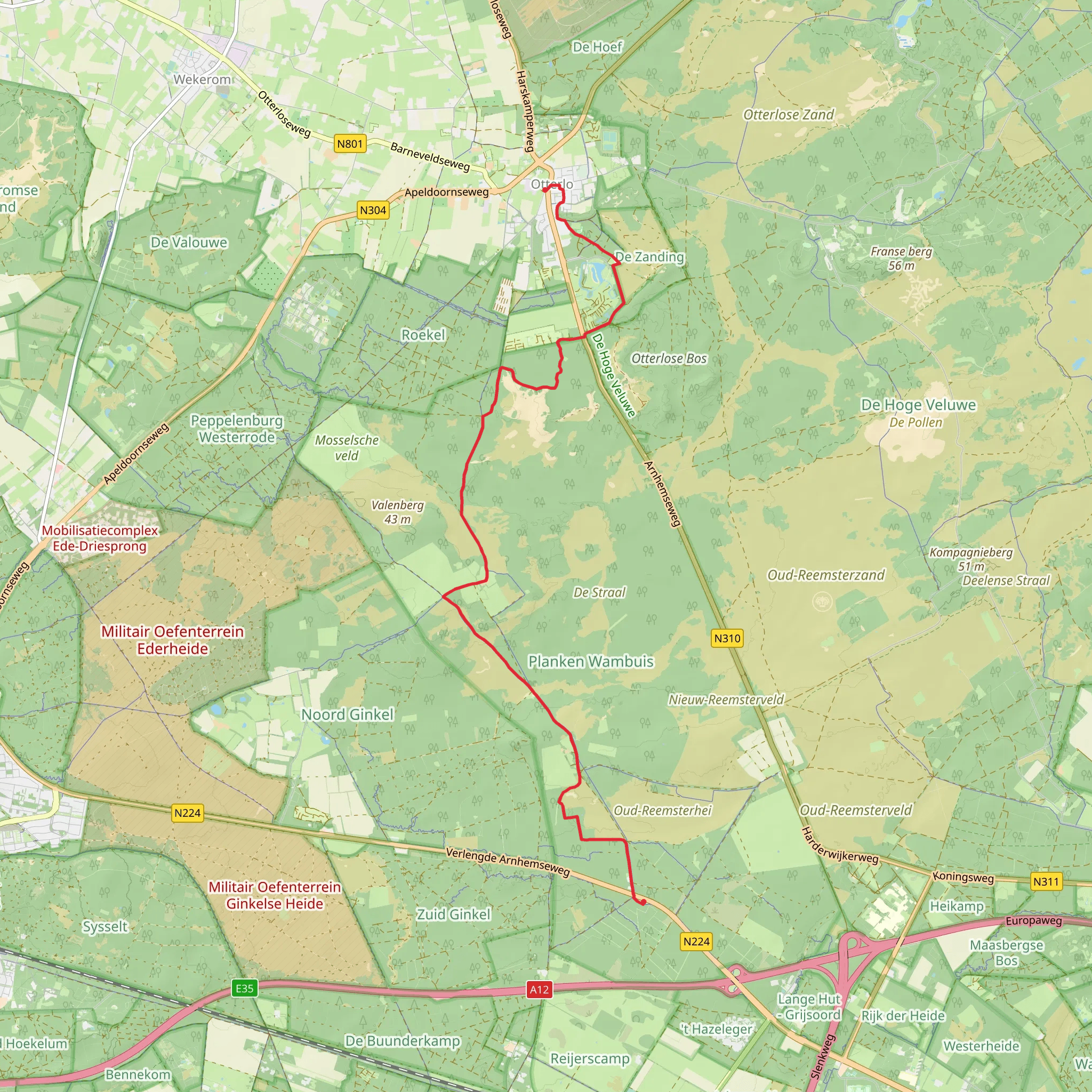
This easy, mostly level loop of about 12 km (7.5 miles) is a classic Veluwe woodland-and-heath walk: wide sandy tracks through pine and mixed forest, quieter single-track-like footpaths, and open stretches across heath where the horizon suddenly widens. With an estimated ~0 m / ~0 ft of elevation gain, the effort comes less from climbing and more from soft sand underfoot in places and the occasional exposed, breezy heath section.
Getting to the start (car + public transport)
Because the start point is listed only as “near,” the most practical way to plan is to anchor your start around the most obvious nearby access points for this route name:
- By car: Aim for the Otterlo area on the west side of De Hoge Veluwe. A common, convenient landmark to navigate to is Otterlo village center (near Dorpsstraat, Otterlo, Gelderland), then use HiiKER to pin the closest trail access/parking to the route line. In this region you’ll typically find small forest car parks (“parkeerplaats”) on the edges of the woods and heath.
- By public transport: The usual approach is train to Ede-Wageningen station, then a bus toward Otterlo. From Otterlo, it’s often a short walk to the forest edge depending on where you set your exact start. Use HiiKER to choose a start point that minimizes road walking.
If you share the route’s lon/lat (or a GPX), I can convert it to the nearest named car park, trailhead, or landmark and tailor the directions precisely.
You’ll want comfortable walking shoes rather than road trainers—sand can be tiring and unstable—and in wet periods, expect muddy patches where forest tracks hold water.
What the terrain feels like
The Veluwe is famous for its sandy soils and glacially shaped landscapes, and that character shows up immediately. Much of the walking is on: - Firm forest tracks (easy pacing, good for groups) - Sandy lanes (slower, more effort; sand can drift into ruts) - Heath paths (often narrower, sometimes slightly uneven with heather roots)
Even though the elevation gain is essentially flat, the route can feel “worky” if you hit a long sandy stretch into a headwind across the open heath.
Forest sections: De Zanding & Otterlose Buurtbos
Early on you’ll likely be in managed Veluwe woodland—a mix of pine plantations and patches of deciduous trees. The forest floor is typically a mosaic of moss, needles, and sandy clearings, and you’ll notice how quickly the ground drains after rain.
Wildlife is one of the big reasons people walk here: - Red deer are present in the wider Veluwe region; you’re most likely to spot them at quieter times (morning/evening) near forest edges. - Roe deer are smaller and often appear briefly before slipping back into cover. - Wild boar are also part of the Veluwe ecosystem; you’ll more often see rooted-up ground than the animals themselves.
Look out for fresh tracks in sand—hoofprints and boar rooting are easiest to read on the smoother sections of path. If you do encounter boar, give them space, keep dogs close, and avoid getting between an adult and piglets.
Open heath: Oud Reemsterhei
The shift from forest to heath is the route’s big “wow” moment: the trees thin, the light changes, and you get that open, airy feel that’s so characteristic of Dutch heathlands. The Oud Reemsterhei area is valued for its heather, grasses, and scattered solitary trees, and it can feel surprisingly wild for such a flat country.
Seasonal highlights: - Late summer (often August–September): heather can bloom, turning sections purple. - Spring: bird activity increases; listen for calls from the open ground and forest edge. - Winter: the heath can be stark and beautiful, but wind chill is more noticeable.
This is also where navigation can feel less obvious in poor visibility because multiple sandy lines can braid across the heath. Keep an eye on your position with HiiKER, especially at wider junctions where several tracks look equally “main.”
Landmarks, atmosphere, and regional history
This part of Gelderland sits within the broader Veluwe landscape, long shaped by sand, heath management, and forestry. Heathlands like Oud Reemsterhei are not “untouched wilderness” in the modern sense—they’re historically linked to traditional grazing and land use, which helped keep trees from reclaiming open ground. The surrounding forests include areas that were planted and managed over time, reflecting changing needs for timber and land stabilization.
You may pass: - Sandy clearings and drift-sand-like patches (a hallmark of Veluwe soils) - Forest edges with long sightlines (excellent for wildlife scanning) - Occasional benches, waymarkers, or small information boards depending on the exact line of the loop
Practical planning: time, water, and what to watch for
- Time needed: Most hikers will take roughly 2.5–3.5 hours for 12 km (7.5 miles) depending on sand depth, stops, and pace.
- Water & snacks: Treat this as a self-sufficient walk—carry water, especially in warm weather. Shade is plentiful in the forest but limited on the heath.
- Footing: The main hazard is soft sand (ankle
Surfaces
Dirt
Concrete
Ground
Unknown
Sand
Asphalt
Unpaved
Gravel
Comments and Reviews
User comments, reviews and discussions about the De Zanding, Otterlose Buurtbos and Oud Reemsterhei, Netherlands.
average rating out of 5
0 rating(s)
