
Download
3D Flyover
Add to list
More
69.4 km
4 days
0 m
Multi Day
“A big-sky, wind-kissed flatland loop of canals and farm tracks—an endurance day for some.”
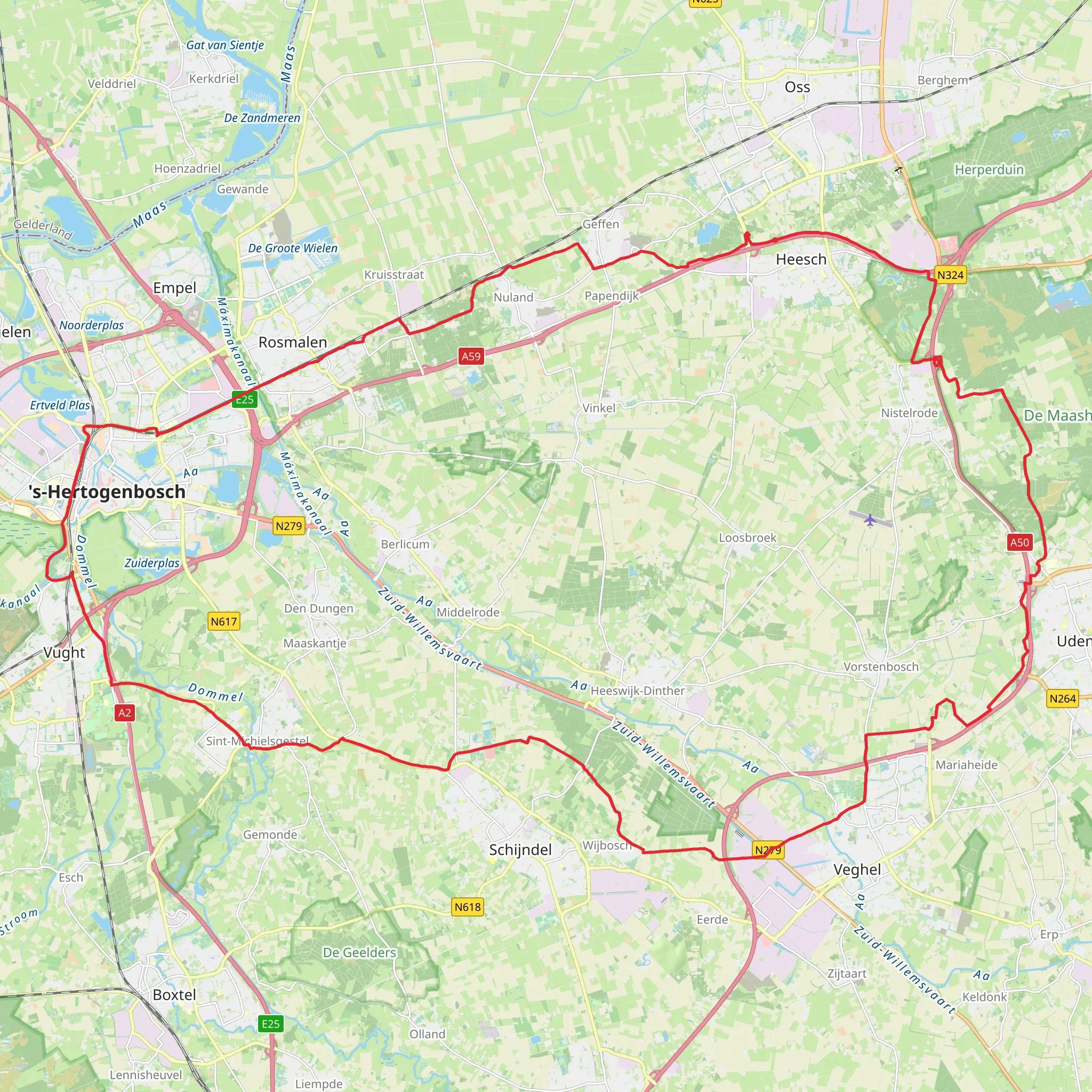
This is a long, low-lying loop of roughly 69 km (43 mi) with essentially 0 m (0 ft) of climbing—expect it to feel more like an endurance walk than a “hike,” with most of the challenge coming from distance, wind exposure, and surface variety (paved cycle paths, compacted gravel, towpaths, and occasional softer farm tracks). Because the terrain is flat, pacing and foot care matter more than “fitness for hills.”
You haven’t provided the exact start coordinates (“Hike head: near …” is incomplete), so I can’t convert a lon/lat to a precise nearby address yet. If you share the start lon/lat (or a GPX), I’ll pin it to the nearest recognizable landmark/address and tailor the access directions and segment distances precisely.
Getting to the start (general, for the Fort Isabella / Vught / ’s‑Hertogenbosch area)
This loop’s place names strongly suggest the ’s‑Hertogenbosch (Den Bosch) / Vught area in North Brabant, Netherlands, with Fort Isabella as a key waypoint.
- By train + short local connection: The most common rail hubs are ’s‑Hertogenbosch station and Vught station. From either, you can typically reach Fort Isabella and surrounding trailheads via local bus or a short taxi/ride-share, and in many cases by walking or cycling on dedicated paths.
- By car: Aim for parking near Fort Isabella (Vught) or on the edge of ’s‑Hertogenbosch where long-stay parking is permitted. Choose a spot that allows all-day parking and doesn’t require a permit (rules vary by neighborhood).
If you tell me where you want to start/finish (Fort Isabella, De Drie Koningen, or Brobbelbies), I’ll suggest the most practical parking/transit option for that exact trailhead.
What the route feels like underfoot
Over 69 km (43 mi), you’ll likely rotate through: - Wide, smooth multi-use paths (fast, efficient, but repetitive) - Canal/towpath-style corridors (straight lines, open sky, wind) - Farm lanes and field edges (muddy after rain; watch for slick clay) - Short urban/edge-of-town connectors near Den Bosch/Vught (crossings, cyclists, and signage)
Because elevation gain is negligible, the “hard parts” are usually: - Headwinds across open polder/farmland - Hard surfaces (pavement fatigue on feet, knees, hips) - Long, exposed stretches with limited shade
Plan footwear for distance: cushioned shoes, blister prevention, and socks you trust for an all-day effort.
Landmarks and historical context you’ll notice
Fort Isabella is the standout historical anchor. The region around Den Bosch has long been strategically important due to waterways, marshy ground, and fortified lines. Fortifications here were historically designed to control approaches to the city and to use wet ground defensively—so even though today’s walk is flat and friendly, the landscape’s “engineered” feel (straight ditches, embankments, controlled water) often reflects centuries of water management and defense planning.
Depending on the exact alignment, you may also pass: - Old defensive earthworks, canals, and military-era corridors (often now repurposed as greenways) - Historic village edges and farmsteads typical of North Brabant - Water-control infrastructure (sluices, drainage channels, and raised paths)
If you share the exact line on HiiKER (or GPX), I can call out the specific fort features and any named works you’ll pass (gates, ramparts, barracks zones, etc.).
Nature, scenery, and wildlife (flatland highlights)
Even without hills, this area can be surprisingly rich in wildlife, especially near water and wet meadows.
Habitats you’re likely to traverse - Canals, drainage ditches, and ponds: look for reedbeds and willow edges - Wet grassland and pasture: open views, big skies, lots of birds - Small woodlots and hedgerows: brief shelter from wind, more songbirds
Wildlife to watch for - Waterfowl (ducks, geese, coots) and wading birds in wetter sections - Raptors hunting over fields (often seen hovering or perched on poles) - Amphibians near ditches in warmer months - In rural edges, you may encounter grazing livestock; give them space and keep gates as you find them.
Bring binoculars if you enjoy birding—flat routes often reward you with long sightlines.
Practical planning for a 69 km (43 mi) “easy” loop
“Easy” here means technically straightforward and low risk of steep terrain, not “short.” Treat it like an ultra-distance day.
Time & pacing - Many hikers average 4–5 km/h (2.5–3.1 mph) on flat ground including brief stops. - That puts a full loop at roughly 14–18 hours depending on breaks, wind, and surface.
Food & water - Plan for steady fueling (small snacks every 30–45 minutes works well for many people). - Carry enough water capacity for longer gaps; canals don’t mean potable water. - Town-edge segments may offer cafés/shops, but don’t rely on them without checking hours.
Weather & exposure - Wind is the big variable on open farmland. A light shell can matter
AI Planner
Days planned around your pace, with somewhere to stay each night.
Surfaces
Asphalt
Unknown
Paved
Wood
Concrete
Sand
Comments and Reviews
User comments, reviews and discussions about the De Drie Koningen, Fort Isabella and Brobbelbies Loop, Netherlands.
average rating out of 5
0 rating(s)



