
Download
3D Flyover
Add to list
More
12.6 km
~2 hrs 52 min
213 m
Loop
“A gentle Arnhem green-belt loop—beeches, ponds, and quiet estate lanes with softly rolling rises.”
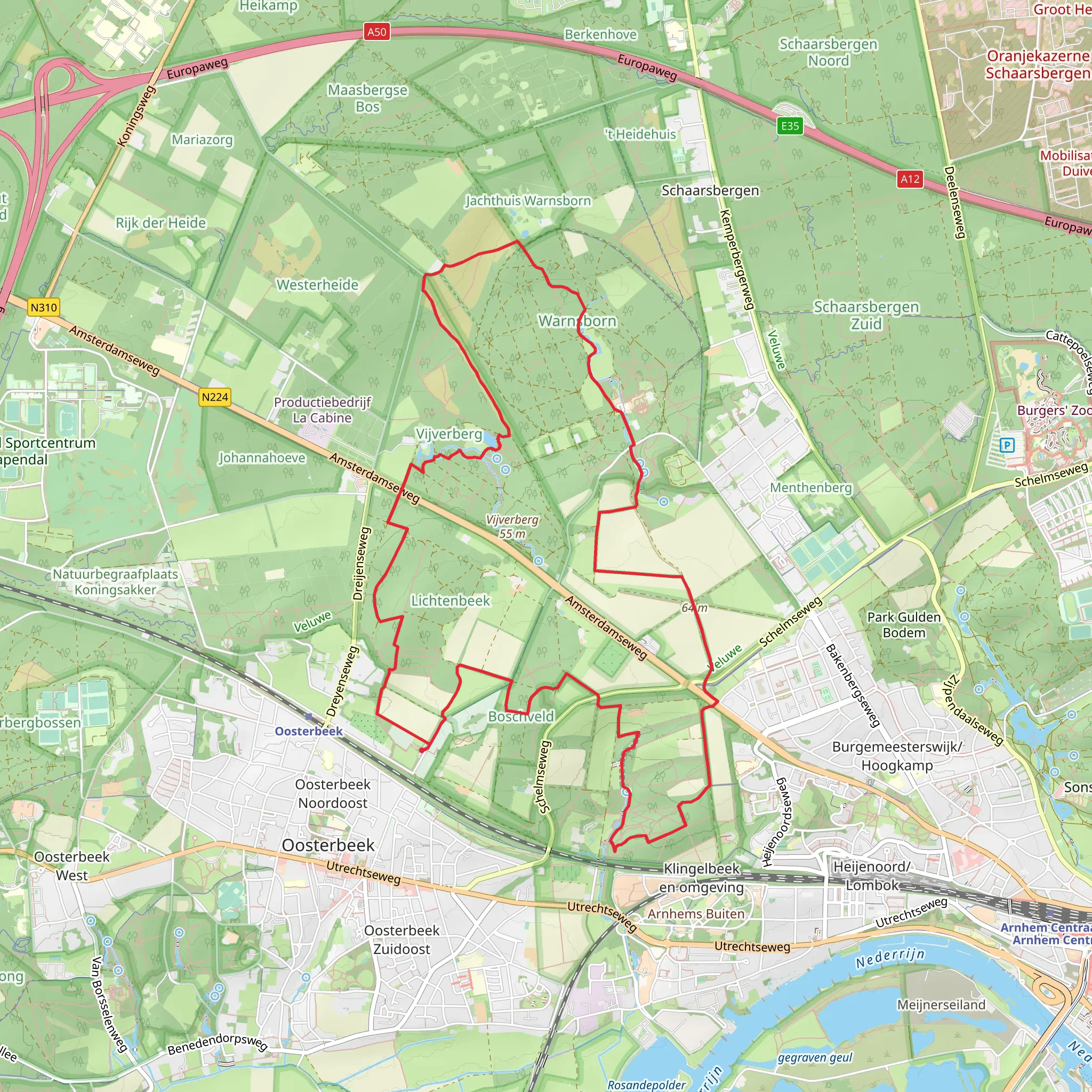
This easy loop is a gentle, mostly wooded walk of about 13 km (8.1 mi) with roughly 200 m (656 ft) of total climbing—spread out in small rises rather than one big hill. Expect a mix of broad forest tracks, narrower footpaths, and a few short paved or hard-packed connectors as you move between the estates/woodlands of Mariëndael, Vijverberg, and Lichtenboek—a classic “green belt” feel right on the edge of Arnhem.
Getting to the start (car + public transport)
Because the start is listed only as “near …”, the most reliable way to pinpoint it is to open the route in HiiKER and use the start-point coordinates there to navigate to the closest trailhead entrance.
That said, this loop name strongly suggests the Arnhem / Veluwezoom edge where these estate woods sit close together. Common, practical jump-off points in that area are: - By car: aim for a signed estate/forest parking area near the Mariëndael / Schaarsbergen side of Arnhem (look for “P” trailhead lots on HiiKER). Arrive early on weekends—these woods are popular with walkers and cyclists. - By public transport: the easiest pattern is train to Arnhem Centraal, then a bus toward Schaarsbergen / Veluwezoom-edge neighborhoods, getting off near a forest/estate entrance and walking a short connector to the route start. Use HiiKER to choose the stop that minimizes road walking.
If you share the route’s lon/lat, I can convert it to the nearest known address or landmark precisely.
You’ll likely begin on wide, forgiving paths under beech and oak, with the first 2–3 km (1.2–1.9 mi) easing you into the terrain. The climbing is subtle at first—small rollers as you pass drainage lines and low ridges—so it’s a good warm-up section. Underfoot is usually firm, but after rain the low spots can hold water and turn slick with leaf litter.
As you approach the Vijverberg portion, the character often shifts to a more “estate-park” feel: straighter lanes, occasional formal plantings, and clearer sightlines. Keep an eye out for: - Ponds and wet hollows (the “vijver” element): these attract waterfowl and amphibians in season. - Old boundary banks/ditches that hint at historic land division and estate management.
Through Mariëndael and the estate woods (landmarks + history)
Around the middle of the loop—roughly 5–9 km (3.1–5.6 mi)—you’re typically in the most scenic, quiet woodland stretches. These Arnhem-area estates were historically shaped by landed properties and managed forests, and you can often “read” that history in the landscape: long straight rides (old carriage or forestry lines), remnant avenues, and occasional clearings that feel intentionally placed rather than purely natural.
Wildlife is usually subtle but present: - Roe deer are common in these Dutch estate woods—most often seen at dawn/dusk or as movement in the understory. - Woodpeckers (listen for tapping) and mixed songbirds in the canopy. - In wetter pockets, you may spot frogs/newts and dragonflies in warmer months.
If the route threads close to any formal estate features (gates, old lanes, or ornamental water), treat them as “slow down” zones—other walkers, dogs, and cyclists tend to cluster there.
Lichtenboek section and the return leg (terrain + pacing)
The final 4–5 km (2.5–3.1 mi) usually feel a touch more undulating, where the loop picks up the remainder of its ~200 m (656 ft) of ascent in short rises. None of it is steep by mountain standards, but it can feel surprisingly “busy” on the legs if you’ve been striding quickly on flat lanes.
What to watch for on the way back: - Trail junction density: estate woods often have many intersecting tracks. Use HiiKER at junctions to confirm you’re taking the correct spur—especially where multiple wide lanes look nearly identical. - Mixed-use paths: cyclists can appear quickly on the straighter, wider tracks. Hold a predictable line and listen for bells. - Seasonal footing: in autumn/winter, leaf cover can hide roots and make gentle slopes slick; in spring, some sections can be muddy where water collects.
Practical planning notes (what to bring + timing)
- Time on trail: most hikers will take about 3–4 hours for 13 km (8.1 mi) depending on stops and how muddy it is.
- Footwear: light hiking shoes are usually enough; after rain, consider something with better mud grip.
- Water/food: there may be cafés on the Arnhem edge, but don’t count on services deep in the woods—carry what you need.
- Respect estate rules: some estate areas have signed guidance (leash requirements, staying on paths, quiet zones for wildlife). Follow posted signs where the route passes through managed land.
Surfaces
Unknown
Ground
Gravel
Asphalt
Unpaved
Paved
Dirt
Sand
Wood
Comments and Reviews
User comments, reviews and discussions about the Lichtenboek, Vijverberg and Mariendaal Loop, Netherlands.
average rating out of 5
0 rating(s)

