
Download
3D Flyover
Add to list
More
36.1 km
2 days
112 m
Multi Day
“A reflective all-day loop of farm lanes, canal paths, kerkpaden, and a city-street pause.”
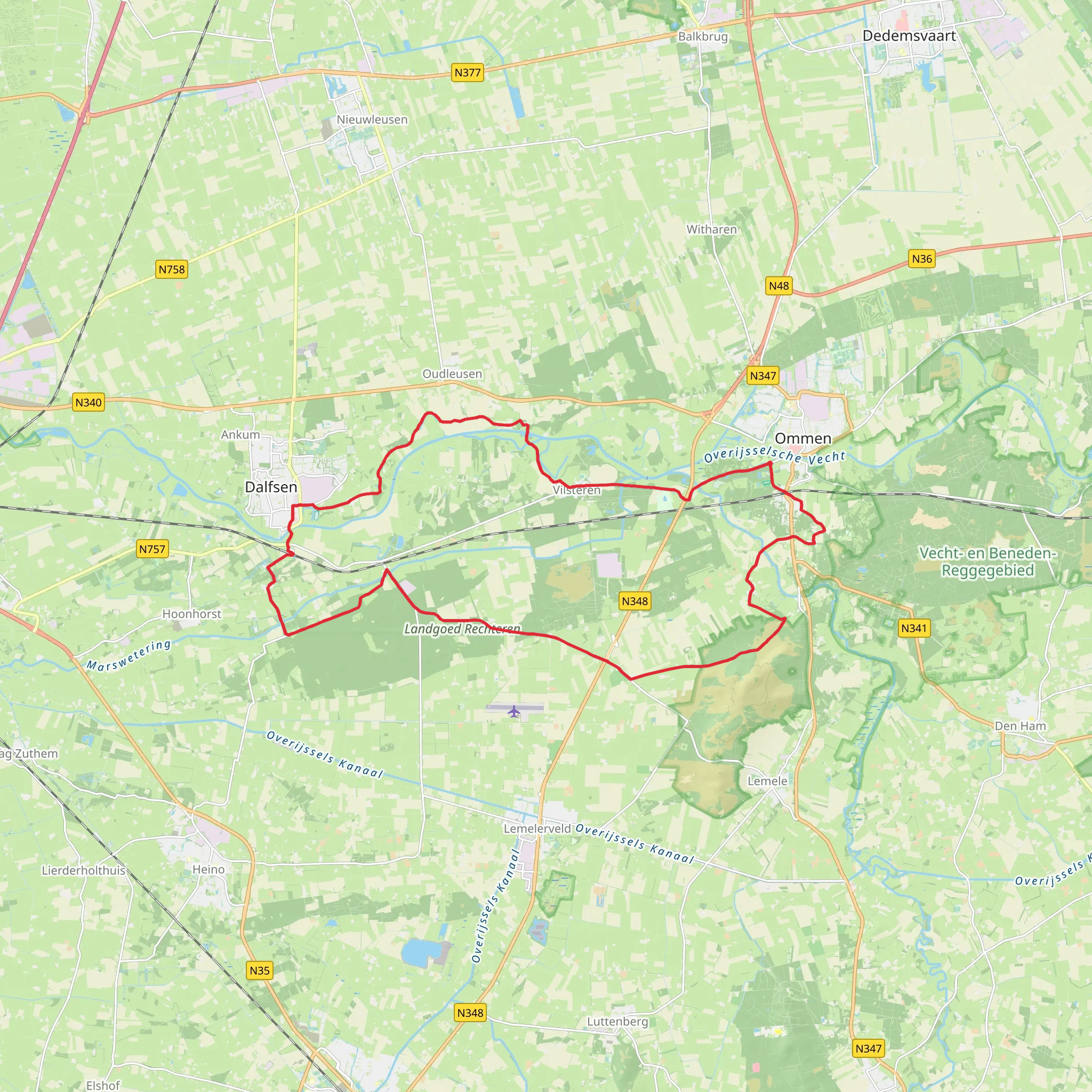
This is a long, low-relief countryside-and-town loop typical of the Salland/Overijssel landscape: farm lanes, canal/river paths, village edges, and short urban connectors. At roughly 36 km (22.4 mi) with about 100 m (330 ft) of total ascent, it’s more about steady time on your feet than climbing—ideal for fit walkers who want an all-day “easy” distance.
Because your start point is listed only as “near” (missing the actual location/coordinates), I can’t reliably convert the start to a nearest address/landmark yet. If you paste the start lon/lat (or a GPX link), I’ll pin it to the nearest recognizable place (e.g., a church, station, bridge, or trailhead) and tailor the access directions precisely.
Getting to the start (general, works for most starts in/near Zwolle–Raalte–Dalfsen area)
- By public transport: This region is well-served by trains and buses. The most common practical approach is to arrive by train at a nearby hub such as Zwolle Station or Raalte Station, then use a local bus or a short walk to the trailhead area. If your start is near a village center, it’s often within 1–3 km (0.6–1.9 mi) of a bus stop.
- By car: Expect easy driving on provincial roads with frequent farm access lanes. Parking is usually simplest near a church, sports club, village hall, or a larger roadside pull-in—but the best choice depends on the exact start point. Avoid blocking farm gates and narrow verges.
Plan for 7–9 hours of moving time for most hikers (pace, breaks, and any town stops will decide the day).
What the route feels like underfoot
You’ll likely alternate between: - Paved farm roads and brick lanes (fast, consistent footing; can feel repetitive late in the day). - Canal/stream-side paths and dike-top tracks (open views, wind exposure). - Short town/village segments (crossings, cyclists, and navigation attention).
Even with only ~100 m (330 ft) of gain, you’ll notice gentle rises onto embankments and overpasses, plus small undulations where paths climb onto dikes or cross infrastructure.
Navigation and wayfinding
This is the kind of loop where turns can come quickly at field corners, bridges, and village edges. Use HiiKER to: - Confirm you’re taking the correct farm lane at T-junctions (many look identical). - Stay on the intended side of canals/streams (bridges can be spaced farther apart than expected). - Handle urban connectors (street grids can tempt shortcuts that break the loop).
Landmarks and character along the way
The place names in your hike title point to a mix of historic footpaths (“Kerkpad”), older roads, and town streets: - Kerkpad (church path): In many Dutch villages, a “kerkpad” is a traditional pedestrian route used for generations to reach the church more directly than by cart roads. Expect a narrower, more intimate corridor—sometimes between fields, hedges, or along property edges. - Oude Raalterweg (“Old Raalte Road”): “Oude” roads often trace older alignments between settlements. These can feel straighter and more direct, with long sightlines across farmland. - Diezerstraat: This name is strongly associated with Zwolle’s city center (Diezerstraat is a well-known shopping street). If your loop truly includes this segment, you’ll get a distinct urban interlude: storefronts, pedestrians, and frequent crossings—great for resupply, but slower walking. - Stuwepad (“weir path”): “Stuw” refers to a weir/water-control structure. Paths with this name commonly run near managed waterways—expect engineered banks, sluices, and a clear sense of the Netherlands’ water-management landscape.
Nature, scenery, and wildlife to look for
This part of Overijssel is shaped by agriculture and water: - Open fields, drainage ditches, and reed-lined canals: Look for grey heron, great egret, mallard, coot, and seasonal migrants. In quieter stretches you may spot marsh harrier quartering low over reeds. - Meadows and field margins: Hares are common; roe deer can appear at dawn/dusk near wooded edges. In spring and early summer, listen for skylarks over open land. - Village edges and small woodlots: Songbirds, woodpeckers, and occasional buzzards riding thermals.
Ticks can be present anywhere with taller grass and brushy edges—especially if the kerkpad or waterside sections run through unmown margins.
Historical context (what you’re walking through)
Even when the terrain is flat, the landscape is “busy” with history: - Settlement-to-settlement connectivity: Old roads and kerkpaden reflect how communities moved before modern transport—on foot, between farms, hamlets, and parish centers. - Water control and land use: Any “stuw” segment highlights the long-standing Dutch practice of regulating water levels for agriculture, flood control, and navigation. You’ll often see straightened channels, reinforced banks, and carefully managed water heights—subtle but defining features of the region. - Urban contrast (if Diezerstraat is included): A city-center street segment adds a layer of mercantile history—traditional shopping corridors often follow older routes through the historic core.
Practical planning: food, water, and timing
AI Planner
Days planned around your pace, with somewhere to stay each night.
Surfaces
Asphalt
Unknown
Concrete
Wood
Sand
Ground
Comments and Reviews
User comments, reviews and discussions about the Giethemer Kerkpad, Oude Raalterweg, Diezerstraat and Stuwepad Loop, Netherlands.
average rating out of 5
0 rating(s)


