
Download
3D Flyover
Add to list
More
14.3 km
~3 hrs 4 min
124 m
Loop
“A gentle loop through castle parkland, sandy heath and cool wetland fringes—best savoured after drier days.”
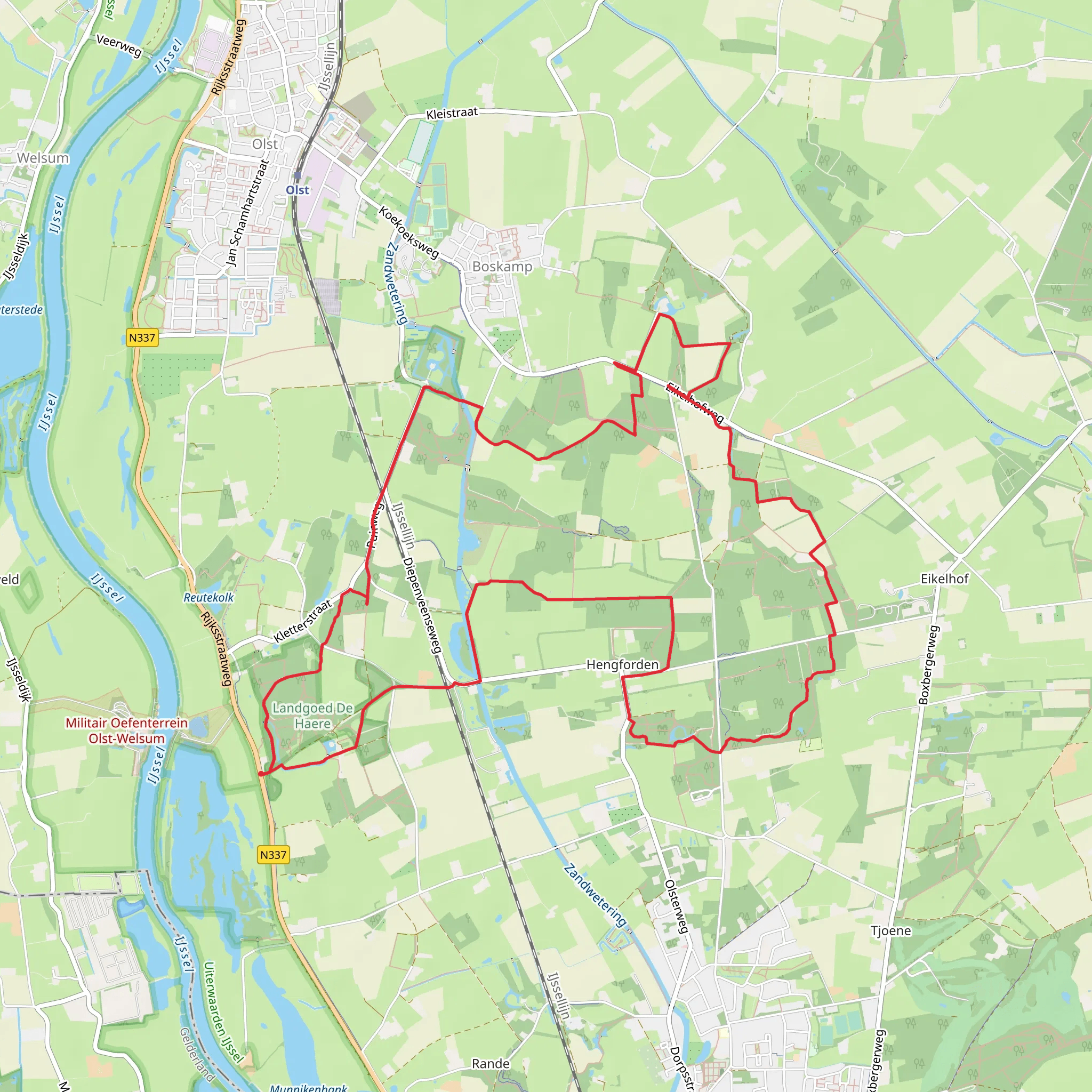
A relaxed, mostly flat countryside loop of about 14 km (8.7 mi) with roughly 100 m (330 ft) of climbing, linking small estates and castle grounds with heathland and wetland edges. Expect a mix of quiet lanes, farm tracks, woodland paths, and sandy heath trails—generally straightforward underfoot, with a few short, gentle rises and occasional muddy patches after rain.
Getting to the start (car + public transport)
Because the start point is only listed as “near” (no coordinates provided), the most practical way to plan is to aim for the estate/castle area around Kasteel De Haere and adjust once you have the exact trailhead pinned in HiiKER.
- By car: Navigate to the nearest signed access point/parking associated with Kasteel De Haere (often posted locally as an estate/landgoed destination). In this region, parking is typically a small public lot or roadside pull-in near estate entrances; arrive early on weekends to avoid full lots.
- By public transport: Plan to reach the nearest town/village rail or bus stop serving the De Haere / Spijkerbosch area, then walk the final 1–3 km (0.6–1.9 mi) to the trailhead. In rural Dutch networks, the last leg is commonly a short walk from a bus stop on a main road to the estate lanes. Use HiiKER to confirm the closest stop to your chosen start pin.
If you share the lon/lat (or a HiiKER link), I can convert it to the nearest known address or landmark and tailor the access instructions precisely.
What you’ll hike (surface, pacing, and elevation) - Distance: ~14 km (8.7 mi) - Elevation gain: ~100 m (330 ft) total—spread out in small increments rather than one sustained climb. - Time planning: Most hikers take 3–4 hours moving time at an easy pace, plus stops for estate viewpoints and nature areas. - Trail feel: Predominantly level. The “climbs” are usually low sandy rises, gentle embankments, or subtle undulations through heath and woodland.
Underfoot conditions to expect: - Estate lanes & compact tracks: firm and fast. - Heath/sandy sections: can be soft; shoes with decent tread help. - Wetland edges (Fonteinkruid area): can be muddy or slick after rain; expect short detours around puddles in places.
Landmarks and character along the loop You’ll likely experience the route in three distinct “chapters,” each with its own scenery and points of interest.
Estate and castle landscapes (first ~4–6 km / 2.5–3.7 mi)
The loop’s early portion typically threads through managed estate woodland and parkland associated with Kasteel De Haere. Even when you’re not walking directly up to the building, the landscape often shows classic estate features: straightened lanes, mature beech/oak stands, and designed sightlines.
What to look for: - Old tree avenues and boundary ditches that hint at historic land management. - Moat/pond systems (common around Dutch kastelen), which attract waterfowl. - Estate gates, bridges, and outbuildings—often the most photogenic details.
Historical context (regionally typical for “kasteel/landgoed” routes): - Many Dutch estates developed from medieval fortified houses into later country residences, with surrounding land shaped for timber, hunting, and agriculture. Even if the current structures are later rebuilds, the land parcel patterns and water features often preserve older layouts.
Heath and open nature sections: “De Hei” (middle ~4–5 km / 2.5–3.1 mi)
As you transition away from the more manicured estate feel, the route usually opens into heathland (“hei”) and lighter woodland. This is where the walking can feel airier and more expansive, with sandy soils and low vegetation.
Nature and wildlife: - Heather and acid-soil plants dominate in season; late summer can bring the most color. - Birdlife is often the highlight: listen for woodpeckers in the tree line and watch for raptors cruising over open ground. - On quiet mornings/evenings, you may spot roe deer at woodland edges.
Things to watch out for: - Sandy stretches can slow pace slightly. - Heath paths can braid into multiple lines—keep an eye on your route in HiiKER, especially at open junctions where signage may be minimal.
Wetland edges and “Fonteinkruid” waters (later ~3–5 km / 1.9–3.1 mi)
The “Fonteinkruid” name points to aquatic vegetation (pondweed), so expect sections near ditches, ponds, or slow-moving waterways. These areas are often rich in insects and birds and can feel noticeably cooler and damper.
What to expect: - Reedbeds and wet meadows depending on the exact alignment. - Boardwalks/bridges may appear, but you should still anticipate mud where paths pinch near water. - In warmer months, mosquitoes/gnats can be present—repellent is useful if you linger.
Wildlife notes: - Water margins can host ducks, coots, herons, and seasonal migrants. - Amphibians are common in wetter pockets; stay on the path to avoid trampling sensitive edges.
Kasteel Spijker
Surfaces
Unknown
Sand
Asphalt
Concrete
Grass
Ground
Wood
Comments and Reviews
User comments, reviews and discussions about the Kasteel De Haere, De Hei Fonteinkruid and Kasteel Spijkerbosch Loop, Netherlands.
average rating out of 5
0 rating(s)


