
Download
3D Flyover
Add to list
More
29.2 km
~6 hrs 7 min
171 m
Loop
“A mellow loop through heathered ridges, whispering woods, and farm-lane edges—easy to wander off without care.”
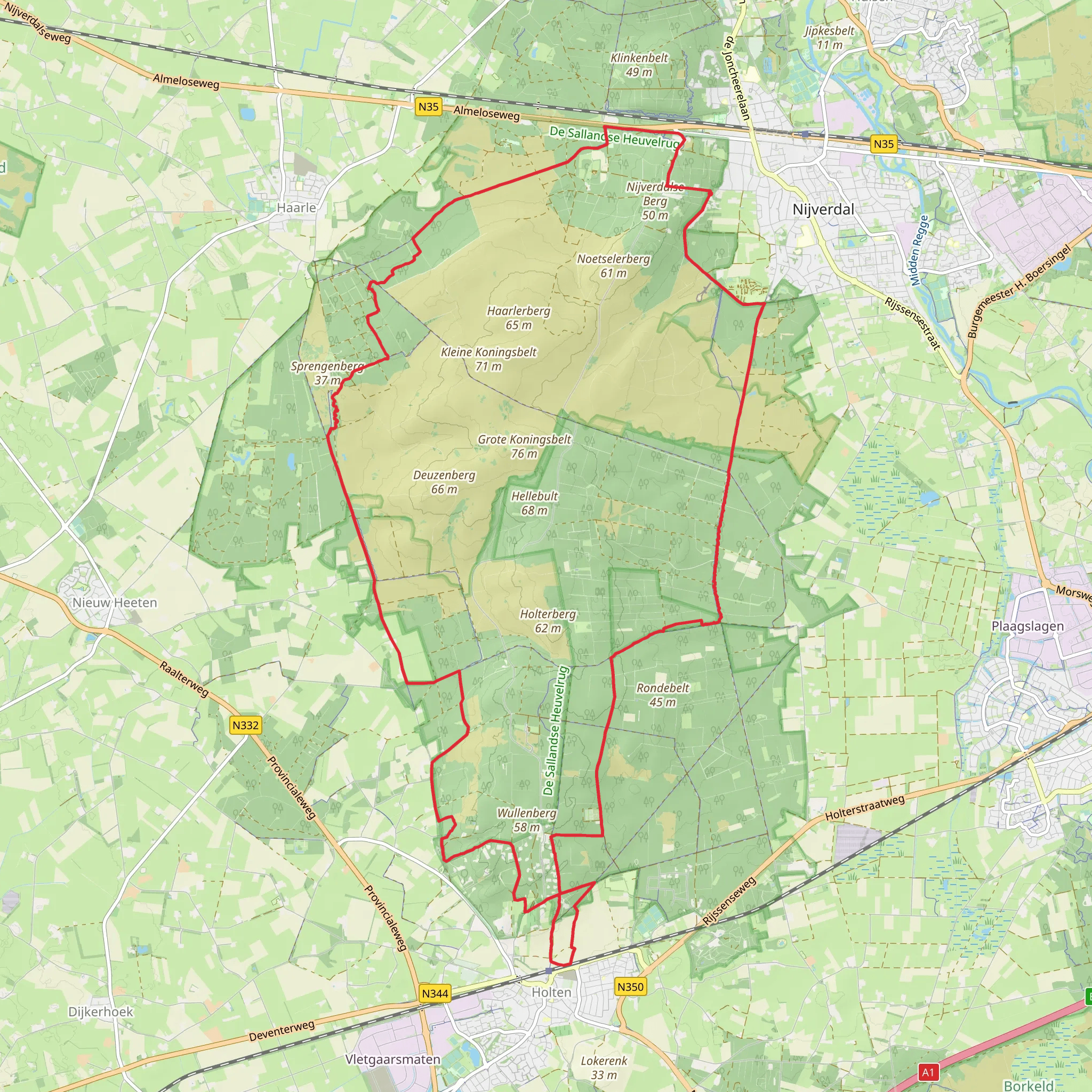
This is a long, low-relief loop of about 29 km (18.0 mi) with roughly 200 m (656 ft) of total ascent—more of a steady ramble than a climb. Expect a mix of heathland ridges, mixed woodland, and Dutch farmland edges, with frequent junctions where paying attention to wayfinding matters more than fitness.
Because your start point is listed only as “near” (no coordinates or town), I can’t reliably convert the start to a nearest address/landmark yet. If you share a lon/lat (or the nearest village/parking area), I’ll pin it to the closest recognizable trailhead/landmark and tailor the access directions precisely.
Getting to the start (general approach)
By car: In this part of the eastern Netherlands (Twente / Salland edge), loops like this typically begin from a signed trailhead/parking area near a forest entrance (often marked as a parkeerplaats). Plan for small rural roads, occasional farm traffic, and limited shoulder space. Arrive early on weekends—popular woodland car parks can fill quickly.
By public transport: The most practical pattern is usually:
1) Train to a nearby regional station (larger towns in the area tend to have the best frequency), then
2) A local bus toward the nearest village, then
3) A short walk to the forest edge/trailhead.
If you tell me the intended start village or coordinates, I’ll map the cleanest bus stop-to-trailhead walk and the most reliable return options.
You’ll want HiiKER loaded for this one: the terrain is easy, but the number of intersecting forest tracks and farm lanes can make it surprisingly easy to drift off the loop without noticing.
You’ll likely encounter: - Hard-packed forest roads and sandy tracks under pines - Heath and open clearings on higher ground (the “berg” names are modest rises, not mountains) - Field-edge paths that can be muddy after rain and rutted by tractors
What the route feels like, section by section
0–6 km (0–3.7 mi): gentle warm-up through lanes and forest edge
The opening kilometers are usually the most “human”—quiet roads, farm access tracks, and the first bands of woodland. Elevation change is minimal here, but you’ll start to notice the subtle rolling profile that adds up to the ~200 m (656 ft) over the day. Watch for soft verges and fast-moving cyclists on narrow paved connectors.
6–15 km (3.7–9.3 mi): Noetselerberg & Wullenberg—heathy high points and airy woodland
This is where the loop tends to feel most scenic. The “berg” sections are typically slightly higher, drier ground with more open views between trees and across nearby fields. Underfoot can switch from firm to looser sand in places, especially on sunny, well-used tracks.
Wildlife is often most active here in the quieter mid-morning hours: roe deer, hares, and a lot of birdlife (woodpeckers in mixed woodland; buzzards overhead in open patches). If you’re hiking in spring/early summer, expect ticks in grassy/heathy margins—long socks and a quick check at breaks help.
Navigation note: this middle portion often has multiple parallel tracks. Use HiiKER to confirm you’re on the correct line when the path “braids” into two or three options.
15–23 km (9.3–14.3 mi): Hexelerbosch—deep woods, long straight tracks, and quiet miles
Hexelerbosch is typically the most consistently wooded part of the loop—think tall conifers mixed with deciduous stands, with long, straight forestry lines that can feel deceptively similar. It’s easy walking, but mentally repetitive; it helps to plan a snack/water break around this segment.
After wet weather, low spots can hold water and become slick with leaf litter. In colder months, shaded sections can stay icy longer than open farmland.
Look out for: - Fallen branches after windstorms (common in managed forests) - Forestry operations on weekdays—if you see machinery signage, give it space and follow any temporary diversions
23–29 km (14.3–18.0 mi): farmland edges back to the start—easy legs, watch the surfaces
The final stretch usually transitions back toward field boundaries and quieter roads. This is where blisters can appear if you’ve picked up grit earlier—sand can work into shoes on heath/forest tracks. If you’ve got gaiters, they’re useful; otherwise, a quick shoe shake-out mid-route can prevent hot spots.
Landmarks, landscape, and regional history (what you’re walking through)
This area’s character comes from the long relationship between woodland management, heathland, and agriculture. Heaths in the Netherlands are often cultural landscapes—historically maintained by grazing, sod-cutting, and careful use of common land. Many forests here were later managed or replanted (often with conifers) for timber and soil stabilization, creating today’s patchwork of straight forestry lines and older, more natural-looking mixed stands.
You may also pass subtle reminders of rural history: old farmsteads, field boundaries, and drainage features that reflect centuries of working marginal sandy soils. Even when there aren’t big “monuments,” the landscape itself is the historical artifact—shaped by land use and reclamation over generations.
What to pack and plan for
AI Planner
Days planned around your pace, with somewhere to stay each night.
Surfaces
Unknown
Asphalt
Sand
Dirt
Ground
Unpaved
Concrete
Comments and Reviews
User comments, reviews and discussions about the Noetselerberg, Wullenberg and Hexelerbosch Loop, Netherlands.
average rating out of 5
0 rating(s)


