Download
3D Flyover
Add to list
More
5.3 km
~1 hrs 3 min
0 m
Loop
“Wander gentle Dutch lowlands—big skies, hedgerows, and estate woods—best enjoyed at an easy pace.”
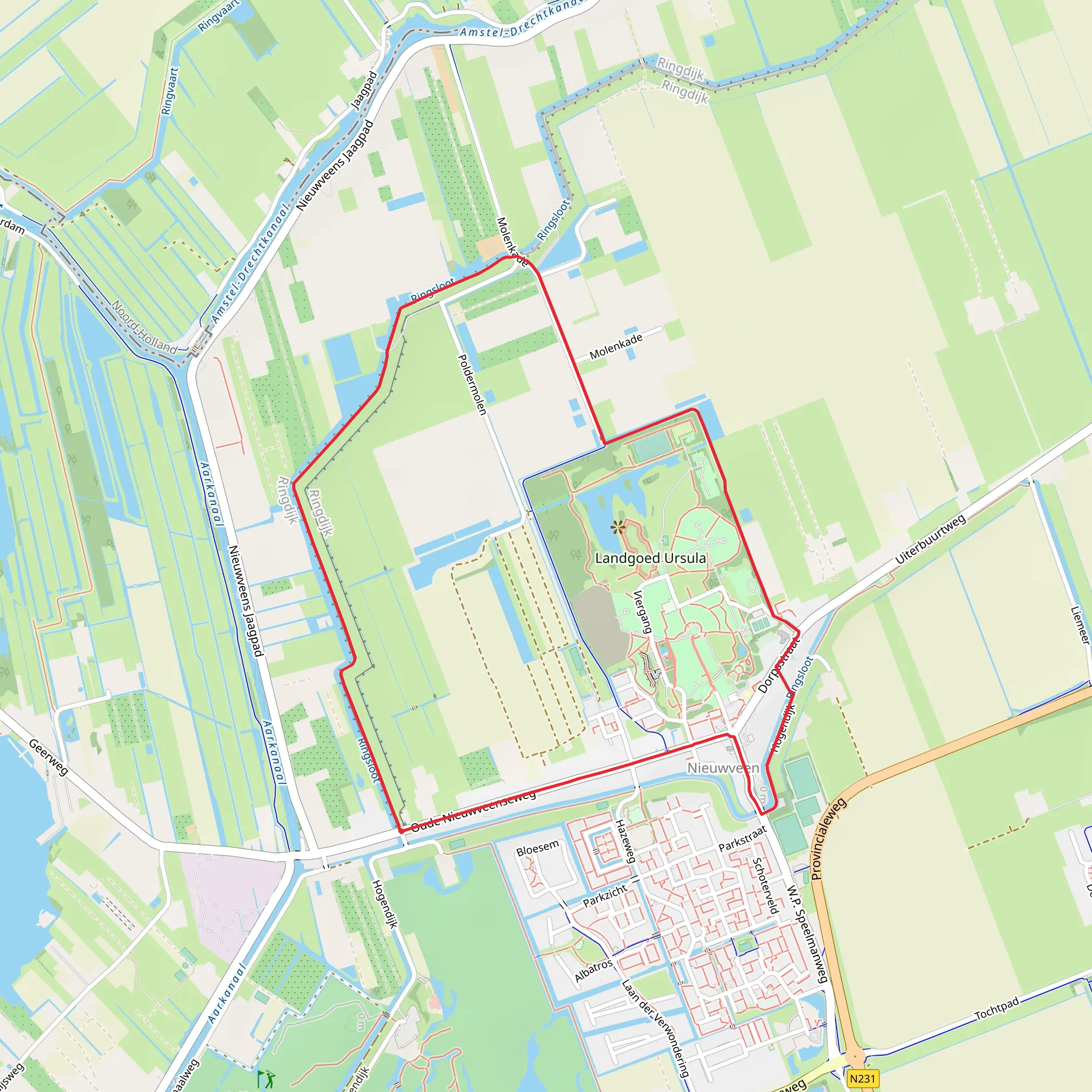
This is a short, low-elevation countryside loop of about 5 km (3.1 mi) with essentially 0 m (0 ft) of climbing—ideal for a relaxed walk on firm paths, field edges, and quiet lanes. Expect big-sky views, hedgerows, drainage ditches, and a mix of open farmland and estate woodland typical of the Dutch lowlands.
Getting to the start (car + public transport)
Because the hike head is listed only as “near” (with no coordinates or town), I can’t reliably convert the start point to a nearest address/landmark yet. If you share a lon/lat (or a HiiKER link), I’ll pin it to the closest recognizable place (e.g., a church, station, parking area, or named estate entrance) and tailor the directions precisely.
For planning purposes, here’s how these loops are usually accessed: - By car: Look for signed parking near the Landgoed (estate) entrance, a small chapel/church, or a farm shop on the edge of the estate. In this landscape, parking is often a small gravel pull-in rather than a formal lot—arrive early on weekends. - By public transport: The most common pattern is train to the nearest town station, then a local bus toward the estate village/hamlet, finishing with a 10–25 minute walk (0.8–2 km / 0.5–1.2 mi) to the trailhead. If you provide the nearest town name, I can outline the most sensible station/bus combination.
What the route feels like underfoot
With negligible elevation change, the main “difficulty” here is surface and seasonality, not steepness: - Firm farm tracks and estate lanes are typically easy walking year-round. - Field-edge paths can turn soft after rain; expect muddy patches where tractors cross or where paths run beside ditches. - Short road connectors may be present—usually quiet, but stay alert for cyclists and local traffic on narrow lanes.
Plan on 1–1.5 hours of walking time at an easy pace, longer if you stop for photos or birdwatching.
Landmarks, scenery, and the character of the area
“Buiten Wester” and “Landgoed Ursula” suggest a route that stitches together outer farmland (“buiten”) with a country estate (“landgoed”). These estates often feature: - Straight or gently curving tree-lined drives (beech, oak, or poplar plantings) - Small woodland blocks used historically for timber, hunting, or shelterbelts - Canals/ditches and culverts managing water in reclaimed or low-lying ground - Occasional historic farmsteads (long, low agricultural buildings) and boundary markers
You’ll likely spend the first 1–2 km (0.6–1.2 mi) easing out through open fields and hedgerows, then transition into a more sheltered estate feel—woodland edges, older trees, and possibly a more manicured track—before looping back through farmland for the final 1–2 km (0.6–1.2 mi).
Nature and wildlife to look out for
This kind of lowland mosaic can be surprisingly lively: - Birdlife: Expect common farmland and wetland-edge species—look along ditches for herons, listen for skylarks over open fields, and scan fence lines for buzzards/kestrels. - Mammals: Hares are often seen in open fields; roe deer may appear at woodland margins, especially early or late in the day. - Plants: In spring and summer, ditch banks and verges can carry wildflowers; woodland edges may show bramble, nettle, and elder, with shaded areas supporting ferns and groundcover.
If the loop passes close to watercourses, bring insect protection in warmer months—gnats and mosquitoes can be noticeable in still, damp conditions.
Navigation and practical prep
Even on an easy 5 km (3.1 mi) loop, estate paths can have multiple junctions and similar-looking tracks. Use HiiKER to: - Confirm the correct turn at woodland/farm track intersections - Check whether any short diversions are needed (seasonal closures, forestry work, or livestock management) - Keep an eye on distance so you know when the loop should begin bending back toward the start
What to pack: - Waterproof footwear or shoes you don’t mind getting muddy after rain - A light rain layer (open farmland can be windy with little shelter) - Binoculars if you enjoy birds - In hunting/forestry areas, consider brighter clothing in autumn/winter for visibility
Things to watch out for
- Livestock and electric fencing: If the route uses pasture edges, keep to the path and close gates behind you.
- Narrow lanes: Where the loop uses roads, walk single file and be mindful of fast-moving cyclists.
- Soft verges and ditch edges: The ground can drop away sharply beside drainage ditches—especially where grass hides the edge.
- Estate etiquette: Some landgoeds allow access on designated paths only; avoid cutting across lawns, private drives, or signed restricted areas.
If you send the start lon/lat (or the nearest village/town) and any route type you prefer (clockwise/counterclockwise, or whether you want the most scenic section first), I’ll anchor the hike head to the nearest recognizable landmark/address and tailor the step-by-step
Surfaces
Grass
Unknown
Asphalt
Comments and Reviews
User comments, reviews and discussions about the Buiten Wester and Landgoed Ursula Loop, Netherlands.
average rating out of 5
0 rating(s)