
Download
3D Flyover
Add to list
More
40.7 km
3 days
0 m
Multi Day
“A wind-brushed Ameland loop of dunes and whispering woods—long, sandy, quietly demanding.”
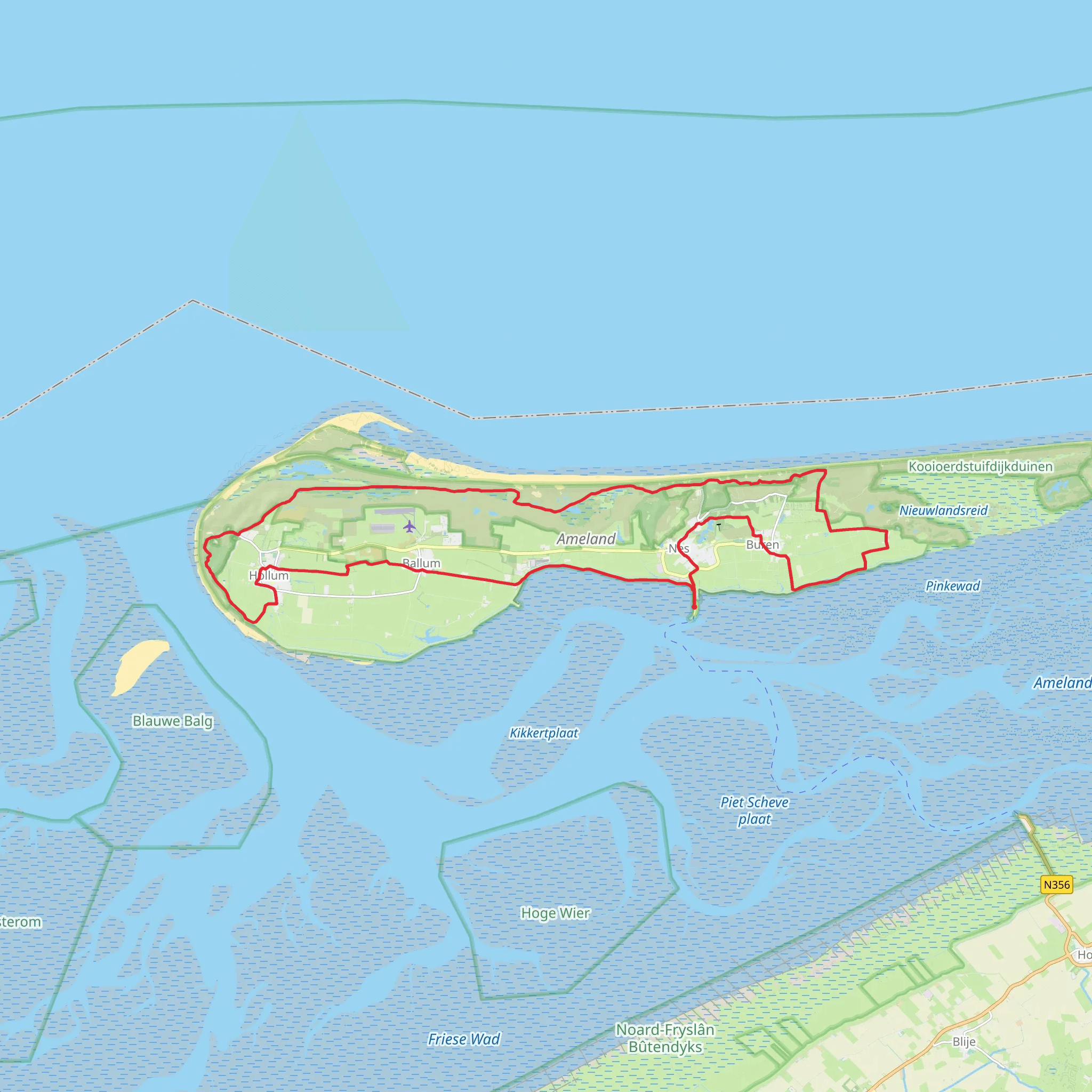
This is a long, low-lying island loop across Ameland’s dune systems and two of its best-known woodland blocks (Hollumerbosch and Ballumerbosch). With roughly 41 km / 25.5 mi of walking and ~0 m / ~0 ft of elevation gain, the challenge is less about climbing and more about distance, wind exposure, and sand underfoot. Expect a mix of firm cycle paths, compacted dune tracks, forest lanes, and occasional softer sandy stretches that can slow your pace.
Where the hike starts (nearest landmark / address)
Because the start point is listed only as “near,” the most practical “nearest known” start for this loop is typically taken from the west end of Ameland near Hollum, close to the main access points into Hollumerbosch and the dunes. A common, easy-to-find landmark to navigate to is:
- Hollum village area (near the lighthouse “Bornrif”) — the lighthouse is the most prominent landmark on western Ameland and a reliable meeting/parking reference.
If you share the exact longitude/latitude, I can convert it precisely to the nearest address/landmark and align the route description to that exact trailhead.
Getting to the start (car + public transport)
By car (most common): - Drive to the ferry port at Holwerd (Friesland, NL) and take the passenger/vehicle ferry to Nes (Ameland). - From Nes, drive west across the island to Hollum (Ameland is compact; road access is straightforward). - Parking is usually easiest on the village edge near dune/forest access points; in peak season, arrive early to avoid full lots.
By public transport: - Train/bus connections typically bring you to Leeuwarden and onward by bus toward Holwerd for the ferry. - After arriving at Nes (Ameland), use the island bus network toward Hollum. In shoulder seasons, bus frequency can be reduced—check schedules ahead and plan a conservative start time. - If you’re timing this as a day hike, build in buffer for ferry times and potential wind-related delays.
What the terrain feels like over 41 km / 25.5 mi
Even with negligible elevation, Ameland can feel “big” on foot because: - Wind can be relentless on open dunes and along the seaward side. - Sand varies from firm, fast surfaces to energy-sapping soft patches. - Long straight sections through forest lanes and dike-side paths can be mentally demanding—pace and fueling matter.
Plan on 7–10 hours moving time for most hikers depending on surface conditions, breaks, and wind.
Route flow and key sections (with approximate distances)
0–8 km / 0–5 mi: Hollum edge → dune approaches
You’ll typically begin on village-edge paths and transition quickly into dune access tracks. Early on, the walking is often on firm multi-use paths (shared with cyclists in places), then becomes more “dune-like” with sandy margins.
Look out for: - Cyclists on shared paths—keep right and be predictable. - Wind chill even on mild days; the North Sea breeze can drop perceived temperature fast.
8–20 km / 5–12.5 mi: Duinen Ameland (dune belt) traverse
This is the most “open” part of the loop: rolling dune forms, dune grass, and scrubby vegetation shaped by salt spray and wind. While the elevation gain is minimal overall, you’ll feel constant micro-undulations and shifting footing.
Nature and wildlife: - Expect classic coastal dune flora (marram grass and hardy shrubs) and a strong chance of seabirds overhead. - In quieter stretches you may spot rabbits and other small mammals; birdlife is often the highlight—bring binoculars if you like wildlife watching.
Practical notes: - Sun exposure can be intense with reflection off pale sand—sunglasses and sunscreen help even on hazy days. - If the route uses narrower dune tracks, keep an eye on blown sand covering trail lines; use HiiKER to confirm you’re still on the intended corridor when paths braid or split.
20–30 km / 12.5–18.5 mi: Ballumerbosch (woodland block) and sheltered miles
The transition into Ballumerbosch is a welcome change: more shelter, more consistent footing, and a different soundscape (wind muted by trees). Surfaces here are often packed forest lanes and mixed-use tracks.
What to expect: - A steadier rhythm and easier pacing than the dunes. - Occasional junction density—multiple forestry tracks can look similar. This is where HiiKER is especially useful for confirming the correct turns.
Look out for: - After rain, some forest sections can hold water; waterproof footwear or quick-drying trail shoes are helpful depending on season. - Ticks can be present in grassy edges and scrub—do a quick check during breaks.
30–41 km / 18.5–25.5 mi: Hollumerbosch return and the long finish
The final third typically arcs back toward Hollumerbosch and the western end of the island. Expect a mix of forest lanes and dune-edge paths, often feeling easier on the legs than the earlier dune miles—until fatigue sets in.
Pacing tip: - Treat the last 10–12 km / 6–7.5 mi as its own hike: steady cadence, short
AI Planner
Days planned around your pace, with somewhere to stay each night.
Surfaces
Unknown
Asphalt
Concrete
Gravel
Cobblestone
Comments and Reviews
User comments, reviews and discussions about the Duinen Ameland, Hollumerbosch and Ballumerbosch Loop, Netherlands.
average rating out of 5
0 rating(s)


