
Download
3D Flyover
Add to list
More
27.8 km
~5 hrs 40 min
68 m
Point to Point
“A big-sky Meuse corridor ramble of farm tracks, ditches and dikes—gentle, but deceptively long.”
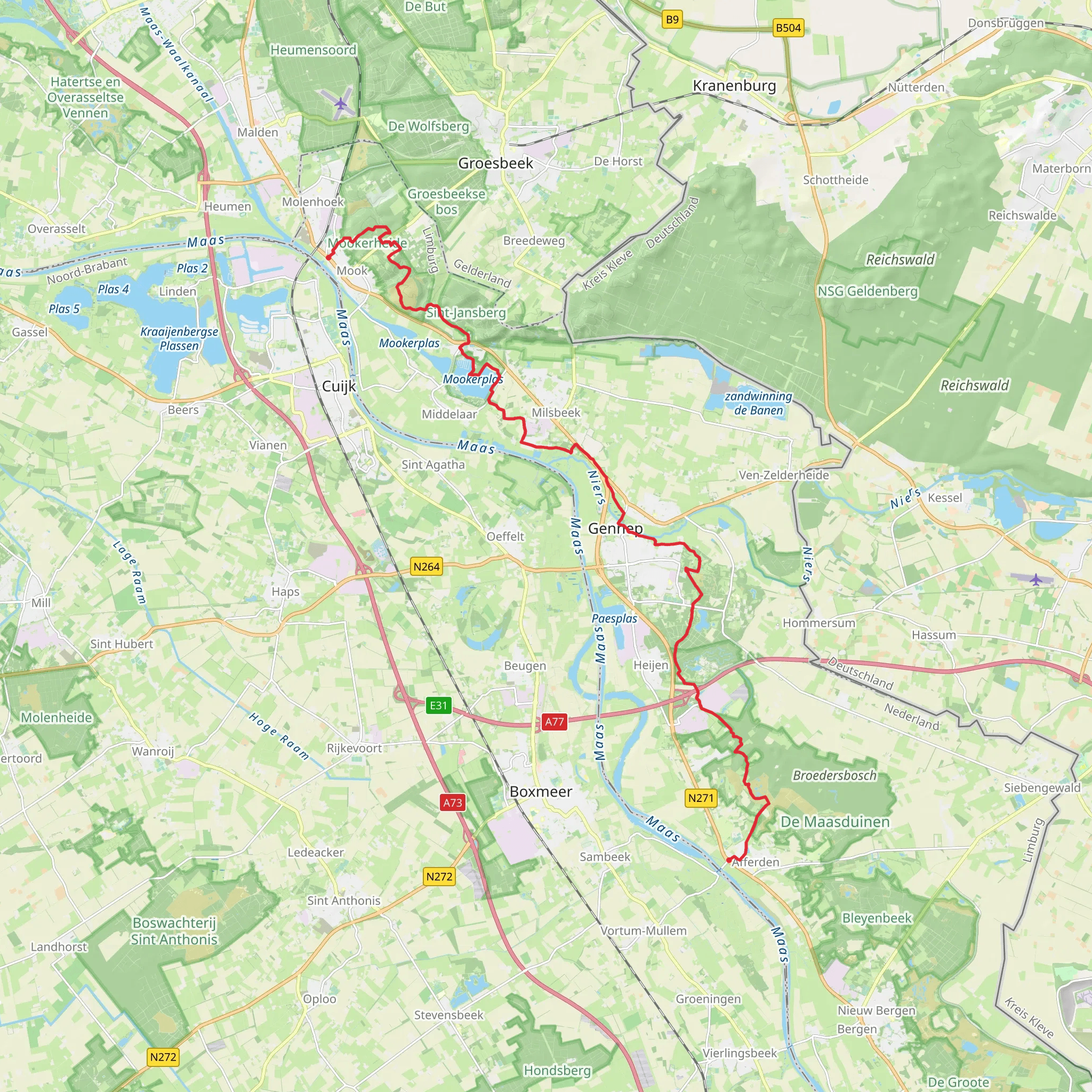
This is a long, low-relief rivers-and-farmland walk typical of the eastern Netherlands/Meuse corridor: expect easy footing, frequent junctions, and lots of “micro-landmarks” (field edges, drainage ditches, hedgerows, small woods) rather than big climbs. At ~28 km (≈17.4 mi) with only ~100 m (≈330 ft) of total ascent, the main challenges are distance, wind exposure across open fields, and staying on the correct farm tracks where several lanes can look identical.
Getting to the start (car + public transport)
Because the start is listed only as “near” (no coordinates provided), the most reliable way to pin it down is to open the route in HiiKER and use the first waypoint/parking icon to identify the nearest village street or trailhead landmark. Once you have that point:
- By car: In this region, starts are commonly near a village edge with informal pull-ins by a farm track or a small roadside parking area near a chapel, cemetery, or sports fields. Use HiiKER’s start point to navigate to the nearest signed parking (look for “P” signs) and avoid blocking farm gates—agricultural traffic is frequent.
- By public transport: The area around Sambeek is typically served by regional buses and nearby rail stations (often via Boxmeer/Cuijk corridors). Use HiiKER to identify the closest bus stop or station to the start point, then plan the last 1–3 km (0.6–1.9 mi) as a walk-in. If you share the start coordinates (or a HiiKER link), I can translate them into the nearest named stop/street/landmark precisely.
What the route feels like underfoot
You’ll mostly be on: - Paved village lanes and cycle paths (fast, easy, but harder on feet over 28 km / 17.4 mi) - Farm tracks (compacted gravel or dirt; can be muddy after rain) - Short woodland or heathy sections around named rises like De Bloksberg (still gentle—think “bump,” not “hill”)
Even with minimal elevation gain, expect small rollers where tracks cross dikes, canal banks, or sandy ridges—these add up to the ~100 m (330 ft) total.
Landmarks and landscape: De Bloksberg and Quin
“De Bloksberg” suggests a locally known higher patch—often a sandy ridge, wooded knoll, or former drift-sand/forest parcel. In this part of the Netherlands, these slightly raised areas can mark: - Older river terraces or ice-age sand deposits - Historic commons later planted with pine or mixed woodland
Around these higher, drier soils you may notice: - Scots pine and birch on sandy ground - Oak and beech pockets where soils are richer - Heath remnants in more open patches (seasonal color if heather is present)
“Quin” reads like a hamlet name, farmstead cluster, or local toponym. In practice, treat it as a navigation anchor: you’ll likely pass a small grouping of farms, a crossroads, or a named lane. These are the spots where it’s easiest to drift onto the wrong parallel track—check HiiKER at every major junction and confirm you’re following the correct line before committing for the next long straight.
The Meuse (Maas) influence and the ferry toward Sambeek
The “Veer naar Sambeek” portion indicates you’re heading toward a ferry crossing associated with Sambeek, a village on/near the Maas (Meuse). This is classic river-country walking: - Dikes and floodplain edges: wide views, big skies, and strong winds - Seasonal high water: some low paths can be damp, closed, or rerouted in wet periods - Birdlife: expect waterfowl and waders—geese, ducks, herons, and (depending on season) migrating flocks using the river corridor
Plan your day around the ferry: - Ferries can be seasonal or have limited operating hours. Check the current timetable before you start and build in buffer time so you’re not forced into a long detour late in the day. - Have a backup route in HiiKER in case the crossing is suspended due to high water, maintenance, or weather.
Nature and wildlife to look out for
This is a human-shaped landscape with plenty of wildlife at the margins: - Roe deer often appear at field edges early/late in the day - Hares and rabbits in open farmland - Buzzards and kestrels hovering over verges and meadows - Along wetter ditches and river-adjacent areas: frogs, dragonflies (in warm months), and reedbed birds
Ticks can be present in grassy margins and woodland edges in warmer seasons—long socks and a post-hike check are sensible even on “easy” terrain.
Historical context you’ll feel on the ground
The Maas corridor has long been a working landscape: farming, river transport, and settlement on slightly higher ground to avoid floods. You’ll often see: - Dike engineering and managed floodplains—evidence of centuries of water control - Older farmsteads and field patterns that reflect gradual land consolidation - Village cores (like Sambeek) that historically clustered near reliable crossings and river routes
Even without dramatic ruins, the “history” here is in infrastructure: dikes, ferries, and the way roads follow higher lines.
Practical planning: time, food, water, and
AI Planner
Days planned around your pace, with somewhere to stay each night.
Surfaces
Unknown
Unpaved
Sand
Asphalt
Ground
Gravel
Paved
Concrete
Grass
Wood
Comments and Reviews
User comments, reviews and discussions about the Veldweg to Veer naar Sambeek via De Bloksberg and Quin, Netherlands.
average rating out of 5
0 rating(s)

