Download
3D Flyover
Add to list
More
25.1 km
~5 hrs 18 min
177 m
Point to Point
“From Millingen’s dikes to De Bijland’s glittering lakes and De Wild’s untamed bends, a gentle, wind-kissed waterside ramble.”
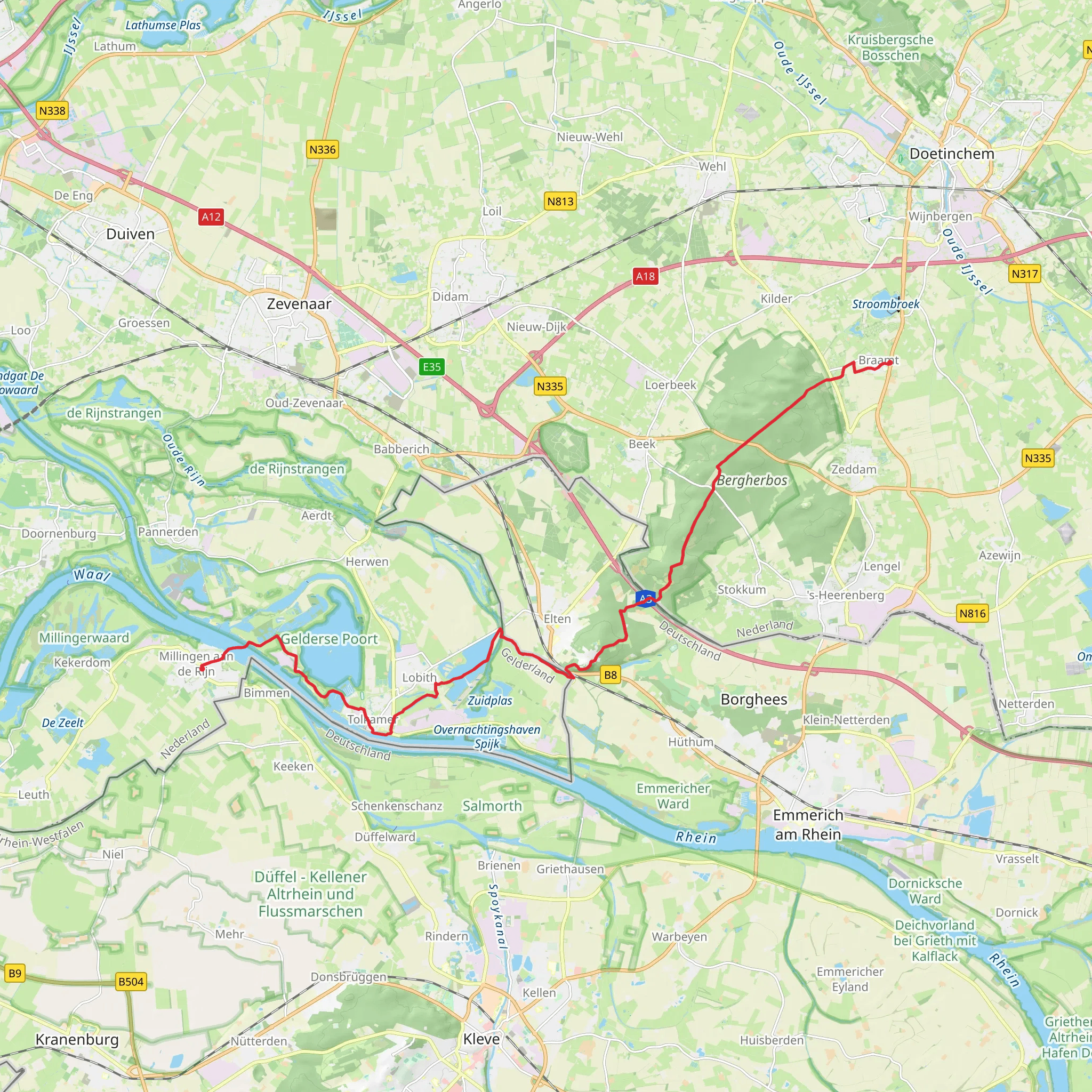
Starting from the village edge of Millingen aan de Rijn (near the Rhine dike on the Dutch–German border), this is a mostly flat, waterside walk through river landscapes, former floodplains, and quiet farmland, linking the recreation lakes of De Bijland with the wilder, re-meandered river nature around De Wild before finishing near Buiting (a small rural hamlet area east of the Ooijpolder). Expect a long but gentle day: ~25 km / ~15.5 mi with only ~200 m / ~656 ft of cumulative ascent—most of it coming from repeated short ramps up and down dikes, bridges, and embankments rather than any sustained climbing.
Getting to the start (Millingen aan de Rijn)
- By car: Aim for parking near the village center and dike access—look for public parking around Heerbaan / Kerkstraat in Millingen aan de Rijn, then walk a few minutes to the Rhine dike (Waaldijk area). Parking is typically straightforward in small Dutch villages, but be mindful of residential restrictions and event days in summer.
- By public transport: The nearest major rail hub is Nijmegen. From there, regional buses run toward the Ooijpolder/Millingen corridor (routes can vary by season and operator). Plan your connection so you arrive with daylight to spare—this route is long, and the most scenic sections are best enjoyed unhurried. If you’re building the route in HiiKER, use it to confirm the exact start point on the dike and the nearest bus stop to your chosen trailhead.
What the terrain feels like (and why the elevation adds up)
Although the landscape looks pancake-flat, the “gain” comes from: - Dike undulations: frequent small climbs (a few metres at a time) as you move between the dike crest, lower paths, and access ramps. - Embankments and bridges: short rises over canals, inlets, and lake edges. Underfoot you’ll rotate between paved dike-top paths, hard-packed gravel, and grass or earth tracks that can turn slick after rain—especially where cattle or horses have churned the ground near gates.
Route flow and key segments (with approximate distances)
0–6 km / 0–3.7 mi: Millingen aan de Rijn → Rhine dike and floodplain edges
You’ll quickly leave the village feel and settle into classic Rhine/Waal borderland scenery: broad water, big skies, and long sightlines. The walking is easy and rhythmic on firm surfaces.
What to watch for:
- Wind exposure: dikes are open and can feel surprisingly cold even on mild days.
- Cyclists: dike paths are popular; keep right and expect fast e-bikes.
6–13 km / 3.7–8.1 mi: De Bijland (recreation lakes and shoreline paths)
De Bijland is a well-known recreation area formed from former gravel extraction, now a chain of lakes with beaches, marinas, and reed-fringed edges. The route here is visually varied: open water, small coves, and pockets of woodland.
Landmarks and nature:
- Lake viewpoints and beaches: good places for a break, but they can be busy in warm weather.
- Reedbeds and wet margins: prime habitat for waterbirds—look for grebes, coots, herons, and geese; in migration seasons you may see larger mixed flocks.
Practical notes:
- Facilities: De Bijland is one of the more reliable areas for seasonal kiosks/toilets, but don’t assume they’re open—carry enough water and snacks for a full day.
13–20 km / 8.1–12.4 mi: De Wild and the “wilder” river nature corridors
As you transition away from the busiest lake edges, the character shifts toward quieter floodplain nature: willow scrub, wet grassland, and side channels. “De Wild” in this region is associated with more naturalized river landscapes—areas shaped by flooding, restoration, and managed rewilding.
Wildlife you’re likely to notice:
- Grazers: depending on the exact track, you may pass areas managed with cattle or horses to keep vegetation open. Give animals space, pass calmly, and keep dogs leashed where required.
- Birdlife: raptors (like kestrels) hunting over fields, and plenty of songbirds along hedgerows.
Footing and navigation:
- After wet periods, lower floodplain paths can be muddy; if a section is waterlogged, the dike-top alternatives are usually firmer. Use HiiKER to confirm the best parallel line if you need to stay high and dry.
20–25 km / 12.4–15.5 mi: Toward Buiting via farmland lanes and dike links
The final stretch tends to feel more agricultural: straight tracks, drainage ditches, and long dike lines. It’s still easy walking, but this is where fatigue can creep in because the scenery becomes more subtle and the distances between “big” landmarks grow.
What to watch for:
- Farm traffic: tractors and local vehicles on narrow lanes.
- Limited shade: in sunny weather, heat exposure can be the main challenge—sunhat and sunscreen matter here.
Historical context you’ll feel underfoot
This borderland is defined by the Rhine/Waal river system and centuries of Dutch water management: - Dikes and polders: The raised dikes you’ll walk are part of a long tradition of flood defense and land reclam
AI Planner
Days planned around your pace, with somewhere to stay each night.
Surfaces
Unknown
Asphalt
Grass
Concrete
Unpaved
Ground
Dirt
Gravel
Wood
Comments and Reviews
User comments, reviews and discussions about the Millingen aan de Rijn to Buiting via De Bijland and De Wild, Netherlands.
average rating out of 5
0 rating(s)