
Download
3D Flyover
Add to list
More
45.0 km
2 days
0 m
Multi Day
“A big-sky heathland loop of sandy tracks, pine straightaways, and seasonal purple heather—endurance required.”
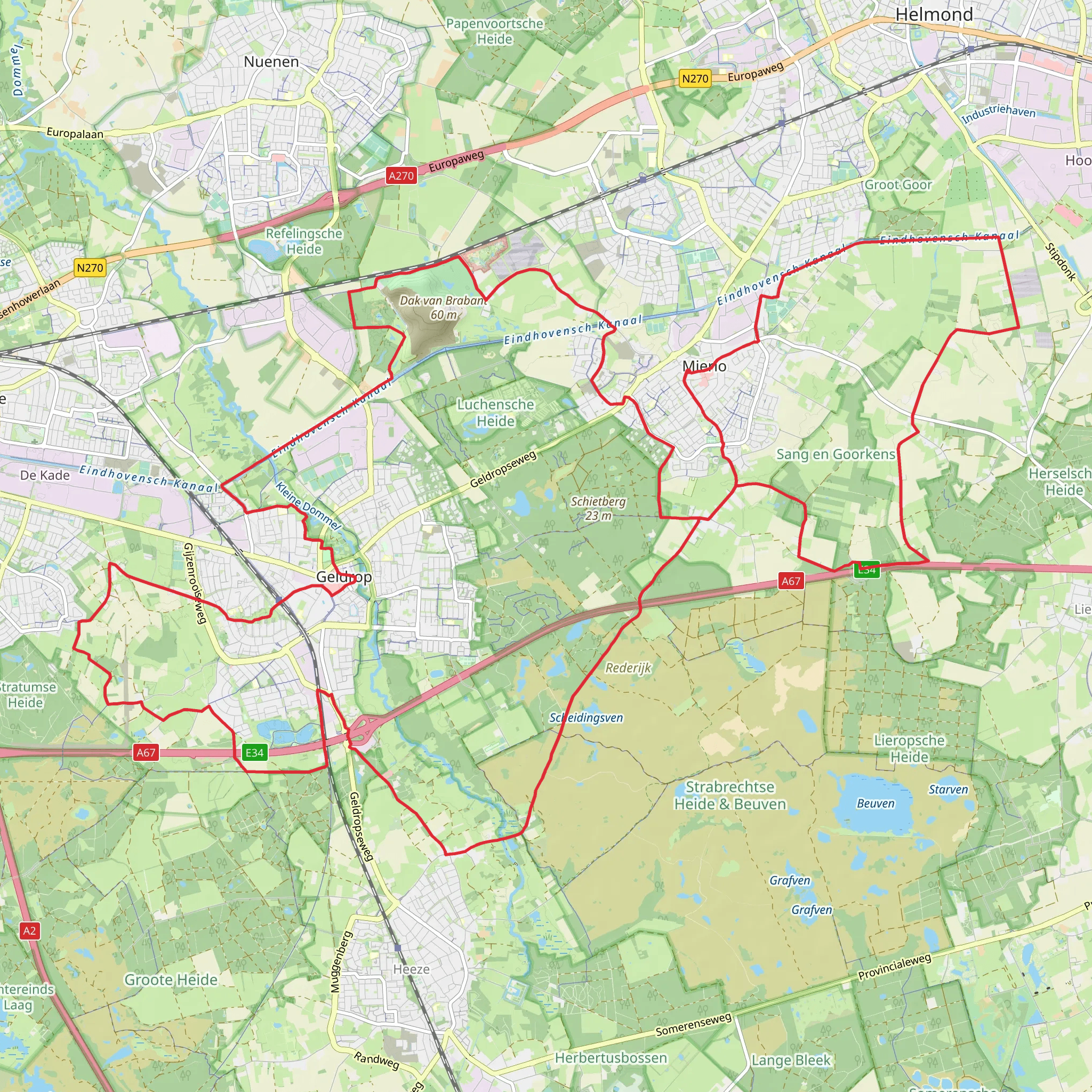
A long, flat, big-sky loop through Dutch heathland and pine forest, this route is all about wide sandy tracks, purple heather (in season), quiet fens, and straight, ruler-line forestry roads that make the kilometres tick by faster than you’d expect. At roughly 45 km (28 mi) with about 0 m (0 ft) of climbing, it’s physically “easy” in terms of elevation, but it’s still a full-day endurance walk because of the distance and the amount of exposed terrain.
Because your start point is listed only as “near”, the most practical way to plan this is to anchor the hike at the most obvious access points to these heaths: the main gateways around Heeze–Leende / Geldrop–Mierlo on the south/east side of Eindhoven. Common, well-known trailheads for Strabrechtse Heide are around Heeze (near the Heeze railway station area) and the main nature access points on the edges of the heath (often signed for Strabrechtse Heide). If you share the lon/lat (or a GPX), I can convert it to the nearest specific landmark/address and tailor the directions precisely.
Getting to the start (car + public transport)
By public transport (most straightforward):
- Aim for Heeze (a well-known access town for Strabrechtse Heide). From there, you can walk out to the heath on local paths/lanes and connect to the loop.
- If you’re coming from Eindhoven, regional trains and buses typically make this easy, then it’s a short walk to the heath edge depending on the exact trailhead you choose.
By car:
- Drive toward the Heeze–Leende / Geldrop–Mierlo side of the heath and use signed parking areas for Strabrechtse Heide (these are usually well-marked at major access points).
- Plan for a full-day parking duration and arrive early on weekends—these heaths are popular with walkers and cyclists.
If you want the “cleanest” logistics for a 45 km loop, pick a start that has: (1) a large car park, (2) clear signage into the heath, and (3) a nearby café or village shop for last-minute water/food.
What the terrain feels like over 45 km
Expect a mix of: - Heathland tracks: sandy, sometimes soft underfoot; can slow your pace. - Pine/forestry roads: firm, straight, and fast but repetitive. - Edges of fens and wet hollows: boardwalks or damp margins in places; after rain, some sections can be muddy even though the route is “flat.” - Occasional paved connectors near villages/hamlets or between nature blocks.
Even with negligible elevation gain, the route can feel demanding because: - Wind exposure across open heath can be constant. - Soft sand can fatigue calves and feet over long distances. - Long straight lines can be mentally tiring—break the day into segments.
A realistic moving-time estimate for most hikers is 8–11 hours depending on sand, stops, and pace.
Landmarks, nature, and wildlife to look out for
This landscape is classic Brabant heath: open, low vegetation with scattered pines and birch, stitched together by sandy paths and managed forest blocks.
Heath and seasonal highlights - Late summer often brings heather bloom (large swathes of purple), while spring and early summer can be bright with fresh greens and flowering edges. - Look for wet heath/fen margins—these are biodiversity hotspots compared with the drier pine stands.
Wildlife - Deer are a realistic possibility at dawn/dusk along forest edges. - Heathland birds are often heard before they’re seen; keep an eye on open areas and fence lines. - In warmer months, expect plenty of insects near wet areas; consider repellent and long socks if you’re sensitive.
Water and “flat doesn’t mean dry” - Even though the route is flat, the heath can hold water in shallow basins. After wet spells, some tracks develop puddled ruts and soft margins—step wide rather than trying to tiptoe the edges (that’s where you slip in).
Navigation and planning (use HiiKER)
This is the kind of terrain where it’s easy to drift onto the “wrong parallel track” because many paths look identical. Use HiiKER to: - Confirm you’re on the correct line when multiple sandy tracks run side-by-side. - Pre-mark bailout points near villages/roads in case you need to shorten the day. - Identify water/food opportunities—on long loops, knowing where the nearest village edge is can prevent a late-day bonk.
Signal is usually decent near towns, but don’t rely on it deep in the heath/forest—download what you need in HiiKER before you start.
Practical preparation for an “easy” 45 km day
Footwear & underfoot conditions - Trail shoes or light boots both work; prioritize sand comfort and blister control. - Gaiters can be helpful if you hate sand in your shoes. - Bring blister care (tape, patches) because sand + distance is a common combo for hot spots.
Water and food - Treat this like an all-day hike: many heath sections have no services. - Carry enough water for long exposed stretches; top up in villages if your loop passes them. - Pack calorie-dense snacks you can eat while walking—flat routes tempt
AI Planner
Days planned around your pace, with somewhere to stay each night.
Surfaces
Asphalt
Unknown
Unpaved
Concrete
Sand
Gravel
Comments and Reviews
User comments, reviews and discussions about the Strabrechtsche Heide, Collsche Heide and Luchen Loop, Netherlands.
average rating out of 5
0 rating(s)

