
Download
3D Flyover
Add to list
More
32.6 km
2 days
0 m
Multi Day
“A long, wind-brushed Zeeland loop of polders, reed-lined canals, and old gates—best savoured steadily.”
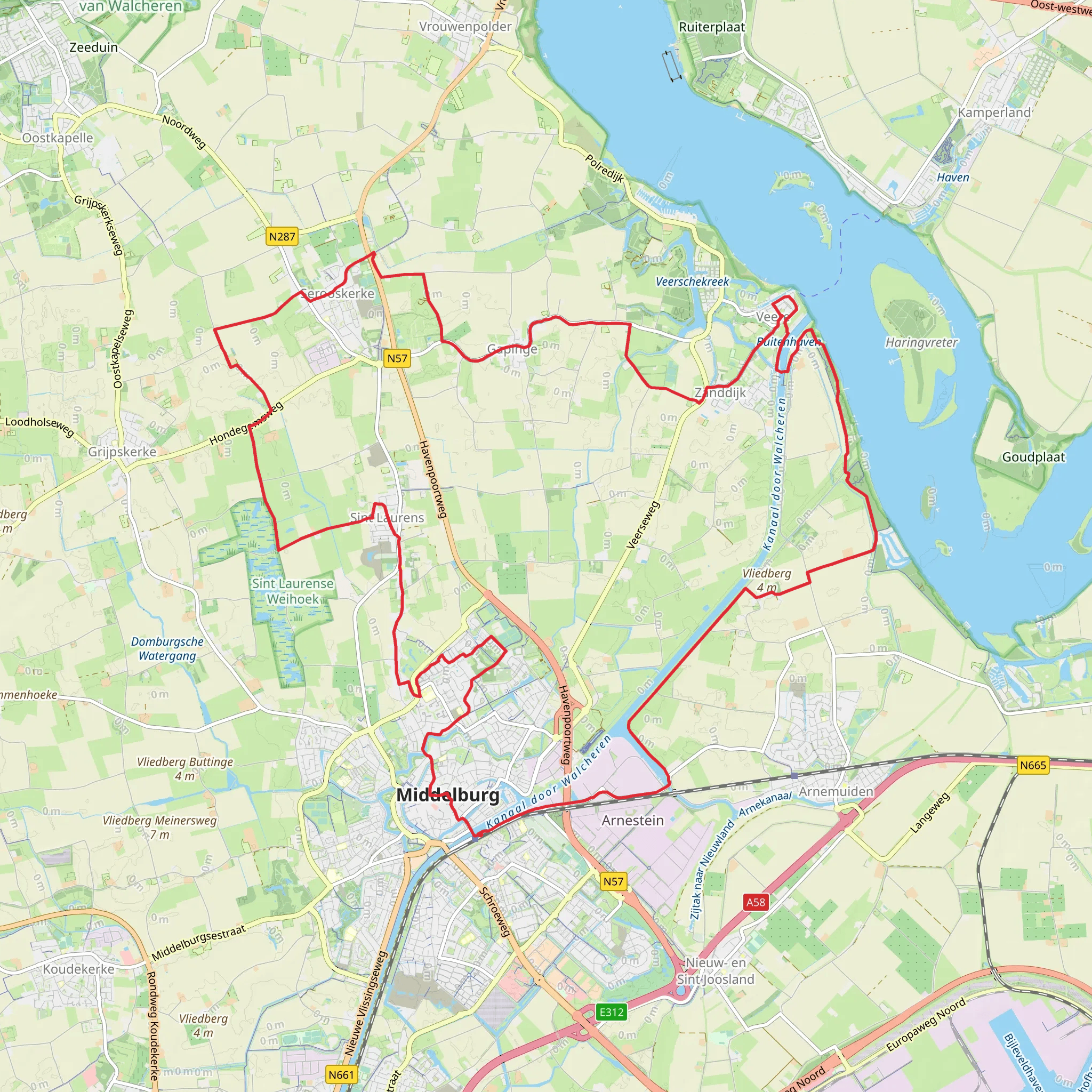
This is a long, low-lying loop of roughly 33 km (20.5 mi) with essentially 0 m (0 ft) of elevation gain, threading through classic Zeeland scenery: open polders, reed-lined ditches, canal edges, and village streets punctuated by old gates, farmsteads, and wind-swept tree lines. Because the terrain is flat and the surfaces are often firm (paved lanes, compacted farm tracks, and dike-top paths), the “Easy” rating is mostly about fitness and time on feet rather than steepness—expect a steady, all-day walk for many hikers.
Getting to the start (car + public transport)
Because the start point is listed only as “near” (no town name or coordinates provided), the most practical way to plan is to anchor the start near the Veersepoort area (a well-known historic “poort”/gate name in Zeeland towns) and then fine-tune the exact trailhead in HiiKER once you open the route. If you share the route link or the start coordinates, I can pin it to the nearest street address or landmark precisely.
By car - Zeeland towns and villages typically have small public car parks near the historic core, church, or harbor/lock area. Aim for parking near the town center closest to “Veersepoort” on your HiiKER map so you can begin the loop without backtracking. - Roads are narrow in places; watch for farm traffic and cyclists, and avoid blocking field gates.
By public transport - Most access is via train to Goes or Middelburg (common rail hubs in Zeeland), then regional bus onward to the nearest village stop. From there, it’s usually a short walk to the loop. - Use HiiKER to identify the closest bus stop to the route line; Zeeland bus frequencies can be limited outside peak hours, so check return times before committing to a late finish.
What the route feels like underfoot
You’ll be moving through a patchwork of: - Quiet village streets (brick or asphalt) - Dike-top lanes with wide views and constant wind exposure - Farm tracks (compacted gravel or dirt; can be muddy after rain) - Canal/ditch-side paths where footing is generally easy but edges can be soft
Even with negligible elevation, the “effort” comes from distance + wind. Zeeland’s open landscapes can turn a calm forecast into a headwind grind, especially on long straight dike sections.
Landmarks and local character (Vliedberg, Aalvanger, Veersepoort)
This loop’s names point to three distinctly Zeeland features:
Vliedberg - A vliedberg is typically a man-made mound historically used as a refuge during floods or as a defensible high point in an otherwise flat landscape. In Zeeland, these mounds are part of the long story of living with water—dikes, reclaimed land, and engineered drainage. - On the ground, a vliedberg often appears as a small wooded bump or grassy rise—don’t expect a “hill hike,” but do expect a noticeable change in micro-landscape: slightly higher, often with older trees and a different feel than the surrounding fields.
Aalvanger - The name suggests an association with eel (aal) and fishing/trapping traditions. Zeeland’s brackish waters, creeks, and managed waterways supported fisheries and trade for centuries. - Where the route runs near channels, sluices, or old waterworks, pause and look for subtle infrastructure: culverts, weirs, small locks, and drainage gates—they’re the quiet backbone of the region.
Veersepoort - “Poort” indicates a gate—often a remnant of historic town defenses or an old entry point tied to trade routes and waterways. Zeeland towns grew around harbors, canals, and fortified lines, especially during periods when control of waterways meant economic and military advantage. - Expect this section to feel more “built” than the open polder stretches: tighter streets, older masonry, and a stronger sense of place.
Nature, scenery, and what to watch for
This is a landscape of big skies and small details.
Birdlife - You’re in prime territory for waterfowl and waders: geese, ducks, herons, and seasonal migrants using ditches, flooded fields, and reed margins. - In spring and early summer, ground-nesting birds may be present in field margins—stay on the path and keep noise low near reedbeds.
Field and ditch edges - Ditches can be deceptively steep-sided. In wet periods, the grass verge may be slick; give the edge space, especially if you’re walking two abreast. - After heavy rain, farm tracks can develop soft ruts—waterproof footwear helps even on a “flat” hike.
Wind and exposure - There’s often little shade. On sunny days, the combination of reflection off water and open fields can increase sun exposure. - In cooler months, windchill can be significant; pack a shell even if the forecast looks mild.
Pacing and distance breakdown (approximate)
Without the exact line from HiiKER, use this as a practical planning template for a 33 km (20.5 mi) day:
- 0–8 km (0–5 mi): Settling in—typically village edges into open polder. Easy navigation, long straight segments.
- 8–18 km (5–11 mi): The “middle miles”—most exposed to wind; likely where you’ll appreciate steady fueling and a consistent pace.
- **18–26 km (11
AI Planner
Days planned around your pace, with somewhere to stay each night.
Surfaces
Unknown
Asphalt
Concrete
Cobblestone
Comments and Reviews
User comments, reviews and discussions about the Vliedberg, Aalvanger and Veersepoort Loop, Netherlands.
average rating out of 5
0 rating(s)


