Download
3D Flyover
Add to list
More
43.6 km
~2 days
698 m
Point to Point
“A rolling South Limburg borderland loop of woods and fields—gentle underfoot, demanding in time.”
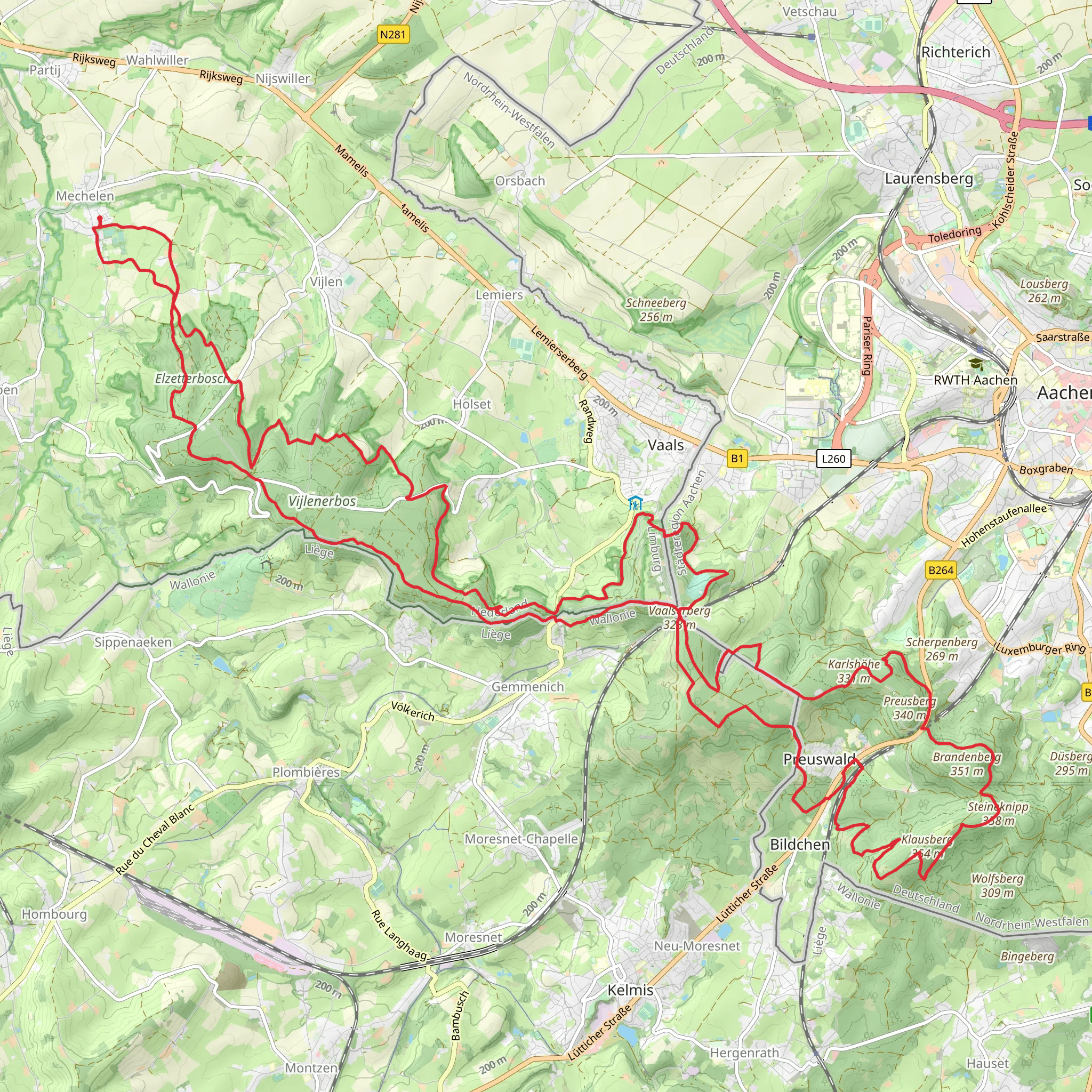
This is a long, rolling woodland-and-farmland circuit of roughly 43 km (26.7 mi) with about 700 m (2,300 ft) of total ascent—more of an endurance day than a steep mountain hike. Even though it’s often labeled “Easy,” that rating usually reflects the non-technical terrain (tracks, forest paths, farm lanes) rather than the time-on-feet. Plan it like a full-day outing.
Where the hike starts (and what “near” likely means)
You didn’t include the exact start coordinates, but the place-names Kerperbosch, Holsetterbosch, Preusbosch, and Elzetterbosch strongly point to the South Limburg border region (the Netherlands/Belgium/Germany triangle), where “-bosch” woodlands and small hamlets cluster around Vaals, Holset, Lemiers, Vijlen, and Epen.
If you share the lon/lat (or a HiiKER link), I can pin the start to the nearest specific address/landmark. Without coordinates, a very common practical “start area” for loops linking these woods is around Vaals—often near Vaals bus hub / town center and within a short walk of trail access toward the surrounding forests and ridge paths.
Getting to the start (car + public transport)
By car - Aim for Vaals (South Limburg, NL) and use a central public car park (Vaals has multiple signed municipal lots). From there, you can usually walk directly onto the network of forest tracks and field paths that connect the named “bosches.” - If your actual start is closer to Holset (a small hamlet west of Vaals), parking is more limited and tends to be roadside/hamlet-scale—arrive early and park considerately.
By public transport - The most common rail gateway is Maastricht or Heerlen (NL), then a bus toward Vaals. Vaals is well-served by regional buses because it’s a border town and a hub for walkers and cyclists. - If you’re coming from Aachen (DE), Vaals is also reachable by local bus connections.
(If you tell me your intended start lon/lat, I’ll translate it to the nearest named stop/parking area and the simplest approach.)
What the terrain feels like over 43 km / 26.7 mi
Expect a repeating rhythm: - Woodland sections (“bosch”): packed dirt, leaf litter, occasional roots, and short punchy rises. - Open farmland: gravel farm roads, grassy margins, and wide views across the Limburg hills. - Hamlet connectors: short paved stretches through quiet lanes.
Underfoot is generally straightforward, but after rain the clay-rich soils in this region can turn slick, especially on shaded forest descents and tractor-rutted field edges.
A 43 km loop with 700 m gain typically breaks down into many small climbs rather than one big ascent. You’ll feel it most in the last third, when the “easy” gradients add up.
Route character by segments (approximate)
Because the loop links multiple named woods, it usually travels as a chain of forest blocks separated by fields and small settlements. A realistic way to plan your day:
0–10 km (0–6.2 mi): settling into the borderland hills - Gentle warm-up on mixed tracks and lanes, with the first 150–200 m (490–650 ft) of cumulative ascent coming in short steps. - You’ll likely pass hedgerows, small orchards, and pastureland—classic South Limburg scenery.
10–24 km (6.2–14.9 mi): the longest continuous woodland rhythm - This is where the “bosch” sections tend to string together: longer forest tracks, quieter footpaths, and more consistent shade. - Expect another 250–300 m (820–980 ft) of ascent spread across rolling ridgelines and shallow valleys. - Navigation can get fiddly where multiple forestry tracks intersect—use HiiKER and pay attention to junction density rather than waiting for a single obvious turn.
24–35 km (14.9–21.7 mi): open views, farm lanes, and exposure - More time in open country: if it’s sunny or windy, this section can feel harder than the elevation suggests. - Surfaces may alternate quickly (pavement → gravel → grass), which can irritate feet late in the day if footwear is too stiff or too minimal.
35–43 km (21.7–26.7 mi): tired legs + small climbs - The final stretch often revisits short wooded rises and descents—nothing dramatic, but enough to punish pacing mistakes. - Budget time for slower downhill footing if it’s wet; leaf-covered slopes can hide slick mud.
Landmarks and sense of place (nature + cultural landscape)
This region is known for a patchwork landscape: managed forests, small-scale agriculture, and centuries-old settlement patterns. Even when you’re in the woods, you’re rarely far from: - Sunken lanes (hollow ways) carved by repeated foot, cart, and livestock traffic over generations. - Field-edge hedges and tree lines that act as wildlife corridors. - Small chapels, wayside crosses, and old farmsteads typical of Catholic South Limburg and the border villages.
If your loop swings near Vaals, the broader area is also associated with the Three-Country Point (Drielandenpunt) and the historic importance of borders and trade routes in this corner of Europe. Even away from the tourist focal points, you’ll feel that “border
AI Planner
Days planned around your pace, with somewhere to stay each night.
Surfaces
Unknown
Asphalt
Ground
Gravel
Dirt
Unpaved
Sand
Paved
Grass
Comments and Reviews
User comments, reviews and discussions about the Kerperbosch, Holsetterbosch, Preusbosch and Elzetterbosch Loop, Netherlands.
average rating out of 5
0 rating(s)