
Download
3D Flyover
Add to list
More
103.0 km
5 days
7 m
Multi Day
“A long, flat wander from IJzeren Man through pines, ponds, heath and wind-swept lanes—best savoured over a few days.”
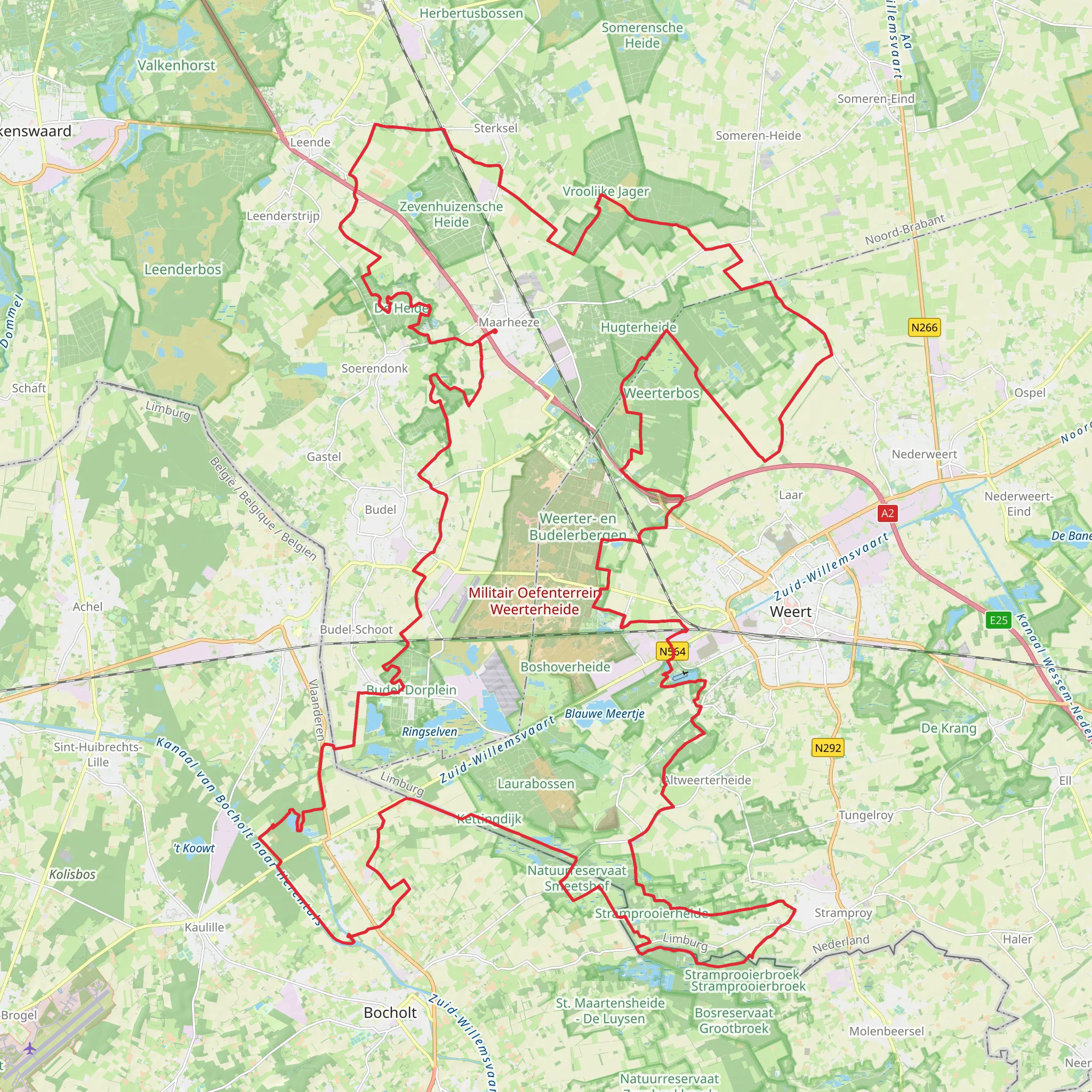
This is a long, low-relief walk of roughly 103 km / 64 mi with essentially 0 m / 0 ft of cumulative climbing in the sense that there are no sustained hills—expect the effort to come instead from distance, surface variety (sand, forest track, towpath, farm lanes), and exposure to wind across open heath and polder-like fields. Because the route name strings together multiple areas, plan it like a 2–3 day hike unless you’re specifically training for ultra-distance.
The most practical “anchor” landmark to treat as a start/finish is Recreatieplas De (Grote) IJzeren Man in Vught, which is a well-known access point with parking and facilities at Boslaan 49, 5263 NX Vught, Netherlands. (ijzerenman.nl)
Getting to the start (car + public transport)
- By car: Navigate to Boslaan 49, 5263 NX Vught (IJzeren Man). There’s large on-site parking associated with the recreation area. (ijzerenman.nl)
- By public transport: Aim for Vught Station (NS rail). From there, the IJzeren Man area is typically reached by local bus/taxi or a short bike ride; if you’re walking in, allow extra time and use HiiKER to keep you on safe pedestrian-friendly streets as you leave town.
What you’ll be walking through is a patchwork of pine-and-oak woodland, wet hollows with ponds, heath-like open ground, and managed countryside. The “easy” rating fits the terrain profile, but don’t underestimate the foot fatigue from long flat kilometers—especially if you hit sandy stretches.
What to expect on the ground (surfaces, rhythm, and pacing)
Surfaces: You’ll likely rotate between: - Firm forest roads (fast, but repetitive impact) - Sandy or loose paths in heath/wood edges (slower, higher calf/Achilles load) - Towpaths and straight drainage-side tracks (very efficient, but mentally monotonous) - Farm access lanes (watch for occasional vehicle traffic)
Pacing strategy: On a 103 km / 64 mi loop, the biggest planning win is controlling your “easy” pace early. Flat routes tempt people into going too fast; later, the same flatness can feel relentless. If splitting days, many hikers find 35–45 km (22–28 mi) per day a workable target depending on pack weight and daylight.
Navigation: The area can have lots of similar-looking junctions (straight tracks, parallel ditches, repeating woodland lanes). Keep HiiKER handy and confirm direction at every major junction rather than “walking it out” and hoping it reconnects.
Key landmarks and landscape character
De (Grote) IJzeren Man (Vught): water, woodland, and a surprisingly industrial origin
The IJzeren Man lake is not a natural lake—it formed from large-scale sand extraction starting around the late 1800s/early 1900s, with the name referring to the digging machinery (“the Iron Man”). Over time the excavation filled with water and became a bosmeer (woodland lake) and later a major recreation spot. (ijzerenman.nl)
On foot, expect: - Wide paths near the recreation facilities, sometimes busy on weekends - A quick transition into quiet forest edges where the soundscape becomes birds and wind in pines - Open water views that can be windy and cool even on mild days
If you’re passing close to the shoreline, be mindful of shared-use traffic (families, runners, cyclists) and occasional muddy edges after rain.
Lozerheide: wet woodland, ponds, and birdlife (boots earn their keep)
Lozerheide is described as a water-rich area where boots in winter aren’t a luxury—that’s a good cue for year-round planning: even outside winter, expect soft ground, puddled tracks, and slick leaf litter in shaded sections. (natuurenbos.be)
Nature highlights commonly associated with this kind of habitat here include: - Ponds and reed margins that draw waterbirds - A strong chance of seeing (or hearing) a variety of birds; Lozerheide is noted for rich bird presence, including species such as heron, cormorant, and kingfisher in the broader wetland/pond setting.
AI Planner
Days planned around your pace, with somewhere to stay each night.
Surfaces
Unknown
Asphalt
Gravel
Dirt
Ground
Sand
Concrete
Unpaved
Grass
Wood
Cobblestone
Paved
Comments and Reviews
User comments, reviews and discussions about the Lozerheide, Kettinghoeve, Grote Ijzeren Man and De Stoeiing Loop, Netherlands.
average rating out of 5
0 rating(s)



