
Download
3D Flyover
Add to list
More
6.0 km
~1 hrs 13 min
13 m
Loop
“A gentle, flat loop through mirror-still ponds and whispering wet woods—best enjoyed with sure footing.”
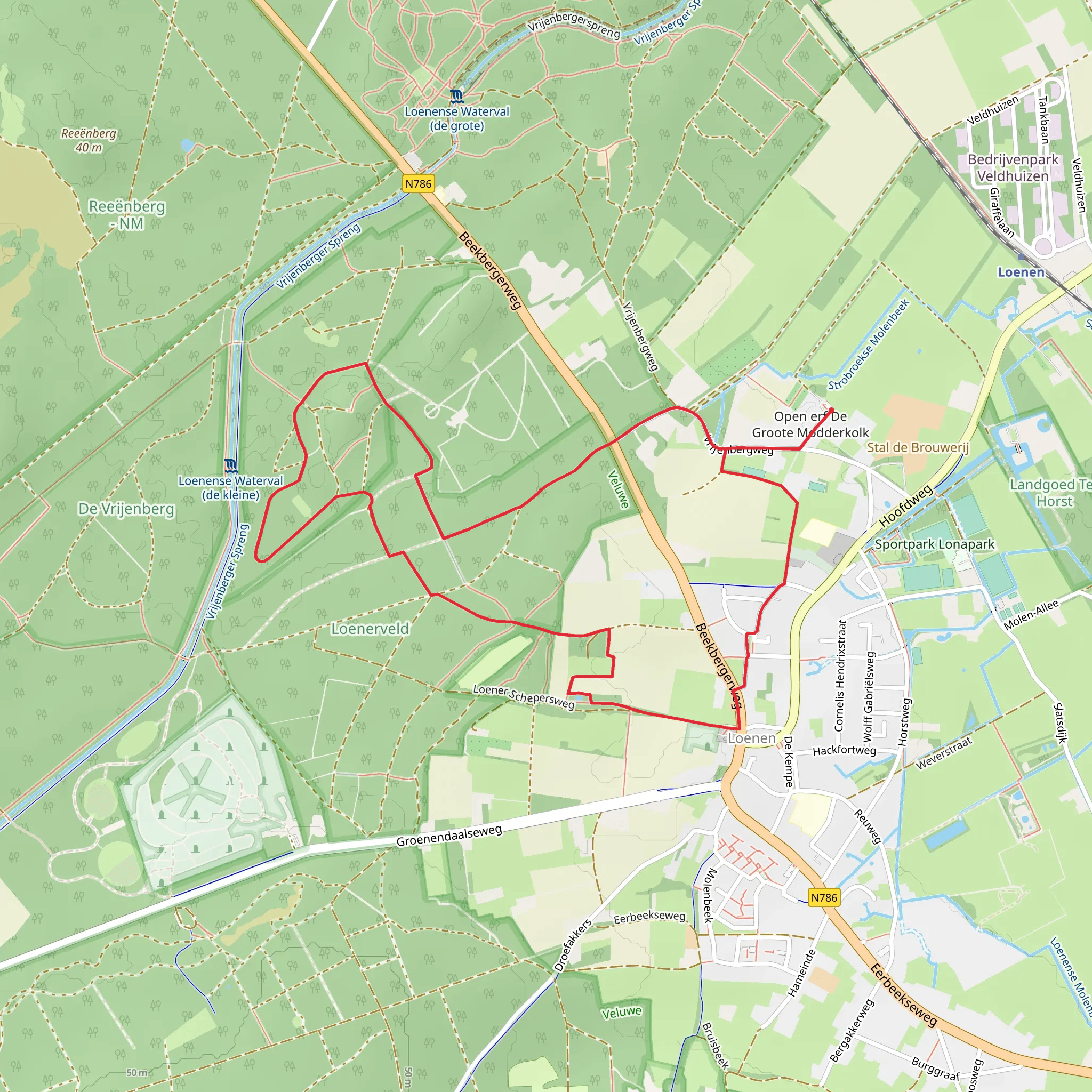
This easy loop is a low-effort, high-reward walk of roughly 6 km (3.7 miles) with essentially 0 m (0 ft) of climbing, ideal for a relaxed half-day outing or a nature-focused stroll. Expect mostly flat terrain with frequent water nearby—ditches, ponds, and wet woodland edges are typical in this landscape—so even with minimal elevation change, conditions can feel “soft underfoot” after rain.
Getting to the start (car + public transport)
Because the start point is listed only as “near” (no coordinates or town provided), the most reliable way to reach the trailhead is to: - Car: Use HiiKER to open the route and navigate to the nearest mapped access point/parking pull-in shown for the loop. In this kind of lowland route, parking is often a small lay-by, a forest access track entrance, or a signed recreation lot rather than a large formal car park. - Public transport: If you’re coming by train/bus, use HiiKER to identify the closest village/town stop to the loop, then plan a short walk (often 1–3 km / 0.6–1.9 miles) from the stop to the nearest access point. In rural lowland areas, service can be infrequent—check the day’s timetable and plan a buffer for the return.
If you share the lon/lat (or a HiiKER link), I can convert it to the nearest known address or significant landmark and give a much tighter “where to park / where to get off the bus” plan.
You’ll typically begin on a firm track or quiet lane before the loop settles into a rhythm of flat paths threading through wet woodland and open lowland edges. Over the first 1 km (0.6 miles), look for subtle transitions in footing: compacted gravel or hard-packed earth can quickly become damp soil, leaf litter, or short grassy sections. Even without hills, the “effort” on this walk is mostly dictated by ground conditions—mud, puddling, and slick roots can slow you down more than you’d expect on an Easy-rated route.
As you move deeper into the loop (roughly 1–3 km / 0.6–1.9 miles), the character is often defined by water management features—straight drainage lines, small culverts, and narrow bridges—common in low-lying landscapes. These are also the spots where you’ll want to pay attention to route-finding: junctions can be subtle, and multiple parallel tracks may look equally “right.” Keep HiiKER handy and confirm you’re on the intended line whenever the path splits near ditches or reedier ground.
Landmarks, nature, and what to watch for
The name “Modderkolk” strongly suggests a muddy pool / wet hollow landscape, so plan for a route where water is a constant presence even in drier seasons. Typical highlights and conditions on a loop like this include:
- Wet woodland and pond margins: Expect alder/willow-type wet woodland edges and small still-water pockets. These areas can be especially atmospheric in calm weather, with reflections and birdsong.
- Birdlife: Wet lowlands are good for water-associated birds—ducks, coots, moorhens, and a variety of songbirds along scrubby edges. Early morning and late afternoon are usually the most active times.
- Amphibians and insects (seasonal): In warmer months, you may notice frogs/toads near wetter sections and more insects around still water. Consider bringing repellent in summer.
- Muddy patches and slick surfaces: The most common hazard here isn’t exposure or steepness—it’s slips. Watch for:
- Rooty singletrack in shaded woodland
- Algae-slick boards/bridges
- Soft verges that look firm but give way near ditch edges
Around the midpoint (~3 km / 1.9 miles), loops like this often swing through their “wettest” or most enclosed section—where the path may narrow and vegetation crowds in. If there’s been recent rain, this is where you’ll most appreciate waterproof footwear and where gaiters can be useful if you dislike wet cuffs.
From ~4–6 km (2.5–3.7 miles), the loop typically opens back out onto broader tracks or quieter lanes, making for an easy, fast finish. This is also where you may encounter more cyclists or local walkers if the area is used for everyday recreation.
Navigation and timing
Even though the distance is short, flat routes in wet woodland can be deceptively “maze-like” due to: - multiple forestry/maintenance tracks, - seasonal reroutes around saturated ground, - and indistinct junctions.
Use HiiKER to confirm turns at every major split, especially where a main-looking track continues straight but the loop turns off onto a narrower path. For most hikers, allow 1.5–2 hours of walking time for 6 km (3.7 miles), plus extra for pauses, photos, or slower going in mud.
Practical prep for an Easy, flat, wetland-style loop
- Footwear: Waterproof hiking shoes/boots are ideal; traction matters more than ankle support here.
- Clothing: A light rain shell is worth packing even in fair forecasts—wet woodland can drip after rain.
- Kids/dogs: Generally suitable, but keep dogs close near water edges and narrow bridges; bring a towel if it’s muddy.
- Seasonal note: After prolonged rain, expect standing water and detours; in dry spells, it can be a very
Surfaces
Unknown
Dirt
Asphalt
Grass
Gravel
Comments and Reviews
User comments, reviews and discussions about the De Groote Modderkolk Loop, Netherlands.
average rating out of 5
0 rating(s)

