
Download
3D Flyover
Add to list
More
18.6 km
~3 hrs 48 min
61 m
Point to Point
“Wander from Lievelde to Winterswijk through pasture vistas, earthwork echoes, and estate-woodland calm.”
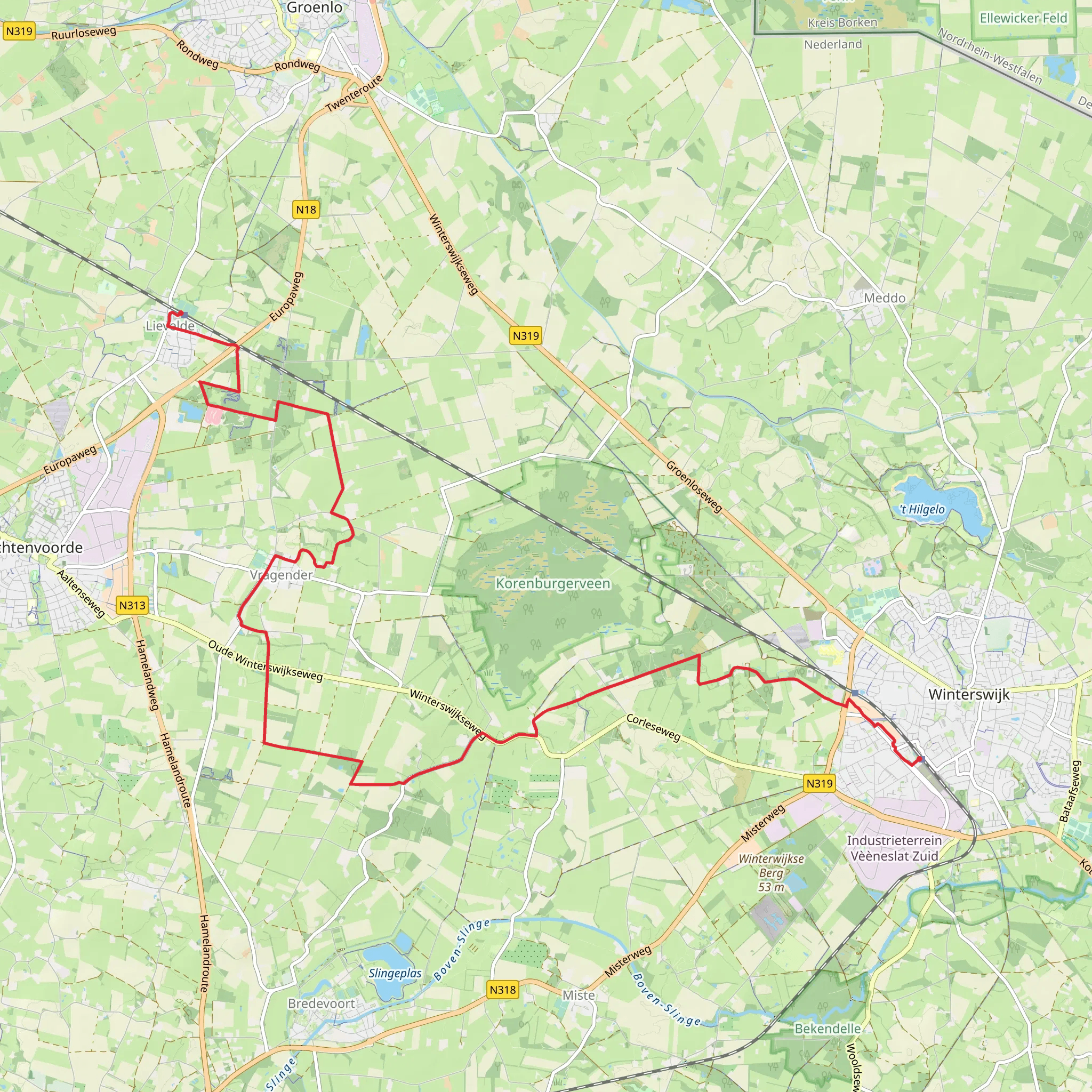
This easy, mostly flat point-to-point walk links two classic Achterhoek towns—Lievelde and Winterswijk—via a pair of small but fascinating historic sites: De Engelse Schans (an old defensive earthwork) and Nieuw Lichtenberg (a former estate/landgoed area). Expect a mix of quiet lanes, farm tracks, woodland edges, and field paths with frequent views across open pasture. At around 19 km (11.8 mi) with roughly 100 m (330 ft) of total ascent, it’s more about steady forward progress than climbing—ideal for a relaxed day, but long enough that footwear, weather planning, and timing still matter.
Getting to the start (Lievelde)
By train (public transport): - The most straightforward start landmark is Lievelde railway station (Station Lievelde), on the regional line between Zutphen and Winterswijk. From the platform area you can pick up local paths and lanes quickly without needing a bus connection.
By car: - Aim for parking near Station Lievelde (the station area is the most reliable “known landmark” to navigate to). If you prefer a more “village” start, Lievelde’s small center is close by, but the station is typically the simplest meeting point and reference.
If you’re using navigation, load the route in HiiKER and confirm whether your version begins at the station forecourt or a nearby lane—both are common start points for Lievelde walks.
You’ll finish in Winterswijk, where the most useful end landmark for pickup or onward travel is Winterswijk railway station (Station Winterswijk).
From Lievelde you’ll quickly leave the built-up area behind and settle into the Achterhoek’s signature landscape: a patchwork of meadows, hedgerows, small woodlots, and drainage ditches. Underfoot is usually firm—compacted farm track, short grass, and occasional sandy or leaf-strewn woodland path—though after rain, low sections can hold water and become slick.
Over the first 4–6 km (2.5–3.7 mi), the route tends to undulate gently (nothing sustained), gaining perhaps 20–30 m (65–100 ft) in small increments. You’ll pass working farms and long field boundaries where you may encounter: - Cattle and sheep in adjacent pastures (usually behind fencing) - Hares and pheasants in open fields - Buzzards and kestrels hovering over rough grass margins - In wetter seasons, frogs and newts near ditches and small ponds
Because much of this area is active farmland, expect occasional electric fencing, mud at gate pinch-points, and the need to yield to tractors on narrow lanes.
De Engelse Schans: a small fortification with a big story
Around 7–10 km (4.3–6.2 mi) into the hike (depending on the exact line you follow), you’ll reach De Engelse Schans, a historic defensive earthwork. Even if it looks modest at first glance—low banks, ditches, and a tucked-away feel—this kind of “schans” is closely tied to the region’s turbulent early-modern history. The eastern Netherlands saw repeated military movement and border pressure, especially during conflicts such as the Eighty Years’ War (1568–1648) and later periods when control of routes, crossings, and supply lines mattered. Small fortifications like this were positioned to protect approaches and slow enemy movement, often using wet ground and ditches as natural force multipliers.
What to look for as you pass: - The raised embankments and the way they shape the ground - The ditch lines (often the clearest “tell” in flat country) - How the site sits relative to surrounding lanes—these places were rarely random; they were about controlling movement
Footing here can change quickly: shaded sections may be slippery with leaves, and the edges of ditches can be soft. Keep children close and avoid stepping onto steep, undercut banks.
Nieuw Lichtenberg and the landgoed feel
As you continue toward Nieuw Lichtenberg (often reached around 12–15 km (7.5–9.3 mi)), the character typically shifts from open farmland to a more “estate landscape” feel—older tree lines, managed woodland pockets, and quieter tracks. Even without dramatic hills, you’ll notice subtle rises and dips that account for much of the remaining ascent (another 30–50 m / 100–165 ft spread out gradually).
This is a good section to slow down and pay attention to: - Mature oaks and beeches along lanes and woodland edges - Woodpecker activity (listen for tapping in calmer stretches) - Deer sign (tracks and browsing) in the softer ground near cover
In autumn and mild winters, leaf litter can hide roots and uneven ground; in spring and early summer, vegetation can narrow paths. If your HiiKER line uses smaller permissive paths here, double-check turns—estate tracks can look deceptively similar at junctions.
Final stretch into Winterswijk: lanes, edges, and town approach
The last 4–6 km (2.5–3.7 mi) gradually transitions toward Winterswijk’s outskirts. You’ll likely encounter more cyclists and local walkers, plus a few more road crossings. None are typically major highways, but visibility can be limited by hedges and bends—pause, look, and listen before stepping out.
As you near town, surfaces become more consistently firm (
AI Planner
Days planned around your pace, with somewhere to stay each night.
Surfaces
Asphalt
Sand
Unknown
Concrete
Paved
Wood
Comments and Reviews
User comments, reviews and discussions about the Lievelde to Winterswijk via De Engelse Schans and Nieuw Lichtenberg, Netherlands.
average rating out of 5
0 rating(s)

