
Download
3D Flyover
Add to list
More
89.7 km
6 days
148 m
Multi Day
“A long, mostly level loop of polder skies, whispering forests and bright lakes—best savoured unhurried.”
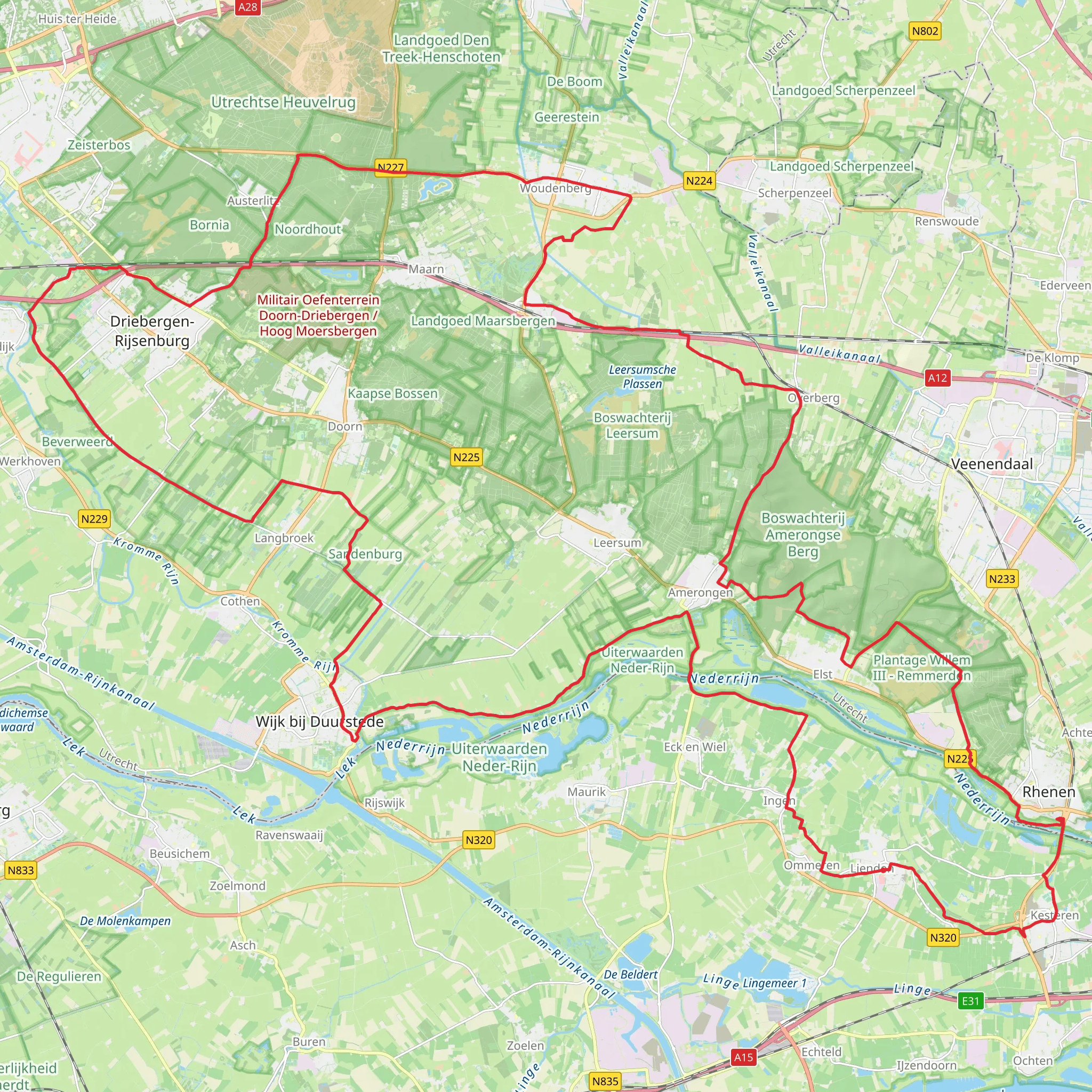
This is a long, mostly-flat countryside-and-forest loop of about 89 km (55 mi) with roughly 200 m (656 ft) of total climbing—more of an endurance day (or relaxed 2-day) than a steep hike. Expect a mix of river polder landscapes, sandy forest tracks, heathland, and a few busy recreation hotspots around lakes and estates.
Getting to the start (public transport + car)
You didn’t include the exact “hike head” location or any coordinates, so I can’t convert a lon/lat to a precise nearby address or landmark yet. If you share the start point (a pin, coordinates, or even the nearest town), I’ll anchor this to the nearest known address and tailor the approach directions.
That said, this loop name strongly suggests a start somewhere convenient to the Amerongse Bovenpolder (near Amerongen/Elst, Utrecht) or near Veenendaal/Rhenen on the south side of Utrechtse Heuvelrug.
- By public transport (typical options in this region):
- Take the train to Rhenen or Veenendaal Centrum / Veenendaal-De Klomp (common rail gateways for the Utrechtse Heuvelrug area), then use local buses toward Amerongen, Leersum, or Woudenberg depending on your chosen trailhead.
- If you want the most straightforward logistics for an 89 km loop, pick a start near a larger station (Veenendaal or Rhenen) so you can finish late without worrying about infrequent buses.
- By car:
- Look for official parking near major access points such as Amerongen (near the Rhine dike/polder access), Henschotermeer recreation area, or Hoge Ginkel / Ede heath access points. These areas typically have signed lots; arrive early on weekends because lake/heath parking fills fast.
What the terrain feels like over 89 km (55 mi)
The elevation gain is low for the distance—~200 m (656 ft) spread across gentle rises—so the challenge is time on feet, not steepness. Underfoot you’ll likely rotate through: - Dike-top paths and farm lanes in the polder (often exposed to wind). - Wide forest roads (packed sand/gravel) through the Utrechtse Heuvelrug woodlands. - Sandy singletrack and heath paths around Hoge Ginkel (can be soft and energy-sapping when dry). - Short paved connectors near villages, recreation areas, and crossings.
Plan pacing like a long walk: even at a steady 4.5–5 km/h (2.8–3.1 mph) moving speed, you’re looking at 18–20 hours of movement time—so many hikers split this into two days or do it as a very early start/late finish ultra-walk.
Route character and key sections (with landmarks)
Because the loop strings together three distinct landscapes—Amerongse Bovenpolder, Henschotermeer, and Hoge Ginkel—it naturally breaks into “chapters.” Distances below are approximate and depend on your exact start point.
Amerongse Bovenpolder: big skies, river history, and open wind (approx. 0–25 km / 0–16 mi)
The polder section is the most open and “horizontal” part of the day: long sightlines, drainage ditches, grazing fields, and the sense of walking on land engineered to cooperate with water. If you’re near the Rhine, you’ll often be close to dikes and floodplain management areas—a landscape shaped by centuries of Dutch water control.
What to look for: - Birdlife is often the headline here: expect geese, ducks, herons, and in migration seasons a wider variety of waterfowl. Early morning tends to be best. - Wind exposure: even mild forecasts can feel tougher on a dike. Bring a light shell and consider gloves outside summer. - Surface: firm, fast walking on dike paths and farm tracks—great for making early distance.
Historical context: - The broader region reflects the Netherlands’ long relationship with river flooding, dike building, and polder drainage. Even when you’re not on a famous “Delta Works” site, the everyday infrastructure—dikes, sluices, canals—tells the story of land reclaimed and protected over generations.
Forest transition toward Henschotermeer: shade, sand, and estate country (approx. 25–45 km / 16–28 mi)
As you leave the open polder and climb gently into the wooded ridge of the Utrechtse Heuvelrug, the feel changes: cooler air under trees, more sheltered walking, and more junctions.
What to look out for: - Navigation complexity increases in the forest grid. Use HiiKER to stay on the intended line at multi-track intersections where several sandy roads look identical. - Soft sand patches can appear unexpectedly—pace and effort can spike. If it’s been dry, consider gaiters to keep sand out. - Wildlife: in these mixed forests you may spot roe deer and hear plenty of woodland birds. Dawn/dusk are most active, but also when visibility is lower.
Henschotermeer: a bright, busy lake oasis (approx. 45–55 km / 28–34 mi)
Henschotermeer is a standout landmark: a clear lake with pale sand and a holiday feel, often with a noticeable jump in foot traffic. It’s a natural place to schedule
AI Planner
Days planned around your pace, with somewhere to stay each night.
Surfaces
Asphalt
Unknown
Concrete
Unpaved
Wood
Comments and Reviews
User comments, reviews and discussions about the Amerongse Bovenpolder, Henschotermeer and Hoge Ginkel Loop, Netherlands.
average rating out of 5
0 rating(s)



