Download
3D Flyover
Add to list
More
20.9 km
~4 hrs 13 min
20 m
Loop
“A steady ramble across Dwingelderveld’s purple heath, pine-scented tracks, and mirror-still fens under big skies.”
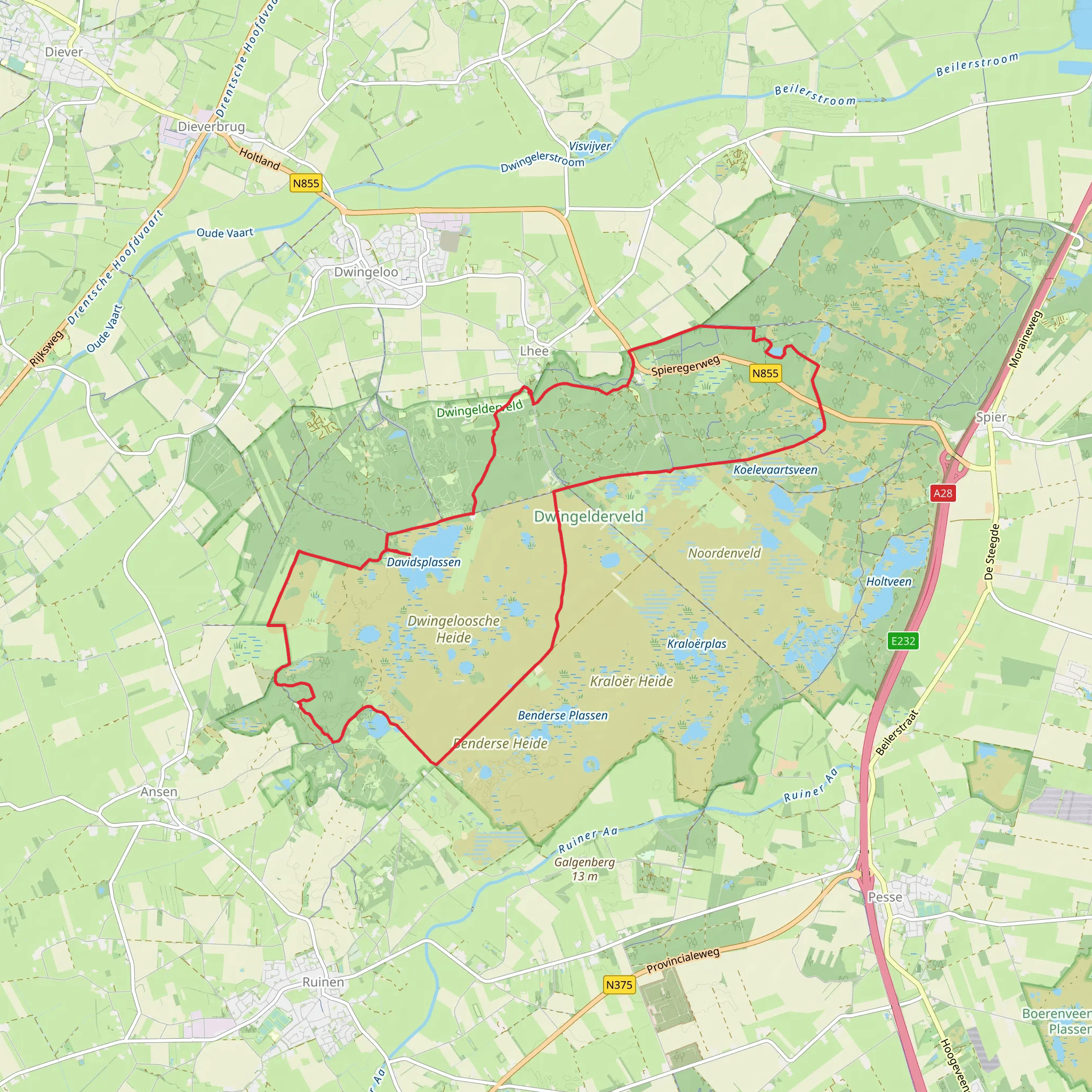
You’ll be walking through the heart of Nationaal Park Dwingelderveld in Drenthe—an expansive, almost perfectly flat mosaic of wet heath, sandy tracks, pine plantations, and peatland pools. At roughly 21 km / 13.0 mi with about 0 m / 0 ft of climbing, the effort is more about steady time on your feet and managing exposed, sometimes breezy terrain than any elevation.
Getting to the start (car + public transport)
Because this loop name is used for routes that start from a few different trailheads around Dwingeloo/Ansen/Lhee, the most practical “nearest known landmark” start for this circuit is the main park gateway at Bezoekerscentrum Dwingelderveld (near Ruinen / Dwingeloo), a common access point for longer loops across the Dwingeloosche Heide.
- By car: Navigate (in HiiKER) to Bezoekerscentrum Dwingelderveld and use the signed visitor-centre parking. From the A28 corridor, you’ll approach via local roads toward Ruinen/Lhee; the last stretch is typically narrow, rural, and shared with cyclists.
- By public transport: The easiest approach is usually train to Meppel or Hoogeveen, then a regional bus toward Dwingeloo/Ruinen plus a short walk or taxi to the visitor centre area. In the Netherlands, bus timetables can vary by day and season, so check the current connection for the exact date you’re hiking.
What the route feels like underfoot
Expect a mix of: - Wide sandy/gravel forestry tracks (fast, easy walking) - Heathland paths that can be firm when dry but soft or damp after rain - Occasional boardwalk-style sections or reinforced pathing near wetter ground (where the park protects fragile peat and fen edges)
Even though the elevation gain is negligible, the surface variety can slow your pace—especially if you hit wet patches around the fens (vennen) and peat bog margins.
Heath, fens, and the “wet heath” landscape
Dwingelderveld is known as the largest wet heathland area in Western Europe, and this loop showcases why: you’ll pass open heather fields broken up by dozens of small pools and boggy hollows. These nutrient-poor wetlands support specialized plants—think sphagnum mosses and other bog vegetation—so staying on the path matters here both for safety (hidden soft ground) and conservation.
In late summer, the heather can dominate the view with broad purple tones; outside that season, the landscape feels bigger and more austere, with long sightlines and big skies. If the route swings through Anserdennen, you’ll notice a change in character: more shelter, more pine scent, and straighter forestry lines compared with the open heath.
Davidsplassen and other standout landmarks
Davidsplassen is one of the memorable watery features on this circuit—typically a quiet, reflective pool area where the route slows down a little as you skirt wetter ground. It’s a good place to pause, scan the waterline, and listen: even when it looks still, these fen edges are often busy with insects and birds.
Other “landmarks” here are often subtle rather than monumental: - Juniper clusters (where present) with sculptural shapes on the heath - Long, straight Drenthe sand tracks that feel almost like corridors through the landscape - The transition zones where heath gives way to woodland blocks and then opens again
Wildlife you’re likely to notice (and what to look out for)
This park is valued for its biodiversity—especially in and around the wet heath and pools.
- Birdlife: Expect heathland and wetland birds; bring binoculars if you have them. Early morning and evening are most active.
- Reptiles: Dwingelderveld is known as habitat for Dutch reptiles; on warm days, watch sunny path edges where animals may bask. Give them space and avoid stepping off-trail into heather.
- Large grazers: Parts of the heath are managed with grazing animals to keep the landscape open. If you encounter cattle or sheep, pass calmly, give a wide berth, and keep dogs under strict control (or leashed where required).
Navigation and practical planning (21 km / 13 mi)
This is an “easy” hike physically, but it’s still a half-day to full-day outing depending on pace and stops.
- Navigation: Use HiiKER and download the route for offline use—signal can be inconsistent in open heath and forest pockets.
- Wind/exposure: The open heath can feel significantly cooler than nearby villages. Pack a light wind layer even in mild forecasts.
- Wet ground: After rain, expect muddy edges and soft sand. Waterproof footwear isn’t mandatory in dry spells, but it’s a good idea most of the year.
- Water/food: Services are limited once you’re out on the heath. Carry enough water and snacks for several hours.
Cultural and historical context you’re walking through
The landscape here is not “wild” in the untouched sense—it’s a cultural heath shaped by centuries of use.
AI Planner
Days planned around your pace, with somewhere to stay each night.
Surfaces
Unknown
Sand
Dirt
Concrete
Asphalt
Paved
Gravel
Comments and Reviews
User comments, reviews and discussions about the Dwingeloosche Heide, Anserdennen and Davidsplassen Loop, Netherlands.
average rating out of 5
0 rating(s)