
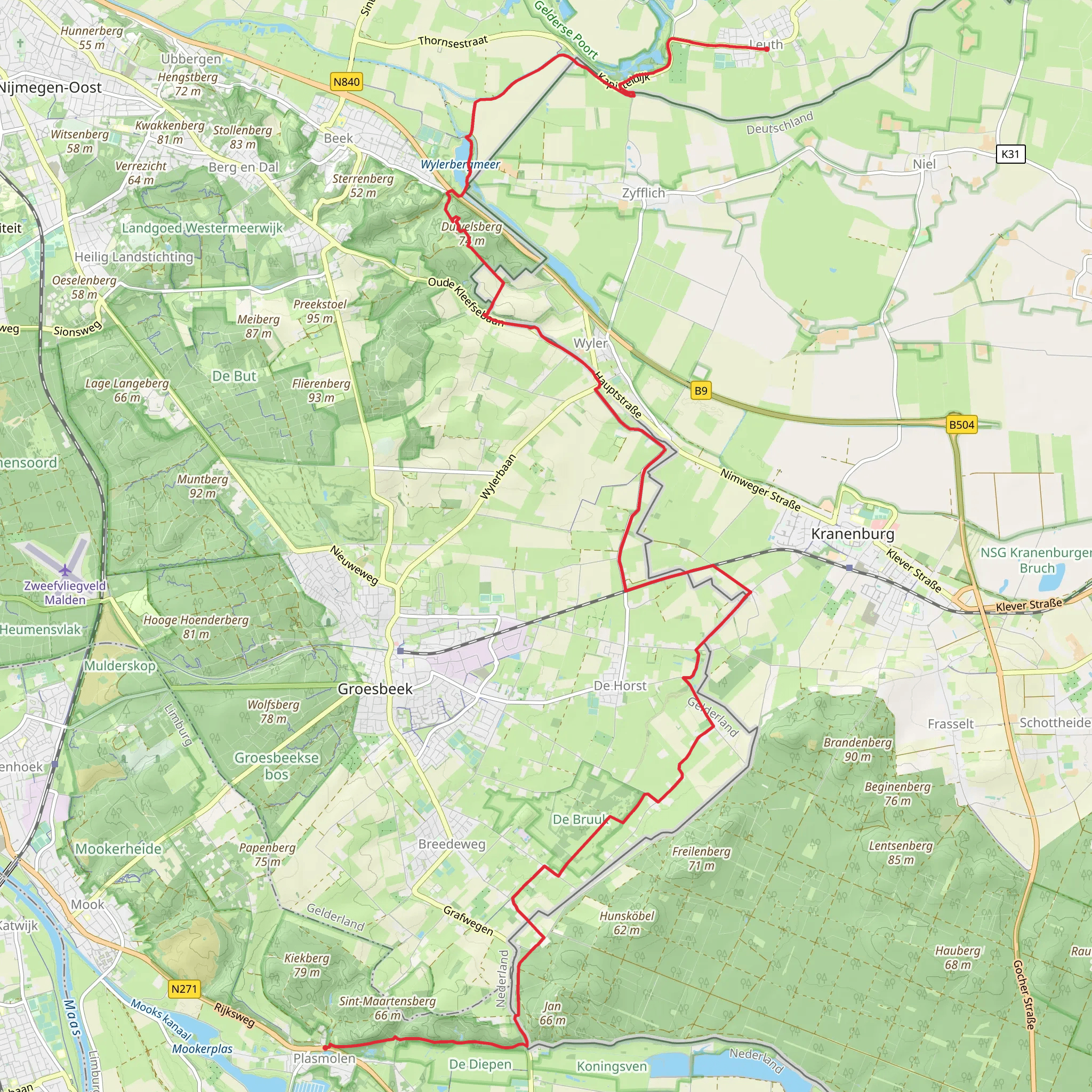
Leuth to Plasmolen via Wylerbergmeer, Duivelsberg and Ruine Romeinse Villa
Download
3D Flyover
Add to list
More
23.3 km
~4 hrs 48 min
88 m
Point to Point
“From Leuth’s big-sky river flats to Wylerbergmeer’s sandy shores and wooded moraine rises, you drift south, unhurried.”
This is a low-stress, mostly lowland point-to-point walk that strings together three very different landscapes: the flat, open river-country around Leuth, the sandy lake-and-recreation zone of Wylerbergmeer, and the short but noticeable moraine hills and deciduous woods of Duivelsberg/Wylerberg before you drift south toward Plasmolen and the Roman villa site. At around 23 km / 14.3 mi with roughly 100 m / 330 ft of total ascent, it’s “Easy” by fitness and technical standards, but it’s long enough that steady pacing, food/water planning, and staying on top of junctions matters.
Getting to the start (Leuth) and finishing in Plasmolen
Start area (Leuth): A practical landmark to aim for is Sint-Remigiuskerk (St. Remigius Church), Kerkplein 2, 6578 Leuth—a clear, central reference point for meeting up and getting oriented. (commons.wikimedia.org)
- By car: Leuth sits east of Nijmegen in Gelderland; street parking is typically easiest on village streets near the church/small center (check local signage). (en.wikipedia.org)
- By public transport: The most straightforward approach is usually via Nijmegen (major rail hub) and then onward by regional bus/taxi to Leuth. (Exact lines/timetables change seasonally—check current routing in your journey planner.)
Finish area (Plasmolen): A useful public-transport landmark is bus stop “Plasmolen, Plein” (Witteweg, 6586 AE, Plasmolen), about a 10-minute walk from the village core depending on where you end your hike. (busmaps.com)
- By public transport back: Plasmolen is served by regional buses (connections commonly route toward Nijmegen/Gennep corridors depending on line). Verify the day’s last departures before you start walking. (moovitapp.com)
- Car shuttle option: If you’re doing this point-to-point, a two-car shuttle (one left near Plasmolen, one at Leuth) is the simplest.
For navigation, load the route in HiiKER and download offline maps before you set off—this area has lots of intersecting foot/cycle paths where it’s easy to follow the “right-looking” track that’s actually a parallel cycleway.
Leuth to Wylerbergmeer: open polder edges, dikes, and big skies (approx. 0–9 km / 0–5.6 mi)
Leaving the village center, you’ll quickly feel the landscape flatten into classic river lowlands: wide fields, drainage channels, and long sightlines. Leuth’s setting is tied to the Waal floodplain environment—historically a place shaped by water management and shifting river landscapes. (en.wikipedia.org)
What to expect underfoot: mostly firm surfaces—village lanes, farm tracks, and paved or compacted paths. After rain, field-edge sections can be slick with thin mud.
What to look for:
- Birdlife is often the headline in open country—expect to see and hear a mix of farmland and wetland-edge species (bring binoculars if you like wildlife spotting).
- Wind exposure: there’s little shelter out here; even a mild forecast can feel cooler on the dike lines.
Wylerbergmeer: lakeside paths, beach edges, and a quick transition into hills (approx. 9–13 km / 5.6–8.1 mi)
Wylerbergmeer is a recreational lake area with beaches and a broad grassy fringe, sitting right under the first folds of the Berg en Dal hills. It’s managed as a recreation area and
AI Planner
Days planned around your pace, with somewhere to stay each night.
Surfaces
Unknown
Asphalt
Unpaved
Concrete
Ground
Dirt
Comments and Reviews
User comments, reviews and discussions about the Leuth to Plasmolen via Wylerbergmeer, Duivelsberg and Ruine Romeinse Villa, Netherlands.
5.0
average rating out of 5
2 rating(s)


