
Download
3D Flyover
Add to list
More
58.6 km
3 days
7 m
Multi Day
“A wind-swept lowland ramble from rivers and polders to Waterline forts—flat, long, quietly epic.”
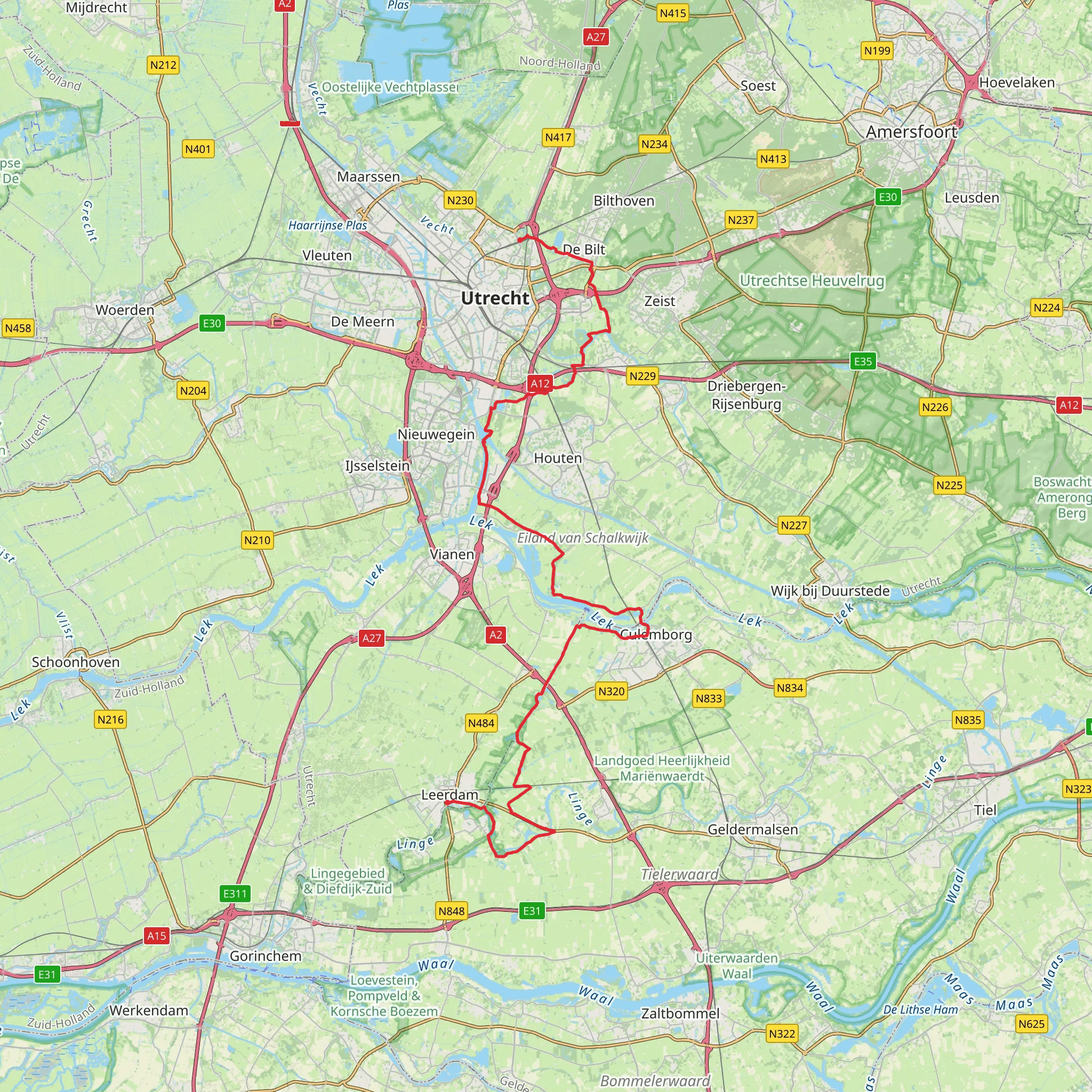
This is a long, flat, lowland route linking river landscapes, reclaimed polder country, and some of the Netherlands’ most important waterline fortifications. At roughly 58 km (36 miles) with about 0 m (0 ft) of climbing, the challenge is less about elevation and more about time on feet, wind exposure, and staying comfortable on hard surfaces (dikes, towpaths, farm lanes, and cycle tracks).
Getting to the start (Leerdam) + where to begin
Best start point: Leerdam railway station (Station Leerdam), Stationsweg, Leerdam, Netherlands (a clear, practical landmark for meeting, resupply, and navigation).
- By public transport: Leerdam is well connected by Dutch rail. Plan to arrive at Station Leerdam and begin walking directly from the station area.
- By car: Aim for parking near Station Leerdam or in central Leerdam (signed public parking is common). Starting near the station makes logistics easier if you’re ending near Utrecht.
Because this is a point-to-point hike, decide in advance whether you’ll:
- return by train from Utrecht-area stations, or
- stage a car at the finish and take the train back to Leerdam first.
Use HiiKER to load the full line and keep an eye on junctions where footpaths share space with cycle routes.
What the terrain feels like (and why “easy” still needs planning)
Expect very gentle gradients and frequent straight, open stretches. Underfoot is often paved or compacted gravel, with occasional softer path sections near wetlands and old river features. “Easy” here means no steep climbs or technical footing, but 58 km (36 miles) is still a full-day endurance outing (or a comfortable 2-day hike).
Key comfort factors: - Wind: Dikes and open fields can be relentless—bring a wind layer even in mild weather. - Foot care: Hard surfaces can punish feet; cushioned shoes and blister prevention matter. - Water/food: Towns and villages appear regularly, but not always exactly when you want them—carry enough to bridge gaps.
Leerdam to the river landscapes and “Wiel van Bassa” (approx. 0–18 km / 0–11 miles)
Leaving Leerdam, you’ll quickly transition from town edges into classic Dutch lowland scenery: canals, drainage ditches, pasture, and long sightlines. The route’s first standout is the Wiel van Bassa area—“wiel” typically refers to a scour lake formed when a dike failed and water carved out a deep pool. These features are common along major rivers and dike systems and are a reminder that this landscape has been shaped as much by engineering and flood events as by natural processes.
What to look for: - Waterfowl on still water: ducks, coots, grebes, and geese are common. - Raptors over fields (kestrels and buzzards are typical in open farmland). - Reedbeds and wet margins: good habitat for small birds and amphibians in warmer months.
Navigation note: In this region, paths can braid into farm access tracks and cycleways. Keep HiiKER handy at junctions where multiple parallel tracks run along the same canal or dike.
Through polder country toward Voorzorg (approx. 18–32 km / 11–20 miles)
This middle portion is defined by polder geometry—straight lines, right angles, and water management infrastructure. “Voorzorg” is a local place-name you’ll pass via; treat it as a waypoint rather than a single dramatic landmark. The interest here is in the working landscape: pumping stations, sluices, and the constant presence of managed water levels.
Conditions to expect: - Very flat walking with long, steady pacing. - Limited shade—sun protection matters in spring/summer. - Occasional narrow verges beside quiet roads or cycle tracks; stay alert and walk single file when needed.
Wildlife and nature: - Meadow birds in open grassland (seasonal; keep distance from nesting areas). - Canal-edge vegetation: reeds, willows, and wetland plants that change quickly with the seasons.
Fort Bij Vechten: a major Waterline strongpoint (approx. 32–45 km / 20–28 miles)
As you approach Fort bij Vechten (near Bunnik, east of Utrecht), the route shifts from purely rural to historically monumental. This fort is part of the New Dutch Waterline (Nieuwe Hollandse Waterlinie)—a defensive system that used controlled flooding (inundation) to create a shallow water barrier that was difficult for armies to cross, while forts protected key access points.
What you’ll notice on approach: - Earthworks and moats: broad, low profiles designed to absorb artillery and blend into the landscape. - Strategic siting near waterways and transport corridors.
Planning tips here: - This is a good place to schedule a long break if facilities are open nearby, but don’t rely on it without checking your day/time plan. - The fort area can have multiple intersecting paths; confirm your line on HiiKER so you don’t drift onto a parallel cycle route that bypasses key sections.
Toward Fort Blauwkapel: finishing on the edge of Utrecht (approx. 45–58 km / 28–36 miles)
The final leg trends toward the Utrecht urban fringe, where you’ll feel a gradual increase in **built
AI Planner
Days planned around your pace, with somewhere to stay each night.
Surfaces
Asphalt
Unknown
Grass
Ground
Paved
Comments and Reviews
User comments, reviews and discussions about the Leerdam to Fort Blauwkapel via Wiel van Bassa, Voorzorg and Fort Bij Vechten, Netherlands.
average rating out of 5
0 rating(s)



