Download
3D Flyover
Add to list
More
22.3 km
~4 hrs 31 min
40 m
Loop
“Wander flat polder forests and reed-fringed dikes, where wind, water, and birds shape the day.”
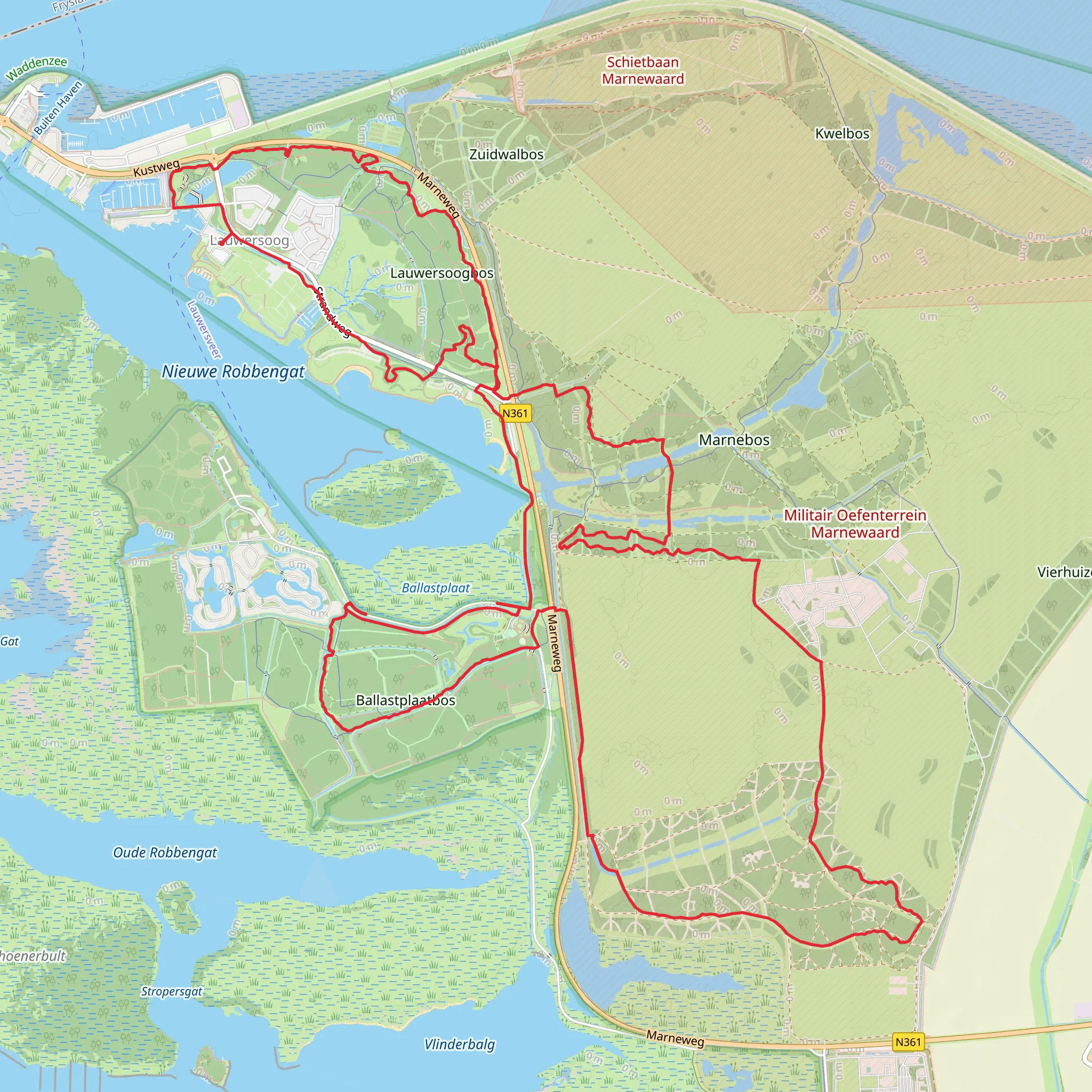
This is a long, low-lying loop through classic Dutch polder woodland and wetland edges—expect wide forestry tracks, grassy dike-top paths, and occasional short paved connectors, with virtually no climbing (about 0 m / 0 ft total gain). At ~22 km / ~13.7 mi, it’s best planned as a steady half-day walk with time for birdwatching and a couple of short stops.
Getting to the start (car + public transport)
Because the start point is listed only as “near” (no coordinates provided), the most practical way to plan is to aim for the Robbenoordbos / Dijkgatbos recreation area near Wieringerwerf (Noord-Holland, Netherlands)—a common access point for loops that include Robbenoordbos, Vlinderbalgbos, and adjacent woodland blocks.
- By car: Navigate to a main public access/parking area for Robbenoordbos (near Wieringerwerf). Typical trailheads here are signed for the forest/recreation area and connect directly to the broad forestry roads used for longer loops. If you share your lon/lat, I can convert it to the nearest recognizable parking area or landmark and tailor the direction of travel.
- By public transport: The nearest larger hub is usually Wieringerwerf (bus connections from regional rail stations such as Schagen or Den Helder depending on your route). From the closest bus stop, expect a walk-in of a few km (1–3 mi) on quiet roads or cycle paths to reach the forest edge. Check the last return service times before committing to the full loop.
What the route feels like underfoot
Most of this loop is “easy” because it’s flat, non-technical, and generally on wide paths, but it can still feel long if the surface is soft or windy.
- Surface: A mix of compacted gravel/forestry road, dirt doubletrack, and grassy sections along drainage channels. After rain, some stretches can be muddy or waterlogged, especially where paths run close to ditches.
- Exposure: Even in woodland, the surrounding polder landscape can be windy. In cooler months, wind chill can be the biggest comfort factor.
- Navigation: The forest road network can be dense and repetitive. Load the loop in HiiKER and keep an eye on junctions where multiple straight-looking tracks intersect.
Segment-by-segment expectations (approximate)
Distances are approximate and will vary slightly depending on the exact start point and which connectors you use between woodland blocks.
0–5 km (0–3.1 mi): Settling into the polder forest You’ll likely begin on broad, straight forestry lanes with drainage ditches paralleling the track. The walking is fast and level. Early on, you’ll notice the “engineered” feel of the landscape—rectilinear lines, canals, and planted woodland compartments typical of reclaimed land management.
5–12 km (3.1–7.5 mi): Vlinderbalgbos and wetter edges
As you transition toward Vlinderbalgbos, expect more wetland influence: reedbeds, ditch crossings, and occasional softer ground. This is often the best section for birdlife—look and listen for:
- Geese and ducks on open water and ditches
- Marsh harriers quartering low over reeds
- Herons/egrets along canal margins
In spring and summer, insects can be intense near still water—bring repellent.
12–18 km (7.5–11.2 mi): Robbenoordbos core tracks The Robbenoordbos portion typically returns you to very straightforward forestry roads. The forest structure can feel uniform, but keep scanning the edges: deer often stay just inside the tree line, and you may spot roe deer crossing tracks early or late in the day. If you’re walking during hunting/management seasons, pay attention to any posted notices and keep to main routes.
18–22 km (11.2–13.7 mi): Long, flat run back The final stretch is usually a steady, level walk-out on the most direct tracks. Fatigue tends to come from distance rather than terrain. If it’s been wet, this is where persistent soft ground can start to feel harder on feet—consider footwear with a bit more underfoot support than you’d use for a short stroll.
Landmarks, landscape character, and historical context
This area sits within the broader story of the Dutch polders—land reclaimed and managed through dikes, pumping, and careful water control. The straight canals, drainage ditches, and geometric woodland blocks reflect that ongoing relationship with water management and land use planning. Forests like Robbenoordbos and neighboring woodland compartments are also tied to 20th-century land development and shelterbelt/forestry planning in reclaimed landscapes, creating large, accessible green spaces in an otherwise open agricultural region.
Wildlife and nature highlights (what to look out for)
- Birds: Waterfowl, raptors (especially over reedbeds), and woodland songbirds depending on season.
- Mammals: Roe deer are the most likely larger mammal sighting; smaller mammals are present but less visible.
- Plants: Reeds, sedges, and wetland margin plants near ditches; planted woodland species in forest compartments.
Practical planning: time, water, and facilities
- Time on feet: Many hikers will take 4.5–6 hours for ~22 km / 13.7 mi depending on pace and stops.
- Water/food: Don’t assume reliable
AI Planner
Days planned around your pace, with somewhere to stay each night.
Surfaces
Unknown
Sand
Dirt
Asphalt
Concrete
Grass
Ground
Gravel
Wood
Comments and Reviews
User comments, reviews and discussions about the Ballastolaatbos, Vlinderbalgbos and Robbenoort Loop, Netherlands.
average rating out of 5
0 rating(s)