
Download
3D Flyover
Add to list
More
23.6 km
~4 hrs 43 min
0 m
Point to Point
“A long, flat polder wander of wide skies, whispering reeds, and wind‑shaped dike lines.”
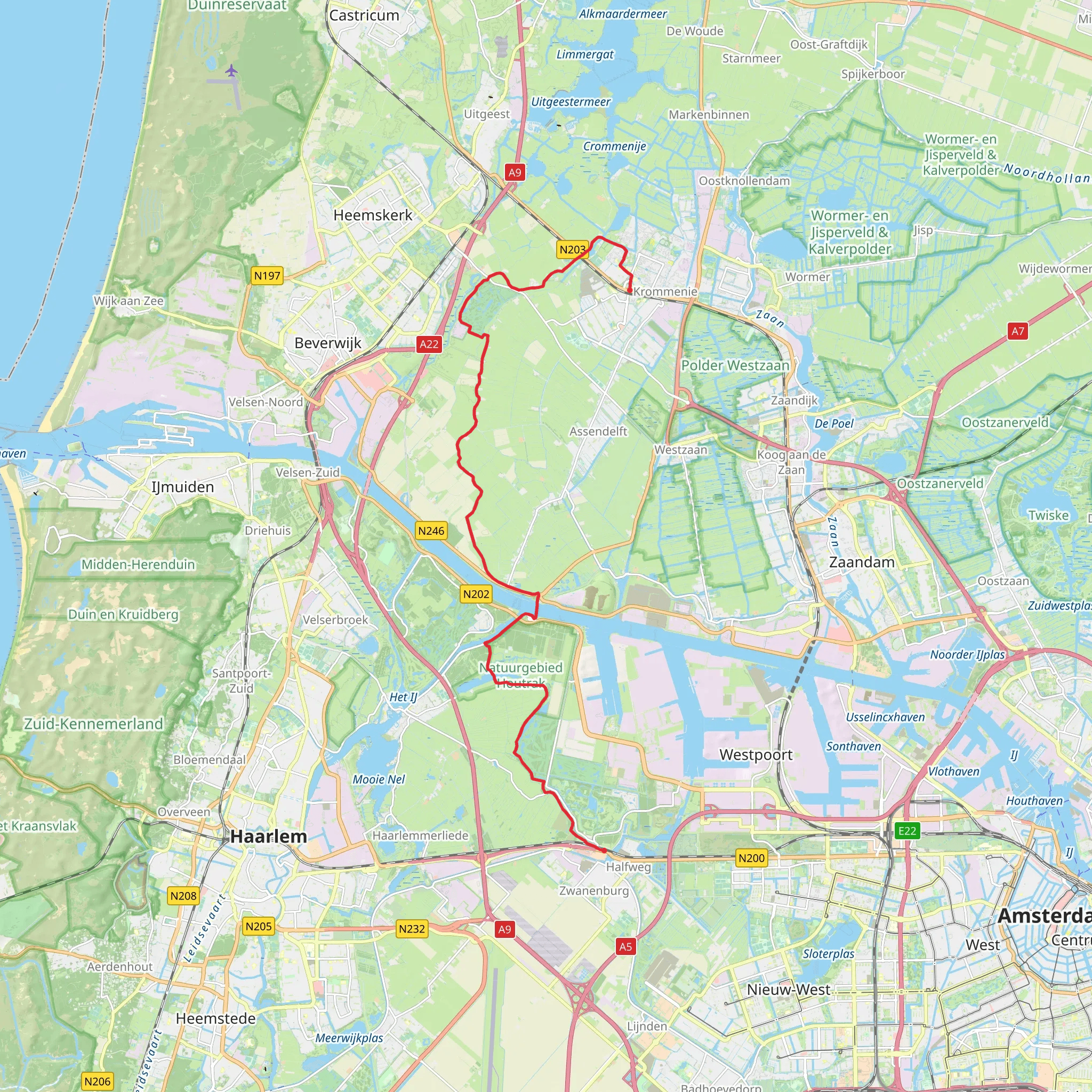
This is a long, flat point‑to‑point walk across the open peat‑polder landscape north and west of Amsterdam, linking the Zaanstreek (Krommenie/Assendelft) with the Halfweg–Zwanenburg area on the edge of Haarlemmermeer. Expect roughly 24 km / 15 miles with essentially 0 m / 0 ft of climbing—but don’t underestimate how exposed it can feel: wind, wide skies, and long straight dike paths can make the day feel bigger than the elevation profile suggests.
Getting to the start (public transport + car)
Nearest practical start landmark: the walk is most naturally started near Krommenie‑Assendelft railway station (Station Krommenie‑Assendelft), a well-known access point between the towns of Krommenie and Assendelft.
- By train (recommended): Take an NS train to Krommenie‑Assendelft (on the Zaanlijn corridor between Amsterdam and Alkmaar/Uitgeest). From the station area you can pick up local paths and quiet roads leading you out into the polder.
- By car: Navigate to Station Krommenie‑Assendelft and use nearby station parking (availability varies by day/time). Because this is a point‑to‑point hike, consider either:
- parking at the finish and training back to the start, or
- using two cars, or
- planning your return by train/bus from the Halfweg/Zwanenburg side.
- parking at the finish and training back to the start, or
Finish landmark: “Halfweg–Zwanenburg” typically means the corridor around Halfweg‑Zwanenburg railway station and the village edges near Zwanenburg, close to the North Sea Canal (Noordzeekanaal) and the western outskirts of Amsterdam.
What the route feels like underfoot
Most of this hike is on paved cycle paths, compacted gravel farm tracks, and dike-top paths. Mud is usually limited, but after rain the unpaved polder sections can be slick, and in winter the edges of ditches can be soft. Footwear with decent grip is still worthwhile even on an “easy” profile.
Because the terrain is so flat, the main “effort” variables are: - wind exposure (often the biggest factor), - sun/shade (there’s very little shade in the open polder), - distance (24 km is still a full day for many walkers).
If you’re using navigation, load the route in HiiKER and keep an eye on the many parallel tracks and canal-side options—flat country can look deceptively similar for long stretches.
Krommenie/Assendelft out into the polder (approx. 0–7 km / 0–4.5 miles)
Leaving the station area, you’ll transition quickly from residential streets to the Zaanstreek’s characteristic lowland geometry: straight drainage lines, narrow canals, and long fields divided by ditches. This region sits on historic peat soils; much of the landscape has been shaped by centuries of drainage and water management.
You’ll likely pass: - farmsteads and small bridges over drainage channels, - reed-lined ditches where you may spot moorhens, coots, and herons, - open pasture where geese (especially in cooler months) can be numerous.
Even with “0 m” of gain, you’ll notice subtle rises where paths sit atop dikes—just enough to give slightly broader views across the polder.
Houtrakpolder: big skies, waterlines, and birdlife (approx. 7–16 km / 4.5–10 miles)
This middle portion is the heart of the walk: Houtrakpolder is a broad, open area where the landscape feels intentionally engineered—water storage, drainage, and nature management all share the same space. The walking is straightforward and fast, but it’s also the most exposed section.
What to look out for - Birdwatching: Expect a strong chance of seeing grebes, ducks, geese, swans, and raptors such as kestrels hovering over fields. In migration seasons, numbers can be impressive. - Ditch edges and narrow verges: Many paths run close to water. In wet or windy conditions, give yourself extra margin—especially when passing cyclists. - Wind: With few windbreaks, a headwind can slow your pace significantly. Plan your water/food stops accordingly.
Land and water history This whole corridor sits within the Dutch tradition of polder creation and management—land reclaimed, drained, and maintained through coordinated water control. The flatness you enjoy as an “easy” hike is the result of continuous engineering: canals, pumping, and carefully set water levels. It’s a living example of how settlement and agriculture in North Holland have depended on managing peat and clay soils.
Golfterrein section: manicured greens and shared-use paths (approx. 16–20 km / 10–12.5 miles)
As you approach the “Golfterrein” (golf course area), the scenery shifts from raw polder openness to more managed, landscaped terrain—trimmed grass, tree clusters, and water hazards that can attract waterfowl.
Practical notes - Stay on public paths: Golf facilities often have clear boundaries; keep to marked public rights-of-way and be alert where paths run near fairways. - Quieter wildlife pockets: The mix of ponds, shrubs, and trees can bring different birds than the open fields—listen for songbirds and watch for her
AI Planner
Days planned around your pace, with somewhere to stay each night.
Surfaces
Asphalt
Unknown
Grass
Dirt
Paved
Wood
Unpaved
Comments and Reviews
User comments, reviews and discussions about the Krommenie Assendelft to Halfweg Zwanenbueg via Houtrakpolder and Golfterrein, Netherlands.
average rating out of 5
0 rating(s)

