
Download
3D Flyover
Add to list
More
18.6 km
~3 hrs 43 min
0 m
Point to Point
“Big skies and reed-fringed lakes guide a windswept dike ramble through the Vechtplassen.”
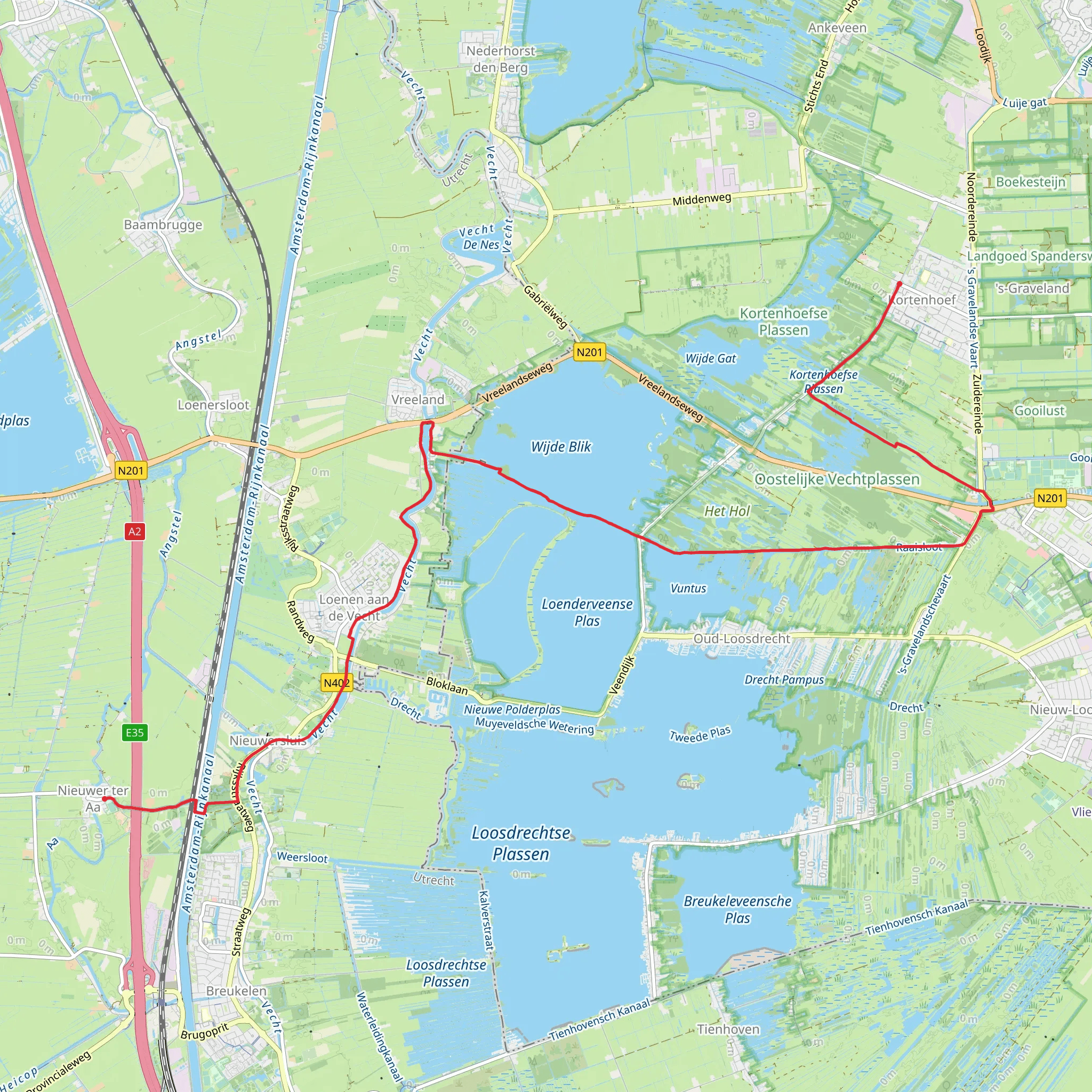
This is a flat, waterside walk through the Vechtplassen (the “Vecht Lakes”) landscape: wide reed-fringed lakes, narrow drainage ditches, peat meadows, and small villages connected by dikes and quiet lanes. With roughly 19 km / 11.8 mi and essentially 0 m / 0 ft of climbing, it’s best planned around wind exposure, soft ground, and limited shelter rather than elevation.
Getting to the start (Kortenhoef area)
By public transport (most practical): - Aim for Kortenhoef (municipality of Wijdemeren). The most common approach is via Hilversum (a major rail hub) and then a short bus ride toward Kortenhoef. From central Kortenhoef, you can walk a few minutes to the dike-side paths that lead toward Wijde Blik. - When you’re building your route, use HiiKER to confirm the exact bus stop closest to your chosen start point and to keep you aligned on the correct dike/path network (there are many parallel tracks and water channels that look similar).
By car: - Drive toward Kortenhoef and park near the village edge where day parking is permitted (often near local sports facilities, small marinas, or signed recreation access points). Parking rules can be strict in residential streets; look for marked public spaces and signage.
Nearest well-known reference point for the start: - The walk begins in/near Kortenhoef, close to the lake-and-dike landscape around Wijde Blik (a prominent open water body in the area). If you share any coordinates you have, I can translate them to the nearest recognizable landmark (e.g., a specific marina, bridge, or dike junction).
You’ll typically set off on firm paths and quiet lanes leaving Kortenhoef, quickly reaching open water views. The first few kilometers are about settling into the rhythm of the lowlands: straight horizons, big skies, and water everywhere. Expect paved dike tops, compacted gravel, and occasional grass or farm tracks. After rain, the unpaved sections can be slick, and in colder months the edges of dikes can be muddy where bikes and walkers have churned the surface.
Distance & pacing:
- 0–5 km / 0–3.1 mi: easy warm-up on dikes/lanes with early lake views; minimal navigation complexity but lots of junctions.
- 5–12 km / 3.1–7.5 mi: the most “waterland” feeling—long, open stretches beside reed beds and drainage channels.
- 12–19 km / 7.5–11.8 mi: approaching Nieuwer ter Aa, you’ll see more settlement edges, bridges, and classic Dutch water-management infrastructure.
Underfoot, exposure, and navigation
Even though it’s “easy,” this route can feel surprisingly committing because the landscape is so open: - Wind: With little tree cover, a headwind can slow you down significantly. Bring a windproof layer even on mild days. - Surface changes: Dike paths can alternate between smooth pavement and rougher gravel; grass verges may be uneven. Shoes with decent grip help, especially if you’re walking close to the water’s edge. - Route-finding: The area is a grid of waterways and parallel paths. Use HiiKER to stay on the intended side of canals and to avoid accidental detours to dead-end bridges or private farm access tracks.
Waterland scenery: Wijde Blik and the Vechtplassen
The Wijde Blik section is the visual highlight: broad water, reed margins, and a sense of space that’s rare in more wooded parts of the Netherlands. This region is part of the wider Vechtplassen system—lakes and wetlands shaped by centuries of peat extraction and water management. What looks like “natural lakes” often began as peat-cutting areas that later flooded or were widened, leaving a patchwork of open water, narrow strips of land, and reed beds.
Wildlife to look for (season-dependent): - Waterbirds: grebes, coots, moorhens, various ducks, and geese are common; in migration periods you may see larger mixed flocks using the open water. - Reed-bed species: listen for small birds in the reeds; you’ll often hear more than you see. - Raptors: open meadows and wetland edges can attract hunting birds of prey. - Mammals: in quiet stretches near reed and ditch networks, you may spot signs of small mammals; dawn/dusk is best.
Because much of the habitat is sensitive, stick to marked paths and respect any seasonal restrictions or fenced areas.
Dikes, polders, and Dutch water engineering
As you move away from the lake edges into polder country, the walk becomes a living lesson in how the Netherlands manages water: - Dikes act as the “spines” of the route—slightly raised, often the driest footing, and the best viewpoints. - Drainage ditches and canals run in straight lines, controlling water levels for agriculture and settlement. - Bridges and sluices appear regularly; they’re not just crossings but functional infrastructure regulating flow.
Historically, this landscape reflects a long relationship between people and water: peat was a valuable fuel, and extracting it reshaped the ground level and hydrology. Over time, communities adapted with dikes, pumping, and careful water-level control—creating the distinctive mosaic you’ll be walking through.
AI Planner
Days planned around your pace, with somewhere to stay each night.
Surfaces
Asphalt
Unknown
Grass
Gravel
Paved
Ground
Unpaved
Wood
Comments and Reviews
User comments, reviews and discussions about the Kortenhoef to Nieuwer ter Aa via Wijde Blik, Netherlands.
average rating out of 5
0 rating(s)

