Download
3D Flyover
Add to list
More
68.1 km
4 days
39 m
Multi Day
“A sweeping Oosterduinen dune loop of big skies and wind-sculpted sand—flat yet demanding in weather.”
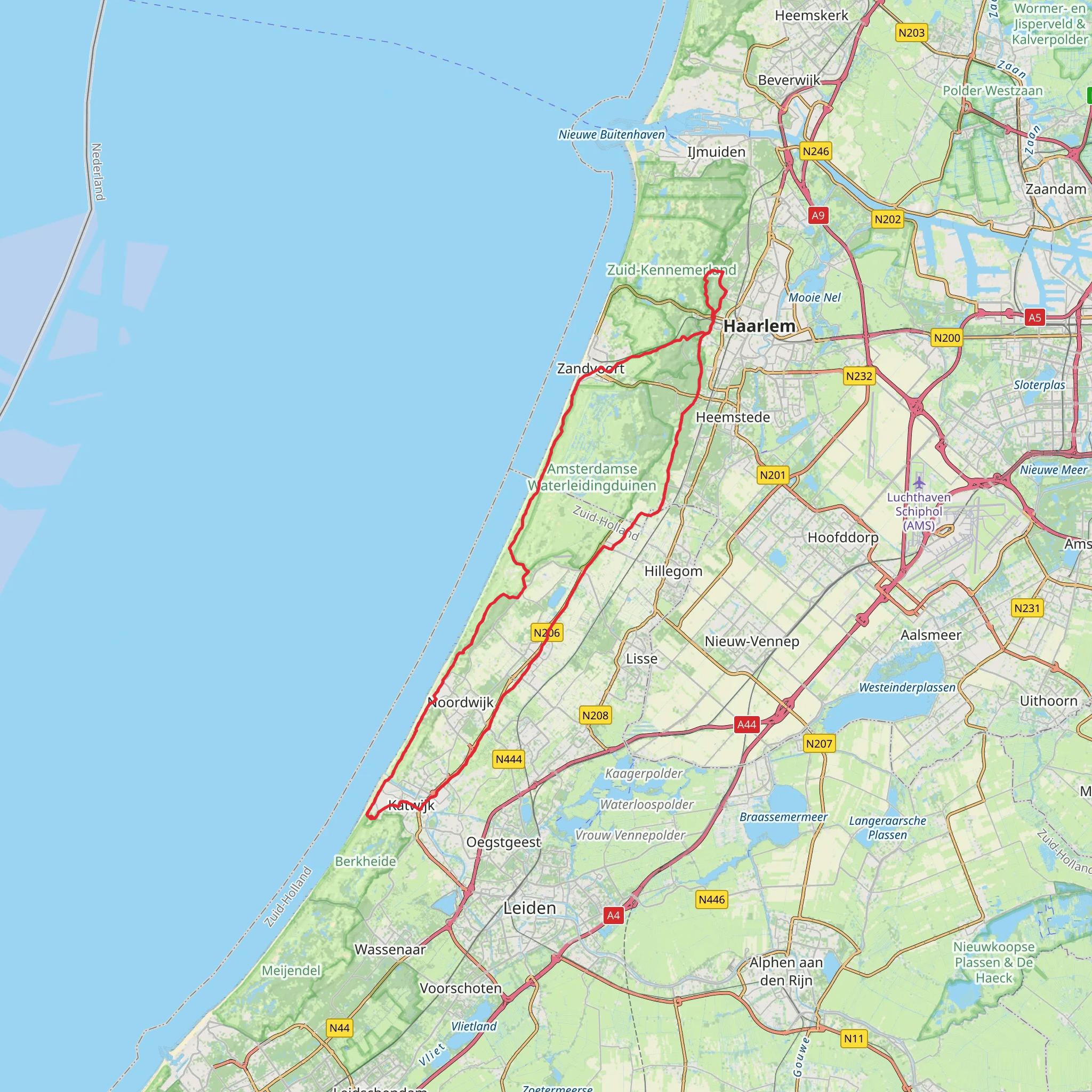
A long, low-lying coastal loop through the Oosterduinen dune system that links two classic path networks—Rijwietpad and Visserspad—this route is all about big skies, wind-shaped sand, and quiet stretches of scrub and grassland rather than climbing. At roughly 68 km (42.3 mi) with about 0 m (0 ft) of total ascent, it’s physically “easy” in terms of elevation, but the distance, sand underfoot, and exposure to wind and weather make it a serious all-day outing for fast walkers or a comfortable two-day hike for most people.
Start location (nearest landmark/address guidance)
“Oosterduinen” is a well-known dune area name in the Dutch coastal belt; the most practical way to anchor a start is to use a major, obvious access point on the dune edge such as a main dune entrance/parking area (Duinopgang) near the nearest coastal village. If you share the exact lon/lat (or a GPX), I can pin it to the closest named dune entrance, parking lot, or transit stop and give a precise “start at X” instruction. Without coordinates, plan to begin at a signed dune access point where the Rijwietpad/Visserspad waymarking is present and where there’s legal parking and a clear trailhead board.
Getting to the start (car + public transport)
By car - Aim for a signed dune entrance parking area on the inland edge of the dunes (often marked “P” and “Duinopgang” on local signage). - Arrive early: coastal dune car parks can fill quickly on fair-weather weekends and holidays. - Bring coins/cards as some lots are pay-and-display or app-based.
By public transport - The easiest pattern in the Netherlands is train to the nearest coastal town station, then a local bus toward the beach/dune entrances, finishing with a short walk to the trailhead. - Because this is a loop, you can also choose a start near a bus stop to avoid relying on parking availability. - Use HiiKER to confirm the closest stop to your chosen trailhead and to keep track of junction numbers/waymarks once you’re on the sand paths.
What you’ll be walking through - Dune ridges and dune slacks: Expect alternating bands of firmer sandy track, softer loose sand, and low, sheltered hollows where moisture lingers. - Coastal scrub and grassland: Marram grass stabilizes the dunes; in more sheltered pockets you’ll see scrubby thickets and tougher coastal plants adapted to salt spray. - Flat horizons: With essentially no elevation gain, the “effort” comes from surface and wind, not hills.
Underfoot and pacing (why “easy” can still feel big) - Sand is the main variable. Firm, compacted sand paths can feel effortless; loose sand can double your energy cost. Over 68 km (42.3 mi), even short soft sections add up. - Wind exposure: With little topographic shelter, headwinds can slow you dramatically. Plan your timing so you’re not fighting the strongest afternoon winds for hours. - Navigation: Dune networks can be deceptively similar—multiple parallel tracks, occasional informal footprints, and seasonal reroutes. Keep HiiKER handy and check your position at every major junction.
Approximate route breakdown (distance-focused) Because this loop stitches together two named path systems, it helps to think in thirds:
First ~22–24 km (13.7–14.9 mi): Settling into the dune corridors
You’ll likely start on broader access tracks that quickly narrow into dune paths. This is where you’ll find the most junctions and the greatest temptation to “just follow the nicest-looking track.” Stick to the planned line on HiiKER and watch for waymarking where available.Middle ~24–26 km (14.9–16.2 mi): The quietest, most nature-forward section
Expect longer uninterrupted stretches, fewer facilities, and more of the classic dune mosaic—open sand, grassed ridges, and sheltered slacks. This is the best section for wildlife spotting, but also where you must be most disciplined about water and food because detours to towns can be time-consuming.Final ~18–22 km (11.2–13.7 mi): Returning via broader tracks and access points
As you arc back toward the starting side of the loop, you’ll usually encounter more day-walkers and cyclists near main entrances. Surfaces may become firmer and faster, but fatigue can make soft patches feel worse late in the day—save a little energy for the last 10 km (6.2 mi).
Landmarks, nature, and wildlife to look out for - Dune slacks (wet hollows): These can host distinctive moisture-loving plants and insects compared with the dry ridges. After rain, some sections may be muddy or waterlogged even though the overall route is “flat.” - Coastal birdlife: Expect a mix of seabirds overhead and smaller songbirds in scrub. Early morning and late afternoon are typically most active. - Mammals: Rabbits are common in dune systems; you may also spot foxes or deer depending on local management and connectivity to nearby reserves. - Seasonal sensitivities: Many dune areas have seasonal restrictions to protect nesting birds or fragile habitats. Respect closures and stay on the designated line shown in HiiKER.
Historical context (why these paths exist) Coastal dune landscapes in the Netherlands are not just “natural scenery”—they’re part of a long human story: - **Coastal
AI Planner
Days planned around your pace, with somewhere to stay each night.
Surfaces
Unknown
Asphalt
Paved
Sand
Concrete
Unpaved
Dirt
Comments and Reviews
User comments, reviews and discussions about the Rijwietpad and Visserspad, Oosterduinen Loop, Netherlands.
average rating out of 5
0 rating(s)