
Download
3D Flyover
Add to list
More
41.8 km
2 days
0 m
Multi Day
“A wind-swept polder traverse of big skies, canals, creeklands, and quiet border forts—long, flat, demanding.”
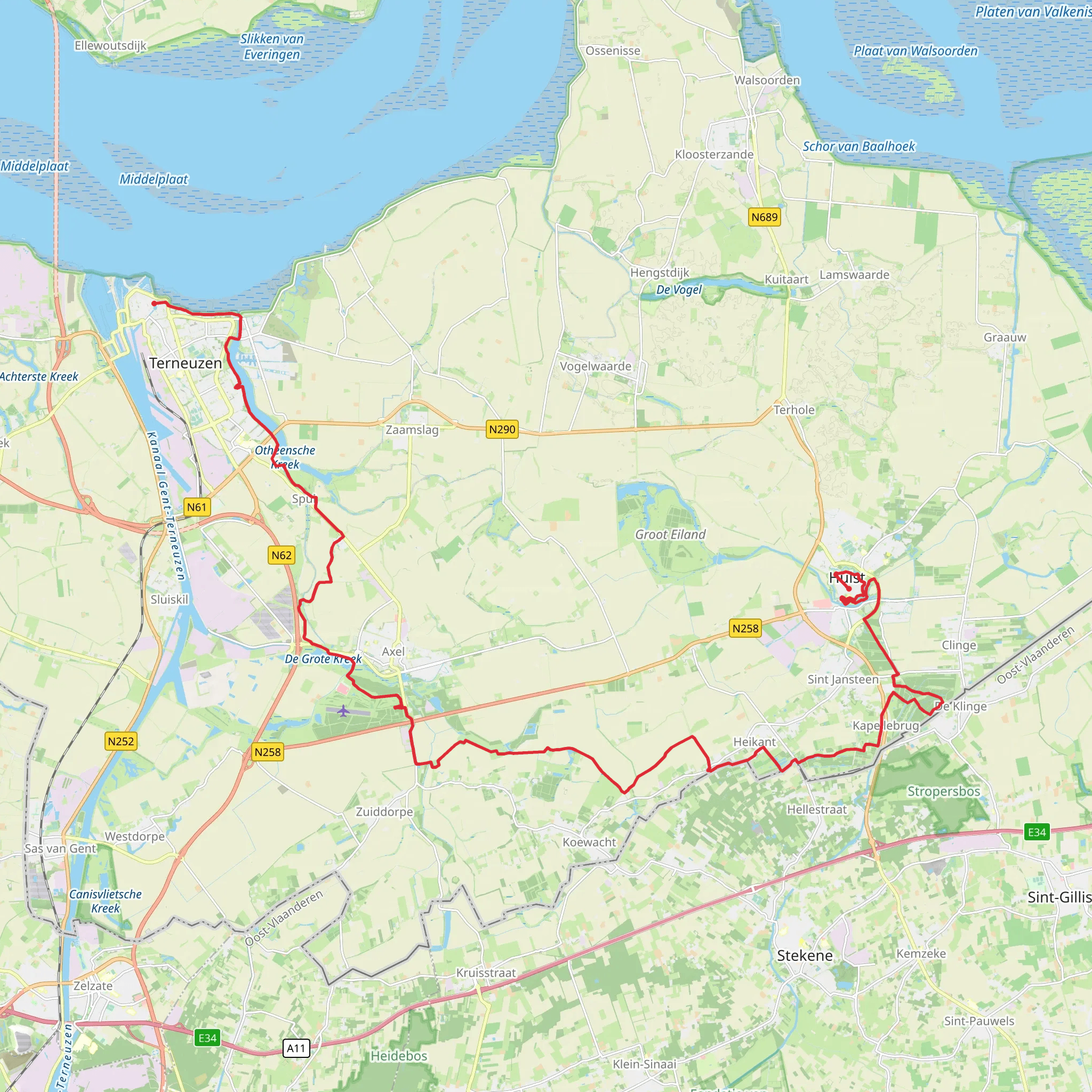
This is a long, flat Zeelandic-Flanders traverse through open polders, canal banks, creek remnants, and borderland villages—more about big skies, water engineering, and military history than hills. Expect roughly 42 km / 26 mi with essentially 0 m / 0 ft of climbing, but don’t underestimate it: wind exposure, long straight sections, and limited shade can make it feel tougher than the “easy” elevation profile suggests.
Getting to the start (Terneuzen)
By car: Terneuzen is straightforward to reach via the N62 (Westerscheldetunnel route) and local roads into town. Parking is usually easiest around the Terneuzen waterfront / city center area (look for public parking near the Schelde quay / promenade), then walk a few minutes to your exact start point.
By public transport: Terneuzen is served by regional buses connecting to larger rail hubs in Zeeland (commonly via Goes or Middelburg connections, depending on the route and operator). Plan your timing so you’re not forced into a late-day rush—this is a full-day walk for most people. Use HiiKER to pin the exact start point and confirm the first kilometers align with safe walking lines out of town.
(You noted “Hike head: near” but didn’t include coordinates. If you share a lon/lat for the start, I can convert it to the nearest recognizable landmark/address and tailor the first 1–2 km precisely.)
What the route feels like (Terneuzen → Axelse Kreek → Kapellebrug → Fort Sint Joseph → Hulst)
Leaving Terneuzen, you’ll quickly trade urban edges for canals, dikes, and agricultural grids. The walking is typically on paved cycle paths, farm lanes, and compacted dike tops—excellent footing in dry weather, but after rain you can get slick algae on concrete edges and muddy shoulders where tractors cut ruts.
Because the landscape is engineered and low-lying, navigation is usually “simple” (straight lines, obvious watercourses), yet it’s also easy to drift onto the wrong parallel farm track. Keep HiiKER handy and check it at every major junction where two dike roads run side-by-side.
Terneuzen outskirts and canal-country (approx. 0–12 km / 0–7.5 mi)
The first third tends to be the most exposed: wide views, few trees, and frequent wind. You’ll likely pass sluices, pumping stations, and drainage channels—a reminder that this region is shaped by centuries of land reclamation and flood control. Even with negligible elevation gain, you’ll feel constant micro-undulations on dike crests and bridge ramps.
What to look out for - Wind chill and sun exposure: bring a light shell even on mild days; also sunscreen and a brimmed cap—shade can be scarce. - Fast bikes on shared paths: Zeeland/Flanders cycle routes are efficient and popular; walk predictably and keep to one side. - Water edges: many dikes have steep, unguarded drops into canals.
Axelse Kreek: a “creek” landscape with birds (approx. 12–22 km / 7.5–13.5 mi)
Around the Axelse Kreek area, the scenery often shifts from strict straight-line drainage to older creek remnants and wetter margins. These “kreek” features are typically former tidal channels or flood-created waterways later enclosed by dikes—so you get a more natural-looking ribbon of water and reedbeds within an otherwise cultivated landscape.
Nature and wildlife - Expect waterfowl and waders: geese, ducks, coots, herons, and seasonal migrants. - Reedbeds can hold marsh birds; you may hear them more than you see them. - In warmer months, insects can be intense near still water—pack repellent.
Practical notes - This is a good place to schedule a short break, but choose a spot off the cycle line and away from soft verges. - If it’s been wet, the edges near reedbeds can be deceptively boggy—stay on the firm track.
Border villages and Kapellebrug (approx. 22–32 km / 13.5–20 mi)
As you angle toward Kapellebrug, the route takes on a borderland feel: small settlements, straight roads, and occasional customs-era geometry in the infrastructure. Kapellebrug itself is a useful waypoint for water and snacks if anything is open when you pass—don’t assume late-afternoon services in small villages.
What to look out for - Long, quiet roadwalks: even with low traffic, stay alert at bends and farm entrances. - Agricultural activity: wide machinery, muddy run-off on pavement, and occasional temporary diversions.
Fort Sint Joseph and the military history thread (approx. 32–38 km / 20–23.5 mi)
Near Fort Sint Joseph, the walk intersects the region’s layered defensive history. Zeelandic Flanders and the Hulst area sat on strategic routes between the Scheldt approaches and inland Flanders, and the landscape still carries the logic of forts, inundation zones, and controlled waterways—defense by water as much as by walls.
Even if the fort area is modest or partially integrated into modern land use, it’s worth slowing down: look for earthworks, angular lines, moats/ditches, and raised embankments that don’t match the agricultural grid.
Planning tip: If you like to pair walking with history, pre-load points of interest in **HiiKER
AI Planner
Days planned around your pace, with somewhere to stay each night.
Surfaces
Unknown
Asphalt
Sand
Paved
Gravel
Grass
Dirt
Concrete
Cobblestone
Unpaved
Comments and Reviews
User comments, reviews and discussions about the Terneuzen to Hulst via Kapellebrug, Fort Sint Joseph and Axelse Kreek, Netherlands.
average rating out of 5
0 rating(s)


