
Download
3D Flyover
Add to list
More
28.5 km
~5 hrs 41 min
0 m
Loop
“A long, flat woodland-and-farmland loop—quiet, breezy, and meditative, best savoured at your pace.”
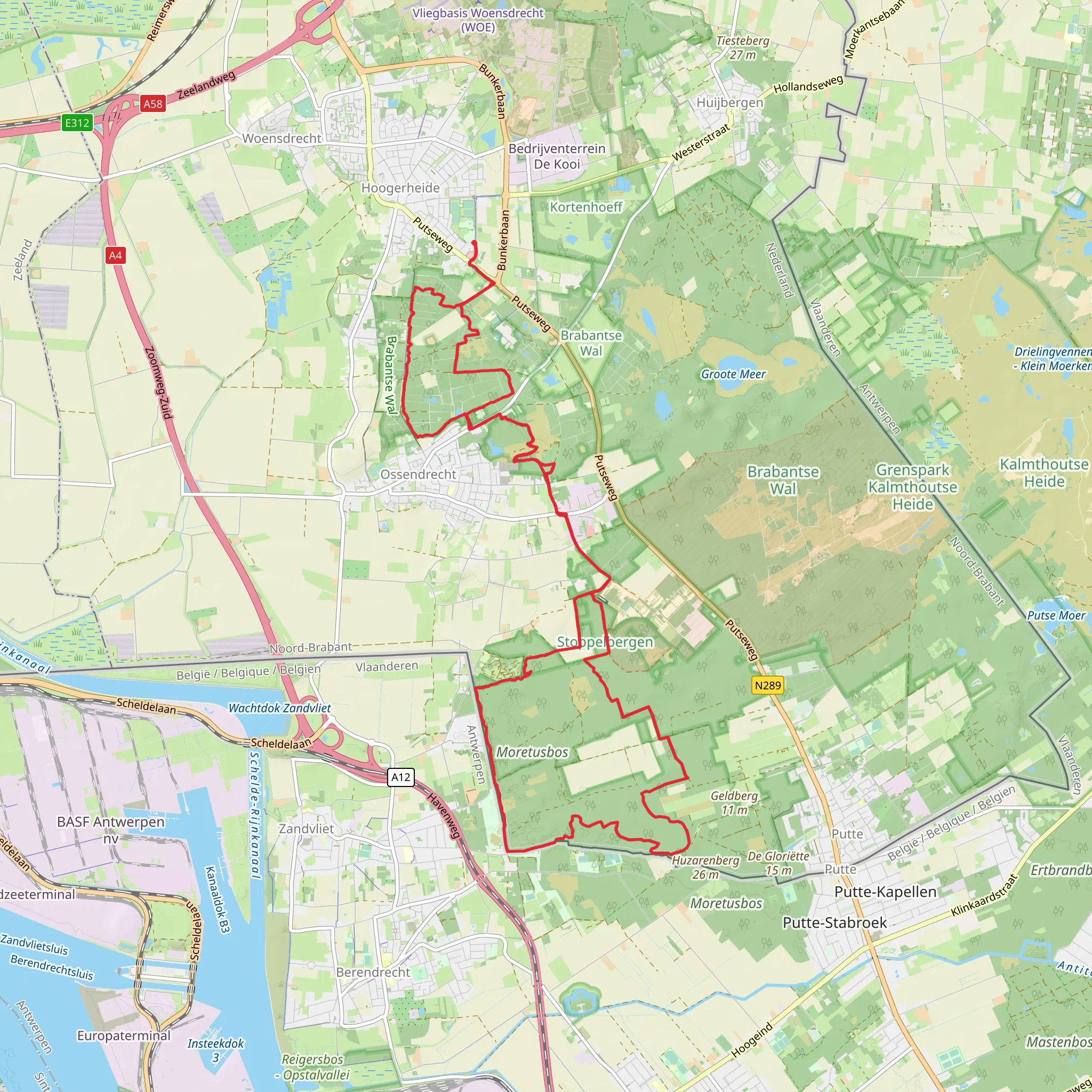
This is a long, low-relief loop of roughly 28 km (17.4 mi) with about 0 m (0 ft) of climbing, linking quiet woodland blocks and open agricultural edges around the Abdijbossen/Wilderbissen/Stoppelbergen area. Expect mostly flat, fast-going terrain—ideal for steady pacing—on a mix of forest tracks, compacted gravel paths, farm lanes, and short paved connectors.
Getting to the start (car + public transport)
Because the start point is only given as “near” (no coordinates or town provided), the most reliable way to pinpoint the exact trailhead is to open the route in HiiKER and use its start-point pin to navigate to the nearest parking pull-in or village street address.
That said, this loop name strongly suggests the Abdijbossen area (commonly associated with the “Abbey Woods” landscape) and nearby named woods/heath blocks. In practice, starts for loops like this are usually set at one of these “easy to find” places:
- a village church square,
- a forest car park at the edge of the Abdijbossen, or
- a signed recreational trailhead near a café/visitor pull-in.
By car: plan for small local roads and limited shoulder parking. If HiiKER shows a forest car park, use that; otherwise, aim for the nearest village center and park legally (watch for farm access gates and private drives).
By public transport: these rural woodland mosaics are typically served by regional buses rather than rail. The usual pattern is:
1) train to the nearest larger town,
2) bus onward to the closest village stop,
3) short walk (often 0.5–2.0 km / 0.3–1.2 mi) to the start pin shown in HiiKER.
If you share the start coordinates (lon/lat) or a HiiKER link, I can convert them to the nearest known address/landmark and give a precise “get off here / park here” plan.
What the terrain feels like underfoot
With essentially no elevation gain, the main “difficulty” comes from distance and surface changes: - Forest sections (largest share): wide tracks with occasional sandy patches; after rain, expect puddling and soft edges. - Field-edge connectors: firm farm lanes; can be exposed to wind. - Short paved stretches: usually between woodland blocks or through hamlets—easy walking but harder on feet over 28 km (17.4 mi).
Footwear: light hiking shoes are fine in dry spells; after wet weather, choose something with better mud grip and a bit of water resistance.
Route flow and pacing (approximate)
Most hikers will break this loop into three natural “chapters,” each with its own character:
0–8 km (0–5 mi): Settling into the Abdijbossen You’ll typically start on easy access tracks that lead quickly into woodland. The first hour is about finding rhythm: long straight forest lanes, gentle bends, and frequent junctions where multiple forestry tracks intersect. This is where HiiKER is most useful—flat forests can feel deceptively uniform, and it’s easy to take the “right-looking” track that slowly drifts off-route.
Look for: - older, thicker-trunk stands mixed with younger plantation blocks, - drainage ditches alongside tracks (common in lowland woods), - occasional clearings that open sightlines across the canopy edge.
8–18 km (5–11.2 mi): Wilderbissen and the open edges This middle portion often alternates between woodland and agricultural margins. You’ll notice more light, longer views, and a change in soundscape—birds and wind replace the muffled forest quiet.
What to watch for: - farm machinery traffic on shared lanes (especially weekdays), - electric fencing or temporary livestock barriers near field edges, - mud at gateways where tractors churn the ground.
If the loop passes near small settlements, you may find a bench, chapel, or roadside wayside cross—common landmarks in this kind of countryside and useful as mental checkpoints.
18–28 km (11.2–17.4 mi): Stoppelbergen and the long, flat finish The final third tends to feel “long” because the terrain stays flat—your legs don’t get the variety that hills provide. This is where small navigational slips happen: fatigue + repetitive tracks. Keep an eye on HiiKER prompts at every major junction.
Expect: - more conifer blocks or mixed woodland, - straight forestry corridors that can be breezy, - a gradual return toward the starting area via familiar track types.
Nature, wildlife, and seasonal highlights
These lowland woodland complexes are typically rich in edge habitat—where forest meets field—which is excellent for wildlife.
Common sightings and signs: - roe deer (often at dawn/dusk along rides and clearings), - hares and pheasants along field margins, - woodpeckers (listen for drumming in mature stands), - buzzards or other raptors circling over open ground.
Seasonal notes: - Spring: fresh leaf-out and strong birdsong; paths can be soft from late rains. - Summer: shaded forest walking is a big advantage on a 28 km day; ticks can be more active in grassy edges—use repellent and do checks. - Autumn: leaf litter can hide roots and make muddy patches slick; great color in mixed stands. - Winter: flat routes stay doable, but expect waterlogged sections and short daylight—bring a headlamp for safety.
Landmarks and
AI Planner
Days planned around your pace, with somewhere to stay each night.
Surfaces
Unknown
Dirt
Ground
Asphalt
Unpaved
Cobblestone
Comments and Reviews
User comments, reviews and discussions about the Abdijbossen, Wilderbissen and Stoppelbergen Loop, Netherlands.
average rating out of 5
0 rating(s)

