
Download
3D Flyover
Add to list
More
33.8 km
2 days
151 m
Multi Day
“From Veluwe’s hushed woods to Flevoland’s big-sky polders, a steady, wind-shaped day loop.”
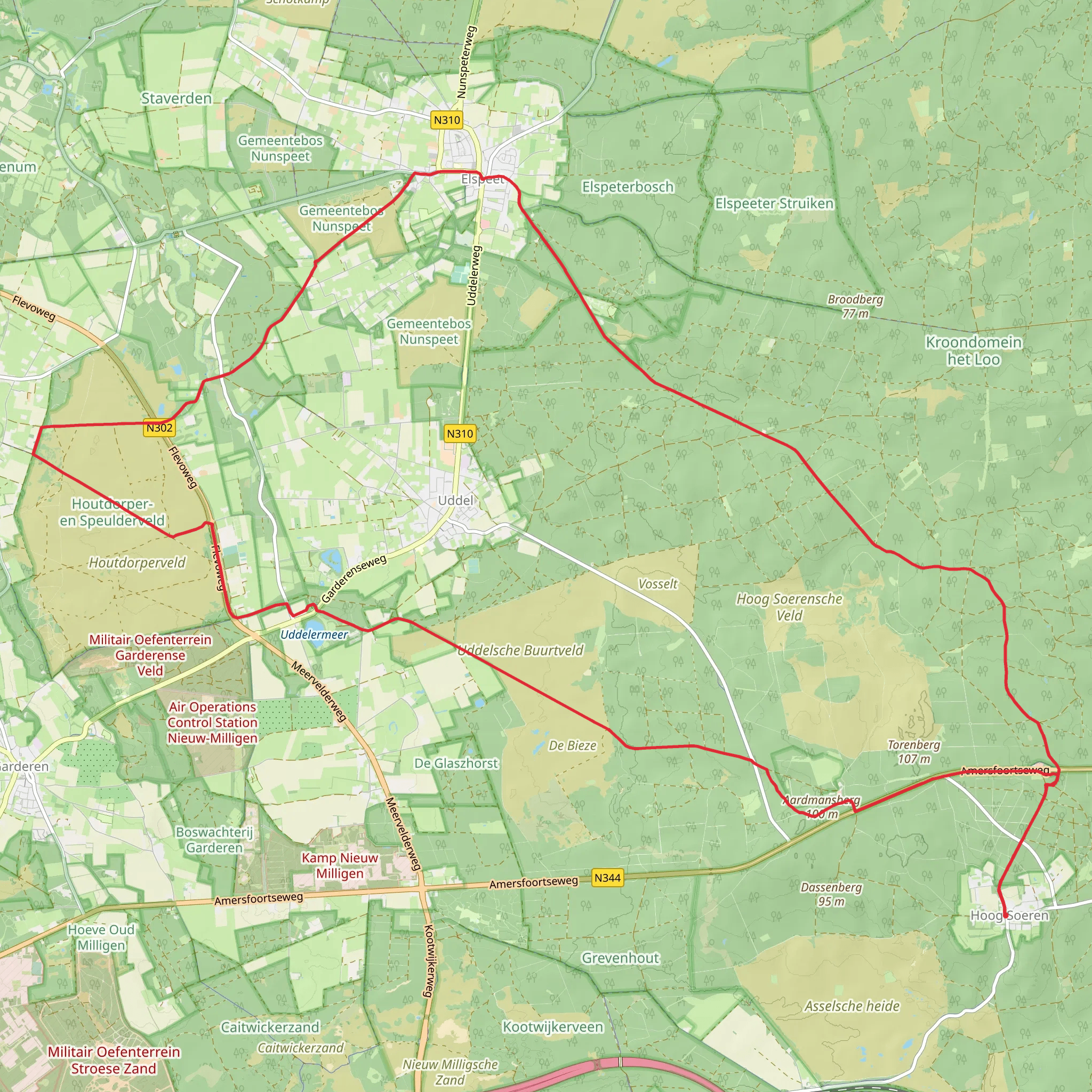
A long, mostly level loop through the Veluwe’s western edge and the open polder landscapes of Flevoland, linking quiet forest tracks, heathland fringes, and long, straight cycleways/secondary roads where you can settle into a steady pace. At around 34 km (21.1 mi) with roughly 200 m (656 ft) of total ascent, it’s physically “easy” in terms of gradient, but it’s a full-day distance—plan for endurance, foot care, and weather exposure (especially wind on the open sections).
Getting to the start (and what “near the trailhead” usually means here)
Because the trailhead is listed only as “near,” the most practical way to anchor this loop is to start from a major, obvious access point along the Amersfoortseweg (N237) corridor on the west side of the Veluwe, close to the built-up edge of Amersfoort/Soesterberg. Common, easy-to-navigate start anchors in this area are:
- Soesterberg village center / Kamp van Zeist area (prominent landmark zone along/near the N237), or
- Amersfoort city edge near the N237 where parking and bus connections are straightforward.
If you share the route’s coordinates (or a HiiKER link), I can pin the nearest known address or landmark precisely.
By car: Aim for parking near Soesterberg (look for signed public parking by village facilities or recreation access points toward the Veluwe). Arrive early—weekends can be busy with walkers and cyclists.
By public transport: The Amersfoort–Soesterberg corridor is well-served by buses from Amersfoort Centraal. A typical approach is:
- Train to Amersfoort Centraal, then
- Bus toward Soesterberg (choose a stop near the N237/Amersfoortseweg side of town to minimize road-walking).
(Exact stop names vary by line and timetable; if you tell me your intended start landmark, I’ll match the most convenient stop.)
What the route feels like underfoot
Expect a mix of: - Forest paths and compacted sandy tracks (Veluwe edge): generally forgiving, can be soft in dry spells and muddy after rain. - Paved cycleways and quiet roads (Flevoweg/polder side): fast, efficient walking but harder on feet—consider cushioned insoles if you’re sensitive to long pavement days. - Straight, exposed stretches: the “Flevoweg” character often means long lines and big skies—great visibility, but wind and sun/rain exposure can be the main challenge rather than hills.
Because the elevation gain is modest (~200 m / 656 ft total), any “climbs” are likely short rises, overpasses/embankments, or gentle undulations rather than sustained ascents.
Distance breakdown (approximate) and pacing
A sensible way to think about the day:
- 0–10 km (0–6.2 mi): Settling in through the greener, more sheltered sections—often the most pleasant walking if you start near the Veluwe edge.
- 10–24 km (6.2–14.9 mi): The loop’s “engine room”—longer, straighter connectors where you’ll cover ground steadily. This is where wind can affect pace and energy.
- 24–34 km (14.9–21.1 mi): Return leg—fatigue management becomes the main task; keep snacks and water for the final third.
At an easy all-day pace with breaks, many hikers will take 7–9 hours for 34 km (21.1 mi), depending on surfaces and wind.
Landmarks, landscape, and wildlife to watch for
This loop sits in a region where Dutch landscape transitions are very noticeable:
Veluwe edge character (woodland/heath influence): - You’ll likely pass through mixed woodland (pine and deciduous patches) and edges of heathland or sandy soils typical of the Veluwe’s margins. - Wildlife commonly seen in these habitats includes roe deer, hares, and a wide range of songbirds; at dawn/dusk you may hear more than you see. - In warmer months, watch for ticks in grassy/heathy margins—long socks and a post-hike check are worth it.
Flevoland/polder character (open, engineered lowland):
- Expect big-sky openness, drainage channels, and long straight corridors—classic reclaimed-land geometry.
- Along ditches and wetter edges, look for waterfowl (geese, ducks), herons, and seasonal migrants.
- Wind is the “wildlife” here—plan layers even on mild days, because exposed sections can feel much cooler.
Historical significance of the region (what you’re walking through)
This part of the Netherlands is a meeting point of two very different stories:
- The Veluwe and its margins have long been shaped by a combination of natural sandy soils and centuries of human land use—forestry, heath management, and settlement patterns that cluster on more workable ground.
- Flevoland is internationally significant as one of the world’s best-known examples of large-scale land reclamation (polders engineered from what was once water). Walking near “Flevoweg” corridors often means moving through landscapes that are deliberately planned—straight lines, controlled water levels, and infrastructure designed around drainage and access.
That contrast—older, more organic woodland edges versus the precise, engineered polder—tends to be the most memorable “landmark,” even when there
AI Planner
Days planned around your pace, with somewhere to stay each night.
Surfaces
Unknown
Gravel
Asphalt
Concrete
Sand
Paved
Comments and Reviews
User comments, reviews and discussions about the Amersfoortseweg and Flevoweg Loop, Netherlands.
average rating out of 5
0 rating(s)



