Download
3D Flyover
Add to list
More
76.0 km
4 days
0 m
Multi Day
“A flat, water-threaded Dutch loop of big skies, straight towpaths, and wind—quietly demanding.”
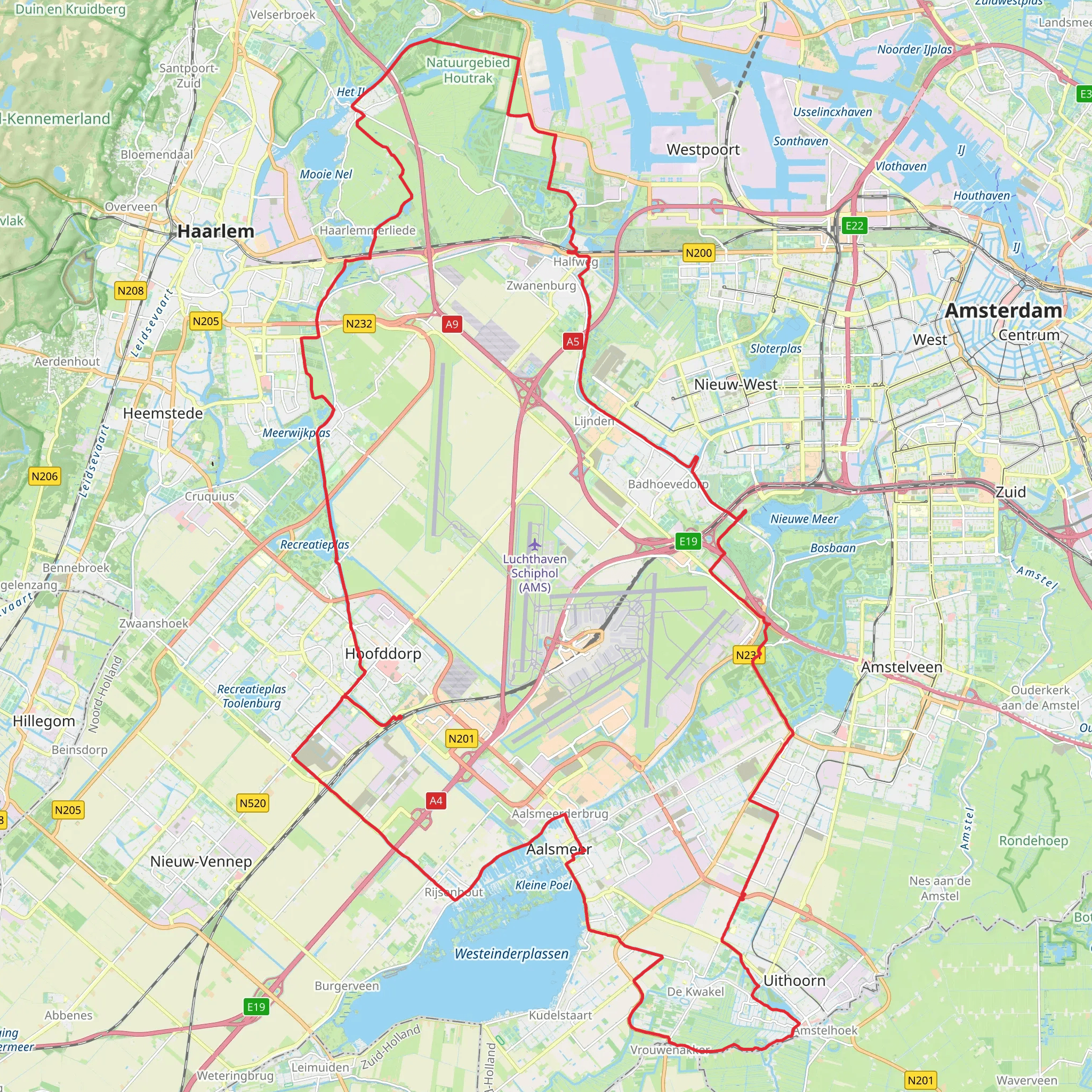
This is a long, flat, water-shaped loop of roughly 76 km (47 mi) with essentially 0 m (0 ft) of climbing—more a test of steady pacing, foot care, and weather management than leg strength. You’ll spend most of the day on Dutch-style multi-use paths: canal-top towpaths, dike roads, park paths through managed woodland, and long open stretches beside lakes and polders. Expect frequent pavement or hard-packed surfaces, lots of straight lines, and big skies—beautiful, but mentally “long” if you’re not ready for it.
Because the route name combines several well-known path corridors (Liniepad, Molenweteringpad, Amsterdamse Bos, Westeinderplassen), the most practical “hike head” is near the Amsterdamse Bos main access area around the Bosbaan rowing course (Amstelveen)—a reliable landmark with transit access, parking, and services. A good anchor point to navigate to is Bosbaan / Amsterdamse Bos, near the rowing course and the Bosbaanweg area in Amstelveen (use HiiKER to confirm the exact start pin and direction of travel for your GPX).
Getting to the start (public transport + car)
Public transport (from central Amsterdam): - The Amsterdamse Bos edge is well connected via tram/metro to Amsterdam Zuid and then bus/tram connections toward Amstelveen. The most convenient approach is to route yourself to the Bosbaan / Amsterdamse Bos entrances and walk in a few minutes to the path network. Use HiiKER to pick the entrance that matches your track direction so you don’t add extra kilometers.
By car: - Aim for parking near Amsterdamse Bos / Bosbaan (Amstelveen side is often easiest). Arrive early on weekends—this park is heavily used. If your loop truly returns to the same point, this is the simplest logistics option for a 76 km (47 mi) day.
What the terrain feels like (and why “easy” can still be demanding)
Even with near-zero elevation gain, this distance is an endurance outing. Underfoot you’ll likely rotate through: - Asphalt cycle paths (fast, but hard on feet and joints over 8–14 hours) - Gravel/shell paths along canals and park lanes (a bit kinder) - Dike-top roads exposed to wind (where pace can swing dramatically)
Plan for wind as the real “hill.” Around open water and reclaimed land, a headwind can slow you more than any climb.
Amsterdamse Bos: woodland, watercourses, and human history
The Amsterdamse Bos is not an ancient forest—it’s a designed landscape park created largely in the 1930s as an unemployment relief project, with planting and construction continuing for decades (the last trees weren’t planted until around 1970). (amsterdamsebos.nl)
As you pass through, you’ll notice the “English landscape” feel: curving waterways, open meadows, and long sightlines that make it feel larger than it is. (amsterdamsebos.nl)
A major landmark you may skirt or cross near is the Bosbaan, a purpose-built rowing course opened in 1937 and widely cited as the oldest artificial rowing course in the world. (en.wikipedia.org)
This area can be busy with runners, cyclists, rowers, and families—expect frequent interactions at junctions and bridges.
Wildlife here is typical of Dutch park-woodland and wetland edges: waterfowl (geese, ducks, swans), herons, and small woodland birds. In warmer months, insects can be noticeable near still water—bring repellent if you’re sensitive.
Canal corridors (Liniepad / Molenweteringpad): long lines, big exposure
Once you leave the denser park core, the character shifts to linear canal and polder infrastructure—paths that follow water management lines. These sections are usually: - Very flat - Very direct - Very exposed (sun and wind) - Navigation-simple but junction-heavy (many crossings, bridges, and parallel cycleways)
This is where HiiKER is most valuable: not because you’ll get “lost in wilderness,” but because it’s easy to take the wrong parallel path and lose time before you notice.
Practical things to watch for: - Fast cyclists on shared paths—hold a predictable line, especially when stepping aside. - Narrow bridges and pinch points where bikes and walkers funnel together. - Limited shade: on a bright day, sun protection matters more
AI Planner
Days planned around your pace, with somewhere to stay each night.
Surfaces
Asphalt
Unknown
Concrete
Grass
Wood
Comments and Reviews
User comments, reviews and discussions about the Liniepad, Molenweteringpad, Amsterdamse Bos and Westeinderplassen Loop, Netherlands.
average rating out of 5
0 rating(s)