
Download
3D Flyover
Add to list
More
23.5 km
~4 hrs 54 min
133 m
Loop
“Wander sandy heath ridges and hushed pine tracks under big skies—easy-going, yet weatherwise.”
I’m missing the start location details (“Hike head: near …” is blank), and I don’t have any lon/lat points to convert to a nearby address/landmark. Share either (a) a pin/coordinates for the trailhead, (b) the nearest town/parking area, or (c) a HiiKER link, and I’ll anchor the directions and the route description precisely.
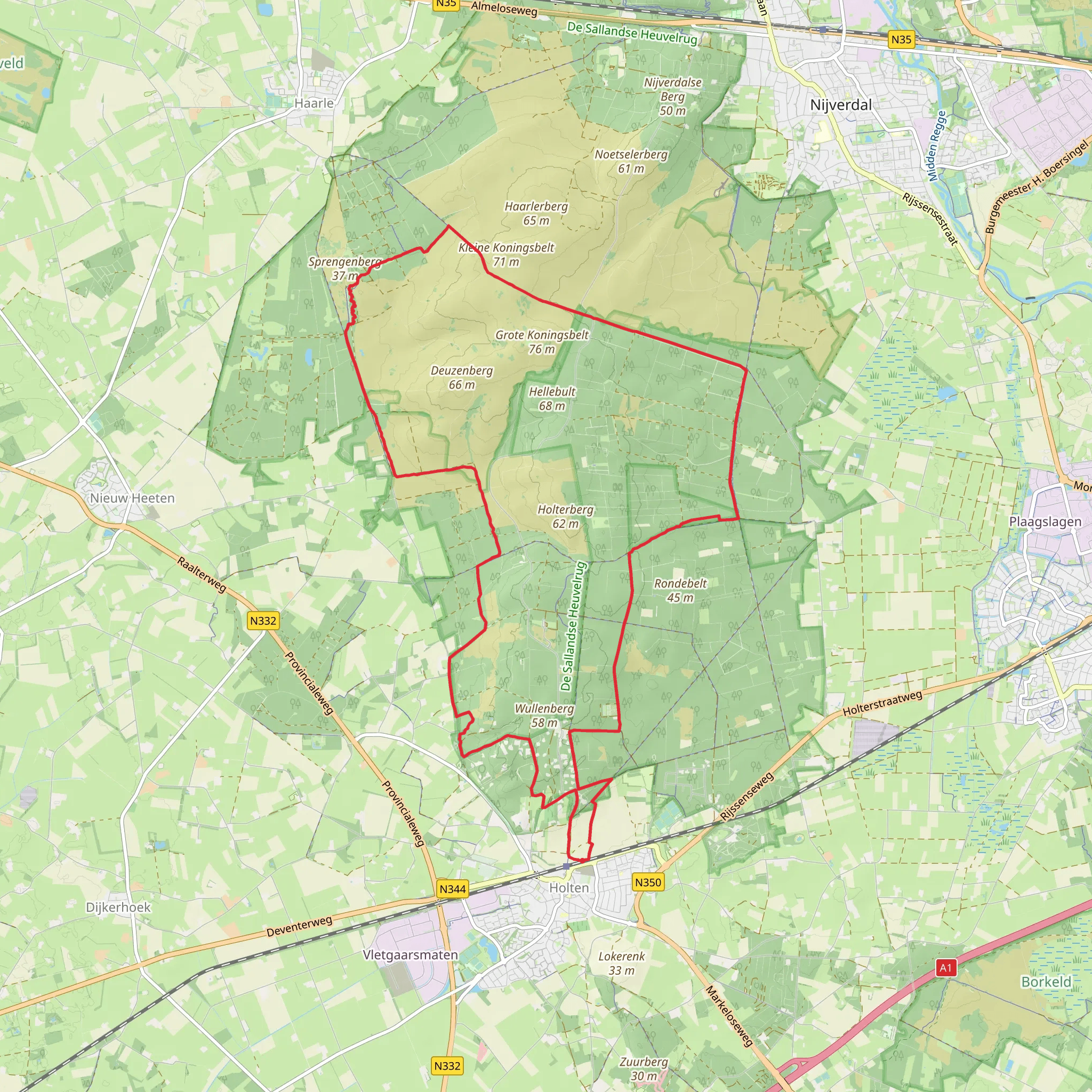
In the meantime, here’s a planning-ready description of what this loop is typically like in the Wullenberg–Sprengenberg–De Dieken area (Sallandse Heuvelrug region, Overijssel, Netherlands), written for a ~23 km / ~14.3 mi easy loop with ~100 m / ~330 ft of total ascent.
You’re looking at a long, low-relief day on sandy heathland ridges and quiet forest tracks, stitched together by wide, well-surfaced paths and narrower singletrack-like sandy lanes. The elevation gain is modest (about 100 m / 330 ft total), but the underfoot conditions can make it feel longer than the numbers suggest: expect stretches of soft sand, pine-needle duff, and occasional muddy patches in wetter months. Because the terrain is open in places, wind and sun exposure can be more noticeable than on a purely wooded walk—pack layers even for an “easy” profile.
Getting to the start (car + public transport)
By car: Trailheads in this area are commonly accessed from the villages on the flanks of the Sallandse Heuvelrug (for example around Nijverdal, Hellendoorn, Haarle, or Holten). Typical access is via small rural roads to a signed parking area at the edge of forest/heath. Once you provide the trailhead coordinates (or a HiiKER start point), I’ll convert them to the nearest named parking area or landmark and describe the exact approach roads.
By public transport: The most practical approach is usually train to Nijverdal or Holten (both have rail connections), then a short bus/taxi or a longer walk to the ridge. Buses in this region can be infrequent outside peak times, so check schedules and plan a buffer. With your exact start point, I can tell you which station is typically closest and the most straightforward last-mile option.
You’ll want to start with at least 1.5–2 L of water for most conditions (more on hot, sunny days), because services can be sparse once you’re out on the heath and forest tracks.
From the trailhead, the loop generally eases you onto broad forest paths with almost no climbing at first—ideal for settling into a steady pace. Within the first few kilometers (roughly 3–5 km / 1.9–3.1 mi), the landscape begins to alternate between darker conifer stands and brighter openings where heather and grasses take over. The “ups” here are short, rounded rises rather than sustained climbs; you’ll often gain only 10–25 m (30–80 ft) at a time before leveling out again.
As you arc toward Sprengenberg, the character becomes more “ridge-and-heath”: sandy, well-drained ground, scattered pines and birch, and wider views across the rolling moraine-like forms of the national park landscape. This is one of the best sections for spotting wildlife at a distance—keep your eyes on the edges where forest meets open heath.
Landmarks, landscape, and what to watch for
Heathland and ridge views: The Sallandse Heuvelrug is known for its heath and gently undulating ridges. In late summer, heather can color the open areas, and even outside bloom season the contrast between pale sand, green pine, and tawny grasses is striking. The “big sky” feel can make weather changes obvious—if clouds build, you’ll see it coming.
Forest tracks and sandy lanes: Expect long, runnable-looking straightaways that can still be slow if the sand is loose. If it’s been dry, sand can shift underfoot; if it’s been wet, the same sections can firm up but puddles appear in low spots.
De Dieken area: This portion is typically quieter and more enclosed, with a more intimate woodland feel. It’s a good place to slow down and listen—woodpeckers and small songbirds are common, and you may see signs of deer along the margins of the path.
Navigation: The trail network here can be dense, with many intersecting forestry roads that look similar. Load the route in HiiKER and pay attention at junctions where multiple wide tracks meet—those are the spots where people most often drift onto the wrong line.
Nature and wildlife
You’re in a mix of heath, pine forest, and patches of deciduous woodland. Common sightings and signs include: - Roe deer (often at dawn/dusk along heath edges) - Foxes (more often seen as tracks than in person) - Birdlife: woodpeckers in the forest; raptors sometimes circling above open heath - Insects: ticks can be present in grassy/heathy margins in warmer months—long socks and a quick post-hike check help.
Dogs are often required to be leashed in sensitive areas (especially where wildlife is present or during breeding seasons), and some heathland sections may have seasonal guidance—follow local signage.
Historical significance and sense of place
This landscape reflects a long relationship between people and heathland: grazing, turf cutting, and forestry shaped the mosaic you walk through today. The broader Sallandse Heuvelrug region is also known for its sandy soils and historic land use patterns that maintained open heath before modern conservation efforts
AI Planner
Days planned around your pace, with somewhere to stay each night.
Surfaces
Asphalt
Unknown
Sand
Ground
Unpaved
Concrete
Dirt
Comments and Reviews
User comments, reviews and discussions about the Wullenberg, Sprengenberg and De Dieken Loop, Netherlands.
average rating out of 5
0 rating(s)


