
Download
3D Flyover
Add to list
More
55.5 km
3 days
6 m
Multi Day
“A long, level wander through heath, pine, and pond-edged lanes—steady, scenic, and quietly demanding.”
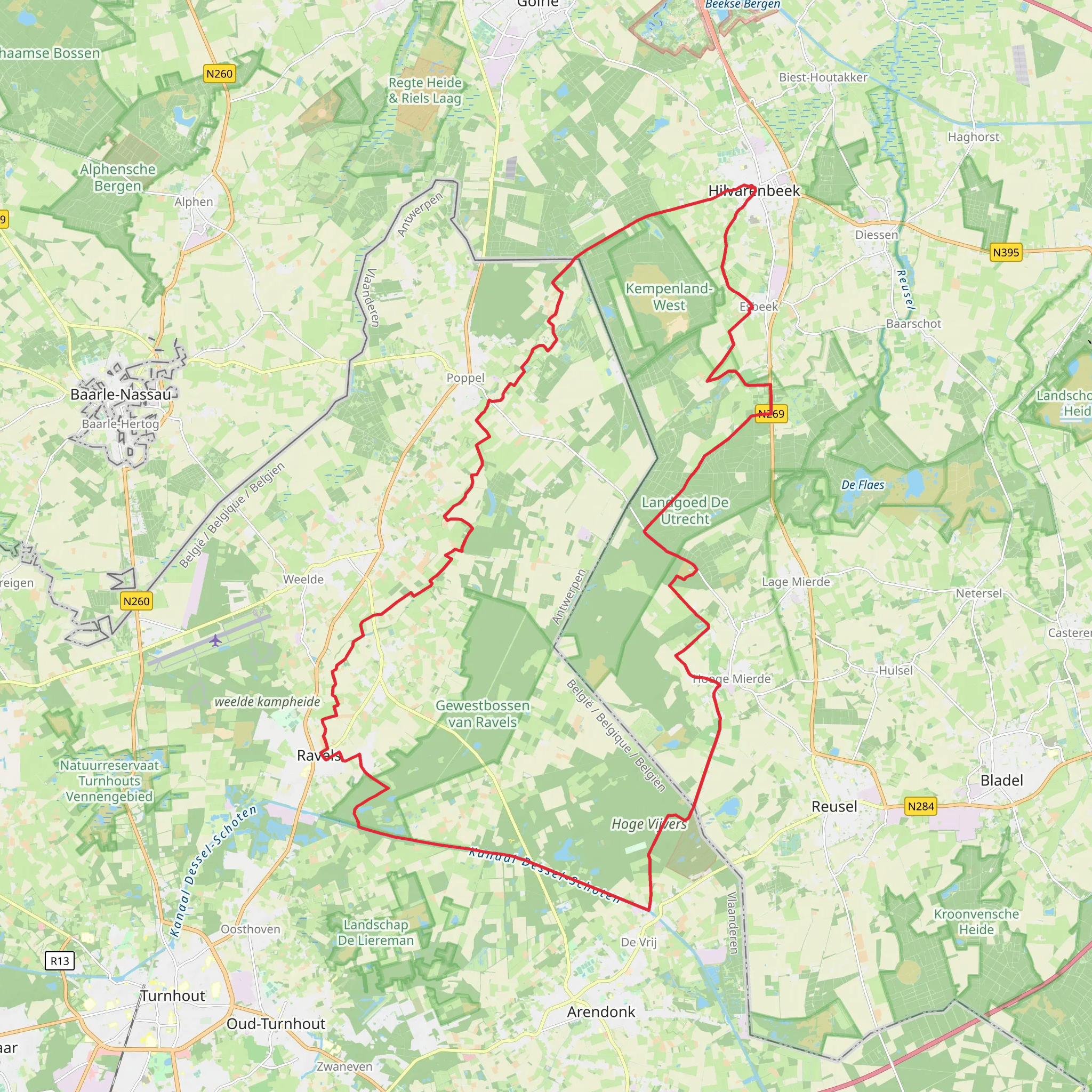
A roughly 55 km (34 mi) loop with essentially 0 m (0 ft) of climbing is a classic long, flat day out—more about steady pacing, foot care, and staying oriented through a patchwork of heath, pine woodland, estate tracks, and waterside paths than about elevation. Even with an “Easy” grade on paper, the distance makes it a big outing: most hikers will treat it as a full-day hike (10–14 hours moving time depending on pace and stops) or split it into two shorter days.
Because your start point is listed only as “near” (no coordinates or town), I can’t reliably convert the start lon/lat to a nearby address or landmark yet. If you share the start coordinates (or the nearest village/parking area you intend to use), I’ll pin it to the closest recognizable place and tailor the access notes precisely.
Getting to the start (general, until you confirm the exact trailhead)
This loop sits in the Landgoed De Utrecht / Hoge Vijvers / Roovert area on the Dutch–Belgian border region, typically approached from the Tilburg–Hilvarenbeek–Esbeek side (NL) or the Poppel / Ravels side (BE), depending on where you begin.
- By car: Expect easy driving on regional roads with multiple options for forest/estate parking areas near the De Utrecht estate and the larger pond clusters (the “Hoge Vijvers”). Parking is usually on signed estate lots or roadside pull-ins near trail access points; arrive early on weekends because these areas are popular with walkers and cyclists.
- By public transport: The most practical approach is usually train to Tilburg (NL) (major hub), then bus toward Hilvarenbeek/Esbeek and a short walk or taxi to the estate edge. From Belgium, buses toward Ravels/Poppel can also work, but service frequency can be limited—plan around weekend timetables and be ready for a longer road-walk if you choose a remote start.
If you tell me your intended start coordinates (or the name of the parking lot/café/stop), I’ll give a step-by-step public transport plan and the most sensible parking option.
You’ll want HiiKER loaded for this one: the terrain is flat and forgiving, but the network of estate roads, forestry tracks, and border-adjacent paths can create “looks-the-same” junctions where it’s easy to drift onto a parallel track and lose time.
What the route feels like underfoot
Most of the loop is on wide, firm tracks—estate gravel, compacted sand, and forest roads—interspersed with narrower footpaths near water and heath. After rain, the low-lying sections can hold water and turn into soft, churned sand or muddy edges, especially where walkers and cyclists share the same corridor.
Because the elevation gain is negligible, the main physical stressors are: - Repetitive impact over a long distance (knees/hips/feet) - Hotspots and blisters from hours on flat, sometimes sandy surfaces - Wind exposure across open heath and along pond edges - Navigation fatigue late in the day when junctions start to blur together
Plan footwear and socks for distance rather than “difficulty.” A shoe that’s comfortable at 15 km (9 mi) can become a problem at 45 km (28 mi).
Key landscapes and landmarks you’ll pass
Even without big climbs, this loop stays interesting because it stitches together distinct habitats and estate features.
Roovert: borderland woods and quiet tracks
The Roovert area is known for its woodland blocks and calmer, less built-up feel, with long straight forestry lines broken by occasional bends around wetter ground. Expect: - Pine and mixed woodland with a soft, resinous scent in warm weather - Straight estate/forestry corridors where pace can be steady but mentally monotonous—good moments to check HiiKER at junction clusters - Occasional drainage ditches and small crossings; after wet spells, edges can be slick
Wildlife is often subtle here: listen for woodpeckers, watch for roe deer at dawn/dusk, and scan sandy patches for tracks.
Hoge Vijvers: water, reeds, and birdlife
“Hoge Vijvers” (literally “high ponds”) typically refers to a cluster of larger ponds that draw walkers for the views and the birds. This is where the route often feels most “scenic,” with: - Reedbeds and open water that can be windy and cooler than the forest - Waterfowl and marsh birds—ducks, geese, coots, and (seasonally) more interesting migrants - Narrower paths near the waterline where footing can be uneven, rooty, or muddy depending on maintenance and water levels
If you’re hiking in spring or early summer, expect more bird activity and also more insects near still water—pack repellent if you’re sensitive.
Landgoed De Utrecht: estate history and managed nature
Landgoed De Utrecht is a large historic estate landscape—managed woodland, heath restoration, and long estate lanes—where the “human history” is visible in the geometry of the land: - Straight avenues and planned forestry compartments (a hallmark of estate management) - Heath and open patches that reflect long-term land use and restoration efforts - Occasional estate buildings/farms and signage that hints at the area’s landownership and management story
Historically, estates like this shaped the region through forestry, agriculture, and land reclamation,
AI Planner
Days planned around your pace, with somewhere to stay each night.
Surfaces
Unknown
Asphalt
Concrete
Paved
Unpaved
Sand
Comments and Reviews
User comments, reviews and discussions about the Roovert, Hoge Vijvers and Landgoed De Utrecht Loop, Netherlands.
average rating out of 5
0 rating(s)



