
Download
3D Flyover
Add to list
More
41.0 km
2 days
86 m
Multi Day
“A long, wind-shaped wander through Twente’s ditches, fields, and woods—best for steady all-day walkers.”
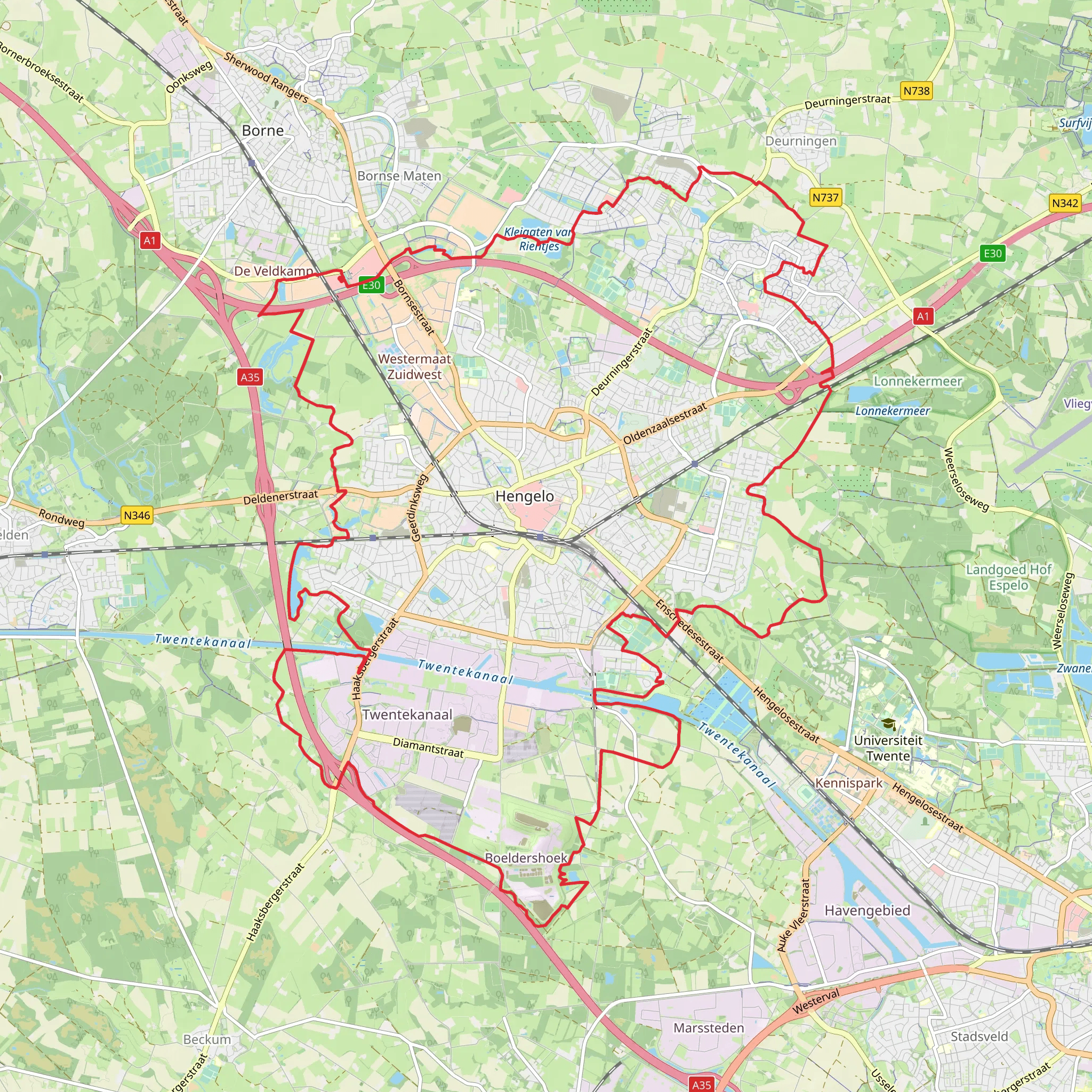
This is a long, low-relief day out through classic eastern Netherlands countryside: broad fields, drainage canals, small woods, and village edges, with almost all of the effort coming from distance rather than climbing. At around 41 km (25.5 mi) with roughly 100 m (330 ft) of total ascent, it suits hikers who are comfortable being on their feet for 8–10+ hours at an easy pace, and who can manage long stretches of flat walking where wind and weather are the main “difficulty multipliers.”
Because your start point is listed only as “near” (no coordinates provided), I can’t reliably convert the start lon/lat to a nearest address/landmark yet. If you share the start coordinate(s) (or a GPX), I’ll pin it to the closest practical landmark (often a station, church square, trailhead car park, or named nature area) and tailor the access directions precisely.
Getting to the start (practical options)
By public transport (best for a loop near Hengelo): - The most common access hub is Hengelo (Overijssel) railway station (NS services; frequent connections via the Twente rail corridor). From the station area you can usually walk a short distance to pick up quiet streets, canal paths, and field tracks that lead out toward Woolder Broek and the rural fringe. - If your intended start is instead closer to the Woolde/Woolder Broek side, local buses in the Hengelo area can shorten the “urban edge” walking. Exact lines and stops depend on the chosen start point—share coordinates and I’ll match the nearest stop.
By car: - Aim for parking near a clear, public landmark such as Hengelo station-area parking, a sports complex, or a village green on the western/southwestern edge of Hengelo where you can step straight onto quieter lanes. The best choice depends on where your loop begins; with coordinates I can suggest the closest legal parking and the cleanest “out-of-town” exit.
What the route feels like underfoot
Expect a mix dominated by paved farm lanes, cycle paths, and compacted gravel/dirt tracks along ditches and field margins. After rain, the unpaved sections can hold water—this landscape is shaped by drainage, and low spots can stay soft even when nearby paths look dry. Footwear with decent water resistance (or quick-drying trail shoes in warm months) is more important than aggressive tread.
With only about 100 m (330 ft) of ascent spread across the whole loop, any “ups and downs” are typically:
- short rises onto dikes/embankments,
- gentle ramps over bridges,
- slight undulations where paths cross older field boundaries.
Navigation and timing
Even on an “easy” profile, 41 km (25.5 mi) is long enough that small navigation errors become costly. Plan to navigate with HiiKER, and download the route for offline use before you leave built-up areas. In this kind of farmland mosaic, you’ll often encounter: - multiple parallel tracks beside the same ditch, - signed cycle routes that tempt you onto a faster surface that may diverge from your loop, - short “missing links” where a field edge path becomes a farm access road.
Build in time for pauses: a realistic moving pace for flat mixed surfaces is often 4.5–5.5 km/h (2.8–3.4 mph), but wind, wet ground, and road crossings can slow you down.
Landscape, nature, and wildlife to look for
Woolder Broek sits in a broader Twente landscape where agriculture, small woodland patches, and wet meadows interlock. “Broek” place-names commonly point to historically wet, low-lying ground, and you’ll notice the telltale features: straight drainage lines, reedier margins, and wetter pasture.
Typical wildlife and seasonal highlights: - Waterbirds along canals and ponds: mallard, coot, moorhen, and (often) grey heron; in migration periods, more variety appears on flooded fields. - Meadow birds in open pasture: lapwing and oystercatcher are common in the region (best chances in spring), though numbers vary by year and land management. - Raptors over fields: kestrels hovering and buzzards circling are frequent sights. - Amphibians in wetter ditches and shaded pools in spring. - Deer and hare are possible at dawn/dusk on quieter edges, especially where small woods meet pasture.
Stay on established paths near wet margins—ditch banks can be undercut, and the grass can hide steep drops into water.
Cultural and historical context (Twente and the Hengelo countryside)
This loop sits in Twente, a region known for its long rural continuity—farmsteads, field patterns, and small settlements that grew around workable land and water management. The flatness and the dense network of ditches and canals reflect centuries of drainage and land improvement, turning wetter ground into productive pasture and arable fields. Around Hengelo, the contrast between village-edge countryside and nearby urban/industrial development is part of the area’s modern story: Twente’s towns expanded strongly in the industrial era, while the surrounding “coulisse” (patchwork) landscape retained its hedgerows, tree lines, and small woods in many places.
On the ground, that history shows up as: - older farm lanes that run arrow-straight between parcels, - occasional historic farmsteads and roadside chapels/wayside features, - water-control structures (sluices, culverts, small bridges) that quietly define
AI Planner
Days planned around your pace, with somewhere to stay each night.
Surfaces
Asphalt
Unknown
Sand
Grass
Unpaved
Ground
Cobblestone
Gravel
Paved
Wood
Concrete
Comments and Reviews
User comments, reviews and discussions about the Woolder Broek and Hengelo Loop, Netherlands.
average rating out of 5
0 rating(s)


