Download
3D Flyover
Add to list
More
49.4 km
2 days
293 m
Multi Day
“A borderland ramble of quiet lanes, farm tracks, and woodland fringes—gentle, long, and endurance-minded.”
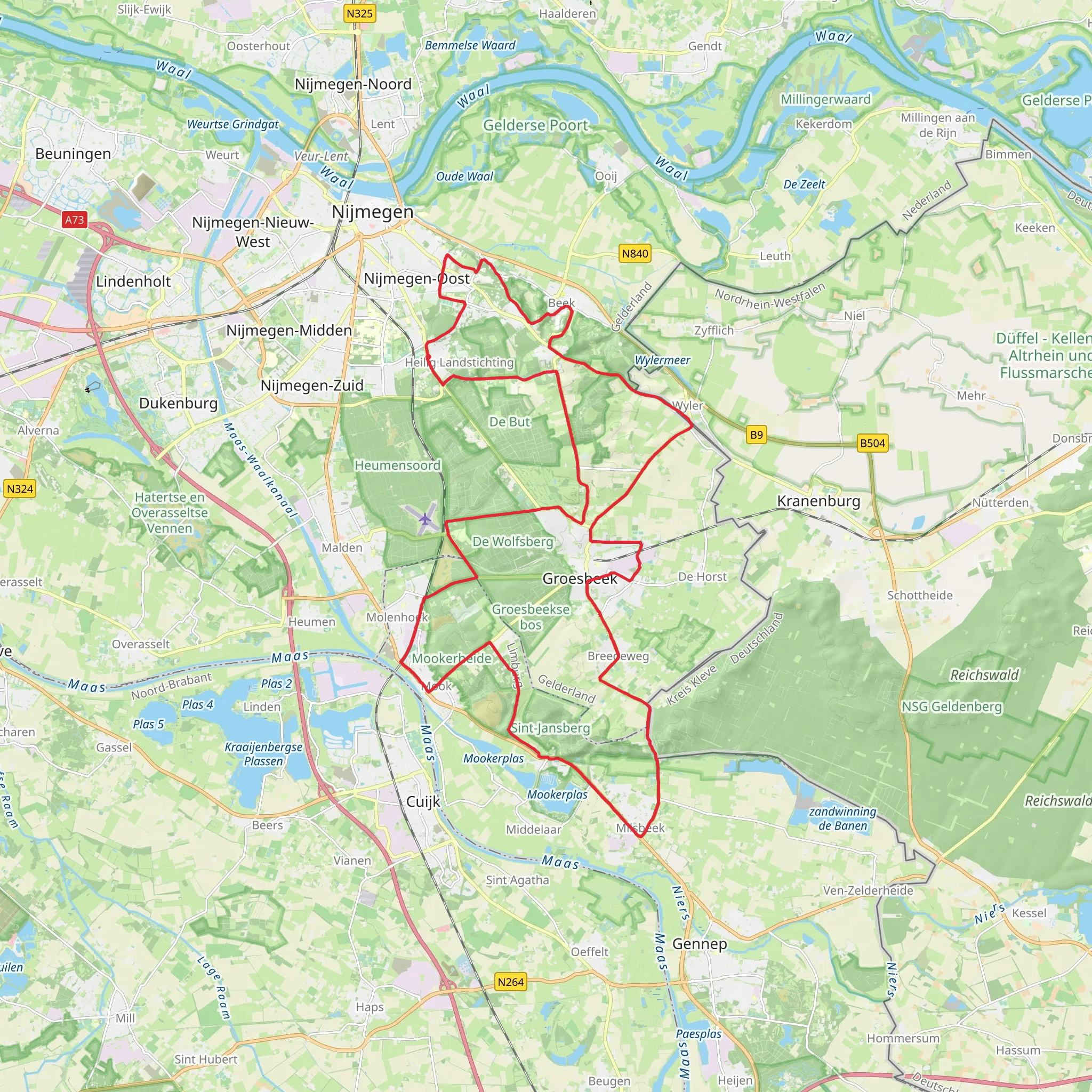
This is a long, mostly low-relief loop (about 49 km / 30.4 mi with roughly 300 m / 985 ft of total ascent) that strings together quiet lanes, farm tracks, and wooded edges typical of the Nijmegen–Groesbeek area near the Dutch–German border. Expect a steady, all-day rhythm rather than steep climbing: the “ups” are short rollers and gentle ridgelines, and the main challenge is time on feet, foot care, and staying fueled.
For a start point “near,” a practical, easy-to-find place that matches these roads is around Nijmegen (Lent) / Ooijpolder side, using a major landmark such as Nijmegen Centraal Station (for public transport access) or a nearby park-and-ride on the north/east side of the city. If you share the route’s coordinates (or a HiiKER link), I can pin the nearest specific address/landmark precisely and describe the first 1–2 km turn-by-turn.
Getting to the start (public transport + car)
- Public transport: The simplest approach is to travel to Nijmegen Centraal (major rail hub with frequent connections within the Netherlands). From there, you can typically reach the outer neighborhoods and trail-adjacent roads by local bus toward the eastern edge of Nijmegen / Groesbeek corridor, then walk a short connector to the loop.
- By car: Aim for parking on the eastern side of Nijmegen (or a designated P+R) so you’re not fighting city-center traffic at the beginning/end of a 49 km day. Choose a lot that allows long stays and doesn’t require a time disc.
What the terrain feels like
Most of the loop is firm, fast walking: paved cycle paths, quiet country roads, and compacted tracks. After rain, the unpaved stretches can turn slick—especially where leaf litter sits on clayey soil—so traction matters more than you’d expect for an “easy” profile.
- Elevation profile: ~300 m / 985 ft total gain spread across the day. You’ll notice gentle rises where the route brushes higher ground near wooded ridges and then drops back toward flatter agricultural land.
- Underfoot: A mix of asphalt, brick cycleway, and dirt/gravel. Plan for road-walking comfort (cushioning) more than mountain grip, but keep enough tread for muddy corners.
- Exposure: Wind can be a factor in open fields; shade increases where the route threads through woodland edges.
Landmarks, landscape, and what to look for
This part of Gelderland is defined by the transition between river lowlands and higher sandy ridges. You’ll move through: - Agricultural mosaics (pastures, hedgerows, drainage ditches) where you’ll often see hares, pheasants, and small raptors hunting along field margins. - Wooded patches and estate-like lanes where old tree lines and straight roads hint at historical land division and long-established travel corridors. - Borderland character: The Nijmegen region has deep historical layers—Roman-era Nijmegen (one of the oldest cities in the Netherlands) and later strategic importance due to its position near major river crossings and the German border. Even when you’re not in the city center, the surrounding road network and settlement pattern reflect centuries of movement, trade, and defense.
Wildlife is generally shy but common: - Deer can appear at dawn/dusk along woodland edges. - Waterfowl and songbirds cluster near ditches and wetter pockets. - In warmer months, expect ticks in grassy verges and woodland margins—especially if you step off the track for breaks.
Pacing, timing, and “easy” difficulty reality
Although the grade is gentle, 49 km / 30.4 mi is a serious distance. A realistic moving pace for many hikers on mixed surfaces is 4–5 km/h (2.5–3.1 mph), which puts moving time around 10–12 hours, plus breaks. Treat it like an endurance walk: - Start early enough to avoid finishing in the dark. - Plan two longer breaks (10–20 minutes) and several short “standing snacks.” - If you’re new to this distance, consider a bail-out plan: identify towns/bus stops you pass so you can shorten the day if needed (use HiiKER to mark exit points).
Navigation (HiiKER) and staying on route
Because the loop uses a web of lanes and intersecting cycle paths, the most common mistake is missing a subtle turn at a junction that looks “obvious” in the moment. - Download the route for offline use in HiiKER before you leave. - Watch for parallel paths (a cycleway beside a road, or a farm track running alongside a drainage line). Confirm you’re on the correct line whenever the route runs close to another path for more than a few hundred meters. - In open farmland, landmarks can look repetitive; use HiiKER’s distance-to-next-turn so you don’t drift past a junction.
Weather, surfaces, and seasonal considerations
- Rain: Expect puddling on farm tracks and slick leaf litter in wooded stretches. Waterproof socks or quick-drying shoes can be more comfortable than fully waterproof boots if you anticipate wet feet.
- Heat/sun: Open sections can feel surprisingly exposed. Carry sun protection and plan water stops.
- Wind: The lowlands can be breezy; a light shell makes a big difference during breaks.
Water, food, and resupply
For a
AI Planner
Days planned around your pace, with somewhere to stay each night.
Surfaces
Asphalt
Unknown
Concrete
Grass
Cobblestone
Unpaved
Gravel
Comments and Reviews
User comments, reviews and discussions about the Zevenheuvelenweg, Maldensebaan, Lindenlaan and Wylerbaan Loop, Netherlands.
average rating out of 5
0 rating(s)