Download
3D Flyover
Add to list
More
43.3 km
2 days
6 m
Multi Day
“A wind-swept, canal-threaded day of big skies, reedbed birdsong, and steady, foot-testing flatness.”
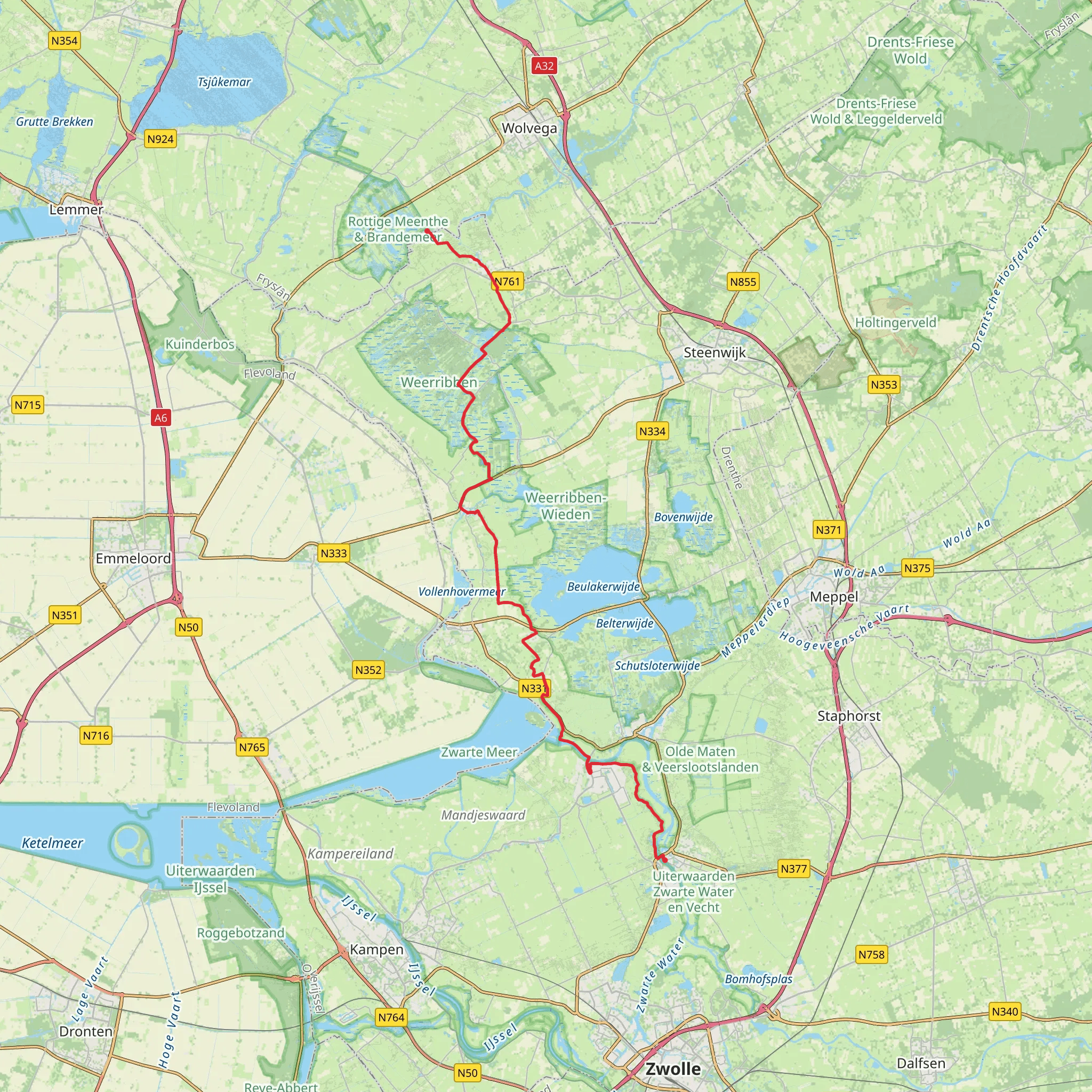
This is a long, flat, point‑to‑point walk of roughly 43 km (26.7 mi) with essentially 0 m (0 ft) of climbing, linking small canal villages, reedbeds, and open polder landscapes. Expect easy gradients but a full day on your feet: the challenge here is distance, wind exposure, and keeping your feet dry/comfortable on mixed surfaces (paved cycle paths, compacted towpaths, and occasionally softer verge sections).
Getting to the start (Hasselt) and logistics
Start area (nearest well-known landmark): the most practical “pin” for Hasselt is around Hasselt town centre / Markt (Market Square), Hasselt, Overijssel, Netherlands, near the historic core and the marina/canal edges that define the town.
- By public transport: Hasselt is typically reached via regional buses from nearby rail hubs (commonly Zwolle is the main rail gateway for this part of Overijssel). Plan your connections so you arrive early; for a 43 km day you’ll want daylight margin.
- By car: Hasselt is straightforward to reach via the regional road network around Zwolle and Zwartewaterland. Use town-centre parking (signed municipal lots) and start on foot from the Markt area.
- Finish logistics: Driewegsluis is a small hamlet/lock area rather than a big town. If you’re not arranging a pickup, check bus options in advance and be prepared for a short extra walk to the nearest larger village stop. If you’re using HiiKER, save the route offline and also mark a couple of “bail‑out” points where you can cut to a road and call a taxi.
You’ll begin in Hasselt’s lowland river-and-canal setting—this region is shaped by centuries of water management. Hasselt itself has a long trading history tied to waterways and the Hanseatic-era economy of the IJssel region; even when you’re not passing a single “big monument,” the pattern of dikes, canals, and reclaimed land is the real historical landmark.
Within the first 5–8 km (3.1–5.0 mi), the walk settles into a rhythm: straight lines, big skies, and water on one or both sides. Surfaces are usually firm, but after rain the edges can be slick—watch for muddy pinch points where walkers and cyclists have worn the verge.
As you transition onto Blokzijtseweg, you’ll notice the landscape opening further into classic polder geometry: long drainage ditches, reed fringes, and occasional farmsteads set back behind narrow access lanes. With no meaningful elevation gain, wind becomes the “hill” of the day—if it’s blowing, it can feel like constant resistance for hours. Dress in layers you can vent easily, and keep a light shell handy even in fair forecasts.
Along Blokzijtseweg: canals, polders, and long straight miles
Over roughly 10–20 km (6.2–12.4 mi) of the day, you’ll be moving through a mosaic of managed wetlands and agricultural parcels. What to look out for:
- Water edges and soft shoulders: Towpaths and canal-side tracks can undercut at the edge. Give the water a respectful buffer, especially if the ground looks cracked or slumped.
- Cyclists: Many of these corridors double as cycle routes. Walk single file when you hear bells, and be extra alert at blind corners near bridges.
- Birdlife: This is strong territory for marsh and meadow birds—expect to see and hear geese, ducks, coots, herons, and (seasonally) a variety of waders. In spring and early summer, ground-nesting birds can be present in adjacent fields; keep to the path and avoid stepping into grassy margins.
You’ll also pass frequent small bridges, culverts, and pumping infrastructure—quiet reminders that this “flat” landscape is actively engineered. The Netherlands’ water boards have been shaping areas like this for centuries; the straightness of many waterways and the regular spacing of ditches are part of that legacy.
Kalenbergerpad: reedbeds, quieter tracks, and a more “wetland” feel
As you pick up Kalenbergerpad, the character typically shifts from open polder to a more intimate wetland corridor—still flat, but with more reeds, narrower paths, and a stronger sense of being threaded between water features. This middle-to-late section often feels more sheltered, though wind can still funnel along canals.
Plan this as your “steady efficiency” segment: by now you may be 25–35 km (15.5–21.7 mi) into the day, and small issues (hotspots, damp socks, rubbing) can escalate quickly on flat terrain because you keep repeating the same stride. A few practical notes:
- Foot care: Bring blister tape and apply it early if you feel friction. Flat, repetitive walking is notorious for hotspots.
- Hydration and resupply: Villages can be spaced out. Carry enough water capacity for long gaps, and don’t assume every café/shop will be open when you pass.
- Surface changes: Watch for transitions from pavement to compacted path—your feet will feel it. If you’re in stiff-soled footwear, the hard surfaces can fatigue the legs; if you’re in very minimal shoes, the longer paved stretches can be punishing.
Wildlife-wise, reedbeds can hide a lot of movement: you may spot marsh harriers quartering low over reeds, and you’ll often hear birds before you see them. In warmer months, insects can be intense near still water—pack repellent if
AI Planner
Days planned around your pace, with somewhere to stay each night.
Surfaces
Asphalt
Unknown
Concrete
Grass
Wood
Ground
Comments and Reviews
User comments, reviews and discussions about the Hasselt to Driewegsluis Sch sl via Blokzijtseweg and Kalenbergerpad, Netherlands.
average rating out of 5
0 rating(s)