Download
3D Flyover
Add to list
More
8.3 km
~1 hrs 39 min
0 m
Point to Point
“From Grijpskerke’s ancient church to Domburg’s dune-edge sea air, walk beneath restless skies.”
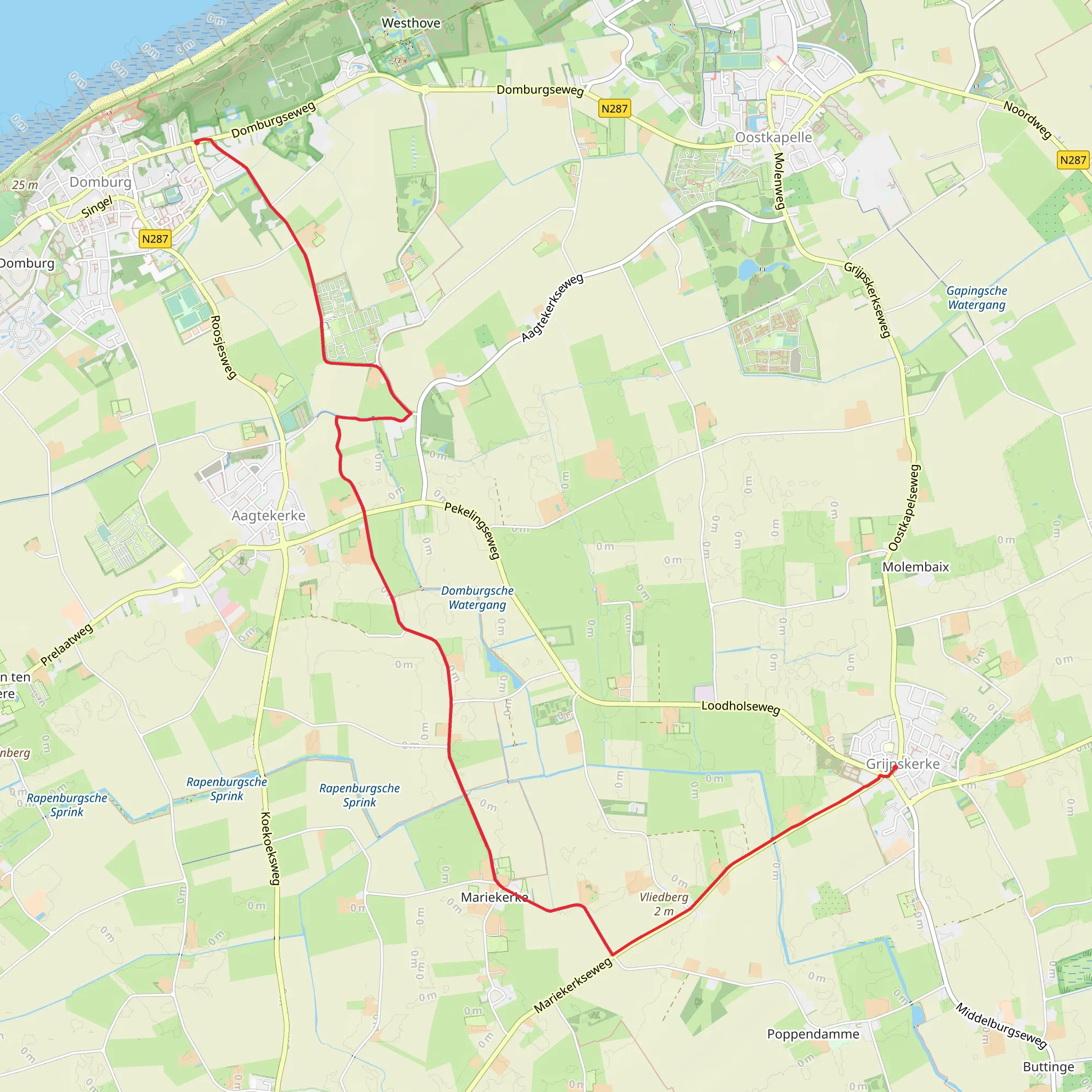
Plan on a flat, wind-exposed walk across Walcheren’s open farmland, linking the church-village of Grijpskerke with the dune-edge resort town of Domburg. At around 8 km / 5.0 mi with roughly 0 m / 0 ft of climbing, it’s an easy outing underfoot—your main “difficulty” factors are wind, rain squalls off the North Sea, and occasional narrow road verges.
Getting to the start (Grijpskerke)
By car: Aim for the village center around the Michaëlskerk (St. Michael’s Church) in Grijpskerke—this is the most obvious landmark to orient yourself in town. Grijpskerke sits on Walcheren, north of Middelburg. (If you’re using HiiKER, set your start near the village center by the church so you’re not hunting for a tiny roadside pull-off.)
By public transport: The most practical approach is usually via Middelburg Station and then a regional bus toward Grijpskerke. A commonly used stop is Grijpskerke, Oostkapelseweg (Noordstraat), which has services connecting toward Middelburg and Domburg. (drgl.nl)
(Exact timetables change seasonally—check the day-of on HiiKER and your local transit planner.)
Route character and what the walking feels like
From Grijpskerke you’ll quickly leave the compact village streets and settle into straight, low-lying polder scenery: big skies, long sightlines, drainage ditches, and fields that shift with the season (fresh green in spring, tall crops in summer, bare earth and stubble in winter). Because the land is essentially at sea level, you won’t “earn” views by climbing—you get them immediately, and they’re all about horizon, cloud drama, and changing light.
Expect a mix of: - Quiet lanes (often with limited verge) - Farm access roads - Short stretches where you may share space with local traffic
A key practical note for this specific corridor: parts of the Mariekerkseweg in/near Grijpskerke have had traffic-calming and speed-limit changes aimed at improving safety, so stay alert for chicanes, new markings, and drivers adjusting to the layout. (veere.nl)
Landmarks and local history you’re walking through
Grijpskerke is a classic Walcheren settlement with deep medieval roots. The village is documented as a parish by the late 12th century, and its Michaëlskerk contains 14th–15th century elements—a reminder that these “quiet” farm villages were established communities long before the modern coastline tourism economy. (encyclopedievanzeeland.nl)
As you head out, you’re also moving through a landscape shaped by centuries of land management, drainage, and agriculture—Walcheren’s human-made order is part of the scenery, even when it looks “natural.”
Nature and wildlife to look for (and when)
Even on a road-and-field walk, Walcheren can be lively: - Ditch lines and wet margins: watch for waterfowl and small waders; after rain, these edges become especially active. - Hedgerows and field boundaries: small songbirds, and in spring/summer plenty of insect life. - Wind conditions: strong onshore winds can push birds low over the fields; you’ll also feel the temperature drop quickly when clouds and wind combine.
Bring a light windproof layer even on mild days—near the coast, conditions can change fast.
Approaching Domburg: dunes, resort heritage, and the sea
As you near Domburg, the atmosphere shifts from agricultural quiet to a more visitor-oriented town. Domburg is widely known as Zeeland’s oldest seaside resort, with seaside tourism developing strongly from the 19th century onward. (zeeland.com)
It also has a notable cultural chapter: around **1900–
Surfaces
Unknown
Asphalt
Concrete
Comments and Reviews
User comments, reviews and discussions about the Grijpakerke to Domburg via Mariekerkseweg, Netherlands.
average rating out of 5
0 rating(s)