
Download
3D Flyover
Add to list
More
44.3 km
2 days
0 m
Multi Day
“Drift beneath vast polder skies from reed-fringed lakes to Oudewater’s old streets, wind willing.”
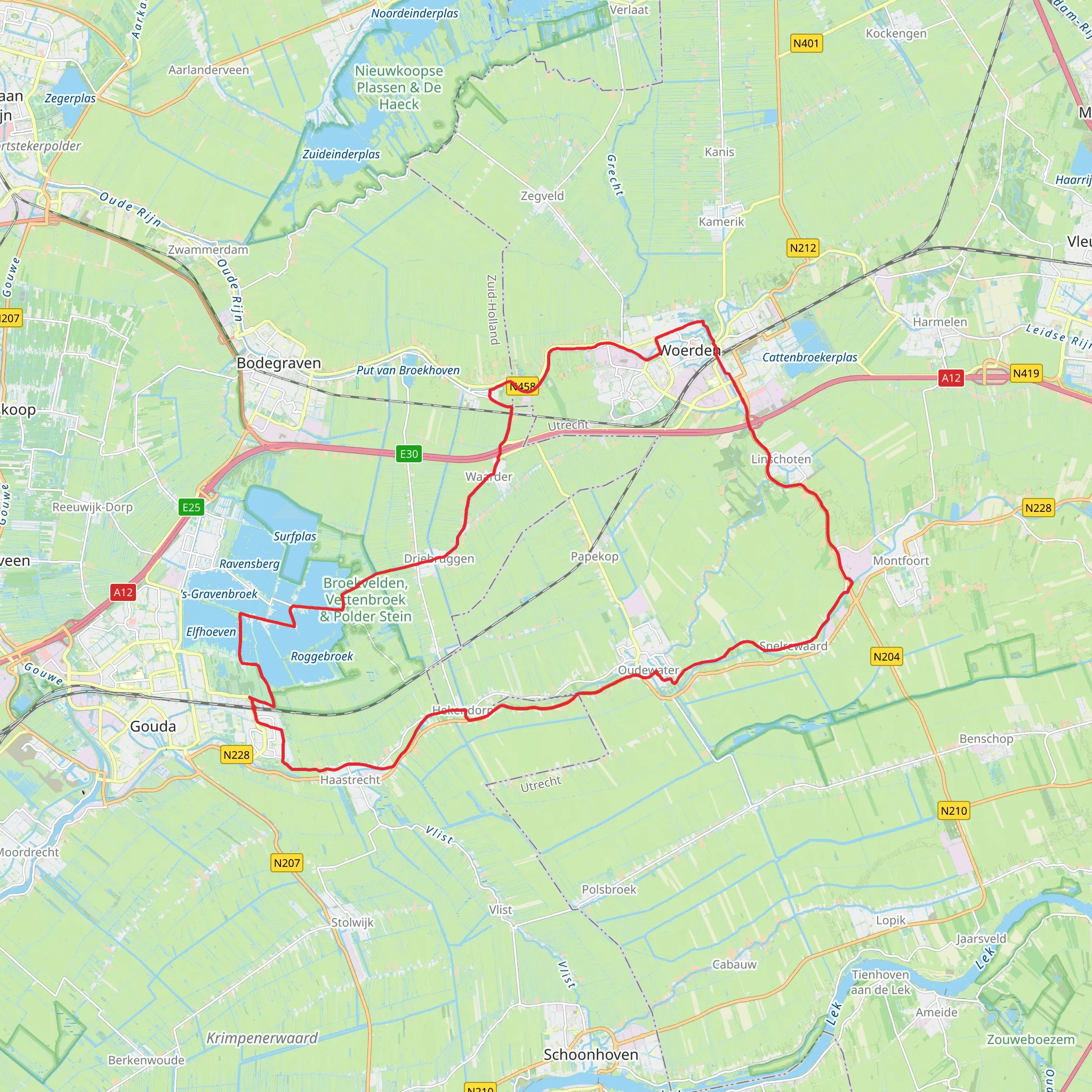
This is a long, flat, waterside loop through the Green Heart of the Netherlands: peat meadows, reedbeds, canals, and big open skies around the Reeuwijkse Plassen lake district, then on through the “Vogelkwartier” (bird-rich polder landscape) and into the historic river town of Oudewater before returning across dikes and farm tracks. At ~44 km (≈27.3 mi) with ~0 m (≈0 ft) of climbing, it’s physically more about time-on-feet, wind exposure, and firm footing than elevation.
Getting to the start (public transport + car)
Because your start is listed only as “near”, the most practical and common access point for this loop is the Reeuwijkse Plassen recreation area on the south side of Gouda—look for Reeuwijkse Hout / Surfplas (a well-known local landmark and trail hub with parking and paths along the water).
- By car: Aim for parking at/near Reeuwijkse Hout (Reeuwijkse Plassen), close to the Surfplas recreation lake. From there you can pick up waterside paths and dike-top tracks immediately.
- By public transport: The nearest major rail hub is Gouda (frequent trains from Rotterdam, Utrecht, and The Hague). From Gouda station, local buses and/or a short taxi ride can get you to the Reeuwijkse Hout/Surfplas area. If you prefer to walk in from town, it’s doable but adds distance—plan on an extra few kilometers each way depending on your exact approach.
If you share a lon/lat for the intended trailhead, I can pin it to the nearest street address or named landmark precisely.
What to expect underfoot and on the horizon - Surface: Predominantly paved cycle paths, compacted gravel, dike-top tracks, and occasional softer farm lanes. After rain, some sections can be slick with algae near water edges or muddy where tractors cut ruts. - Exposure: Very open terrain—wind can be the biggest “difficulty multiplier,” especially on long straight dikes with no shelter. - Wayfinding: The landscape is crisscrossed with canals and parallel paths that look similar. Load the route in HiiKER and keep an eye on junctions where multiple dikes meet; it’s easy to drift onto the “right-looking” path that runs one canal over.
Route flow and key sections (with approximate distances)
0–10 km (0–6.2 mi): Reeuwijkse Plassen waterside and reed margins
You’ll start with classic lake-district scenery: long, narrow peat lakes and ponds separated by strips of land, with reedbeds and willow-lined edges. Expect frequent water views and a steady rhythm of small bridges and canal crossings. Early on, the biggest hazards are simple: cyclists (often fast), narrow path edges, and slippery spots near locks and culverts.
Wildlife is a highlight here. In reedbeds and open water you’re likely to see a mix of waterfowl (ducks, geese, grebes), and in the broader polder skies, raptors and corvids riding the wind. Dawn and dusk are especially active times, but even midday you’ll usually have constant bird movement.
10–22 km (6.2–13.7 mi): Vogelkwartier polder lines—big skies, straight dikes, and “quiet miles”
This middle stretch is where the loop earns its distance: long, flat connectors through agricultural polders with drainage canals, pumping infrastructure, and wide horizons. The “Vogelkwartier” name fits—these open meadows and wet fields are prime habitat for meadow birds and migratory species, and you’ll often hear more than you see at first.
Plan for: - Wind management: If a headwind kicks up, your pace can drop noticeably. Consider a slightly more conservative early pace so you don’t burn energy fighting the wind later. - Foot comfort: Flat routes can still punish feet—repetitive stride on hard surfaces can cause hot spots. Bring blister care and consider cushioned insoles if you’re sensitive to long pavement stretches. - Limited services: Outside towns, options can be sparse. Carry enough water and snacks to cover at least 2–3 hours between reliable stops.
22–30 km (13.7–18.6 mi): Approaching Oudewater—canals, bridges, and the first “town energy”
As you near Oudewater, the landscape gradually shifts from pure polder to a more built-up canal network with more frequent crossings and signage. You’ll likely pass small locks, pumping stations, and classic Dutch water-management features—this region’s entire character is shaped by centuries of controlling water levels in reclaimed peatlands.
Oudewater itself is the psychological midpoint/turning point for many hikers: it’s a good place to plan a longer break, refill water, and grab food.
Oudewater: historical significance to look for
Oudewater is one of those compact Dutch towns where history is visible in the street pattern and waterways. It’s widely associated with the Heksenwaag (Witch Weighhouse)—a famous symbol of the era when witch trials and accusations spread across Europe. Oudewater became known for fair weighing practices, and the weighhouse remains a key landmark tied to that story. Even if you don’t go inside, passing through the historic center gives you a strong sense of the region’s trading and civic past, built around waterways and commerce.
**30–44 km (18.6–27.3 mi): Return leg—dikes back
AI Planner
Days planned around your pace, with somewhere to stay each night.
Surfaces
Asphalt
Unknown
Cobblestone
Wood
Paved
Concrete
Comments and Reviews
User comments, reviews and discussions about the Reeuwijkse Plassen, Vogelkwartier and Oudewater Loop, Netherlands.
average rating out of 5
0 rating(s)



