
Download
3D Flyover
Add to list
More
60.5 km
3 days
0 m
Multi Day
“A big-sky polder loop from Gouda’s canals to reed-fringed peat lakes—flat, wind-exposed, endurance-heavy.”
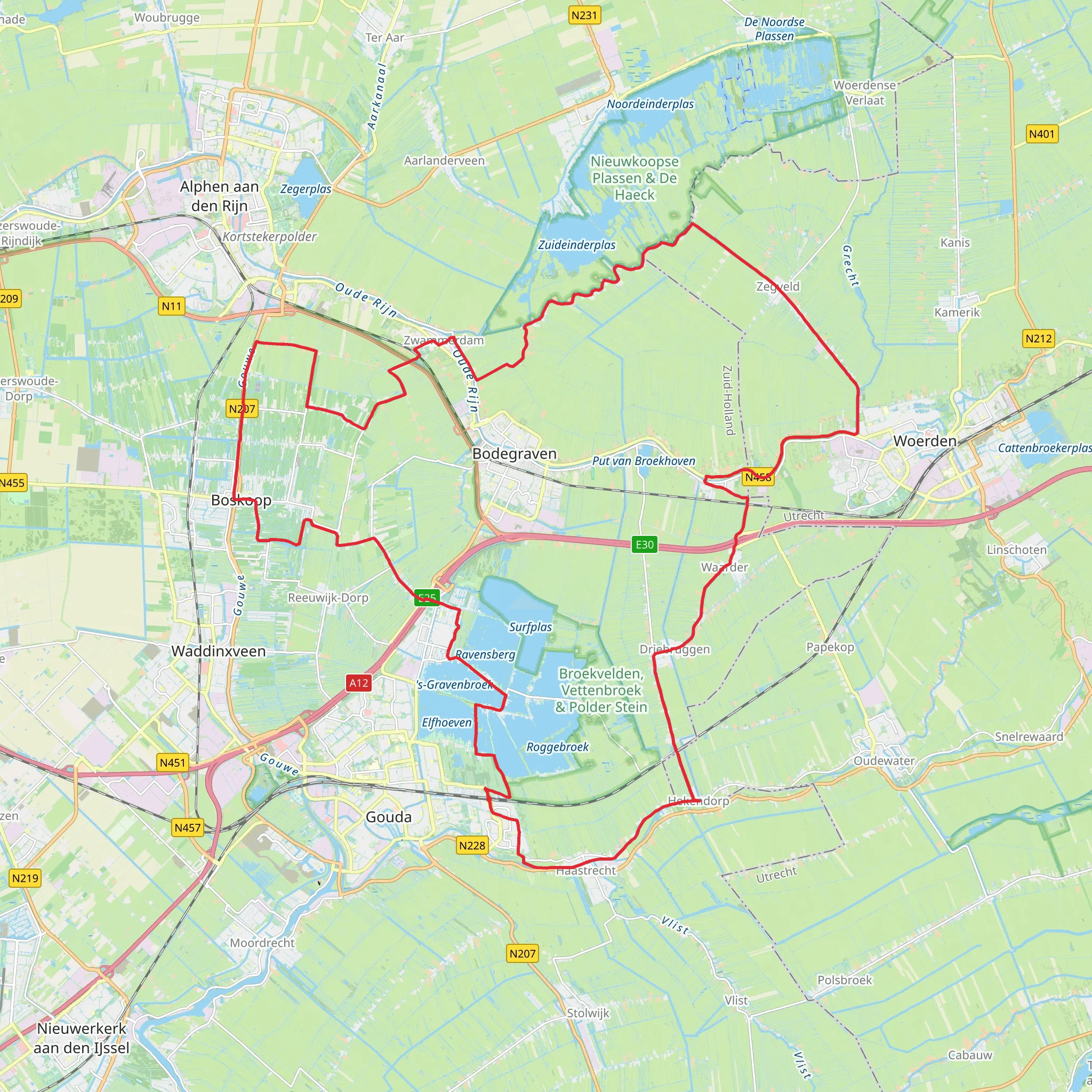
This is a long, low-lying loop through the Green Heart of the Netherlands, linking the peat-lake landscape of the Reeuwijkse Plassen with the open polder and meadow-bird country around Zegvelderbroek. Expect a near-flat day (or two) of walking—about 60 km / 37 mi with roughly 0 m / 0 ft of climbing—on a mix of paved dike paths, farm lanes, canal towpaths, and occasional gravel/grass tracks. The “difficulty” is easy in terms of elevation and technical footing, but the distance makes it a serious endurance outing, and wind/rain exposure can be the main challenge.
Getting to the start (public transport + car)
Because the start point is listed only as “near,” the most practical and well-connected place to begin for this loop is Gouda, Netherlands, using the city as your access hub. A reliable, easy-to-find start landmark is:
- Gouda Railway Station (Stationsplein, 2801 AK Gouda, Netherlands) — a major rail node and a sensible place to begin/end a big loop.
By public transport - Take a train to Gouda (frequent services from Rotterdam, Utrecht, and The Hague). From Gouda Station, you can walk directly into the canal network and out toward the Reeuwijkse Plassen without needing a bus.
By car - Park in/near central Gouda (paid garages and street parking are common) or use a Park & Ride option on the edge of town, then walk to the station area to start. If you prefer to start closer to the lakes, aim for the Reeuwijk-Brug / Reeuwijk-Dorp area (small village access), but parking there can be more limited and local.
If you’re building the route in HiiKER, set your start waypoint at Gouda Station (or a chosen lakeside access point) and confirm any short private-property diversions before you go.
What the terrain feels like (and why “0 m gain” still matters)
This is classic Dutch polder walking: the land is engineered flat, and the “ups and downs” are mostly tiny dike crests, bridge ramps, and underpasses that don’t add meaningful elevation gain. The real effort comes from: - Distance: 60 km / 37 mi is long even on easy footing. - Exposure: wide-open fields and lakes mean wind can be relentless. - Surface repetition: long straight dikes and towpaths can be mentally and physically monotonous—good shoes and pacing matter.
Plan on 10–14 hours of moving time for most hikers depending on breaks and conditions; many people split it into two days.
Route character and key sections (with approximate distances)
Distances below are approximate and depend on the exact loop line you choose around the lakes and through the polders.
1) Gouda to the Reeuwijkse Plassen (about 8–12 km / 5–7.5 mi) Leaving Gouda, you quickly trade city streets for canals, ditches, and low dikes. The landscape starts to open, and you’ll notice: - Narrow waterways with reed fringes - Farmsteads and pasture on soft peat soils - Frequent cycle traffic on shared paths—stay alert and keep right
2) Around the Reeuwijkse Plassen (about 18–25 km / 11–15.5 mi) The Reeuwijkse Plassen are a chain of peat lakes formed largely by historical peat extraction. The walking here is defined by water on multiple sides, small marinas, and reedbeds. Look out for: - Reed-lined shorelines and wet woodland pockets - Waterfowl: grebes, coots, moorhens, various ducks; in migration seasons you can see large mixed flocks - Raptors over open fields (kestrels are common in this kind of country)
You’ll pass viewpoints where the lakes feel surprisingly “big-sky” for such a densely populated region. In warm months, expect more recreational activity (boats, anglers, swimmers) and busier paths.
3) Transition into Zegvelderbroek polder country (about 15–20 km / 9–12.5 mi) As you arc away from the lakes, the route becomes more agricultural and expansive. Zegvelderbroek is known for open meadow landscapes and drainage canals—prime habitat for classic Dutch meadow birds. Depending on season, you may hear or spot: - Lapwing, oystercatcher, godwit (especially spring/early summer) - Geese grazing in fields in cooler months - Herons stalking ditches year-round
This section can feel the most exposed. If the wind is up, it’s worth planning your food/water stops so you’re not forced into long breaks in the open.
4) Return leg toward Gouda (about 10–15 km / 6–9 mi) The final stretch typically follows straighter canal lines and farm roads back toward the city edge. Fatigue is the main hazard here—foot care and steady fueling become more important than navigation.
Landmarks, nature, and what to watch for
Peat lakes and water management This region is a living example of Dutch water engineering. The lakes and polders exist because of centuries of peat cutting, land subsidence, and the ongoing need to manage water levels. You’ll see: - Dikes and drainage canals everywhere - Pumping stations (some modern, some older structures) that keep the
AI Planner
Days planned around your pace, with somewhere to stay each night.
Surfaces
Unknown
Asphalt
Paved
Wood
Concrete
Comments and Reviews
User comments, reviews and discussions about the Reeuwijkse Plassen and Zegvelderbroek Loop, Netherlands.
average rating out of 5
0 rating(s)



