Download
3D Flyover
Add to list
More
23.2 km
~4 hrs 39 min
6 m
Point to Point
“Under wide Maas skies, follow dikes and towpaths from Gennep to Grave in unhurried calm.”
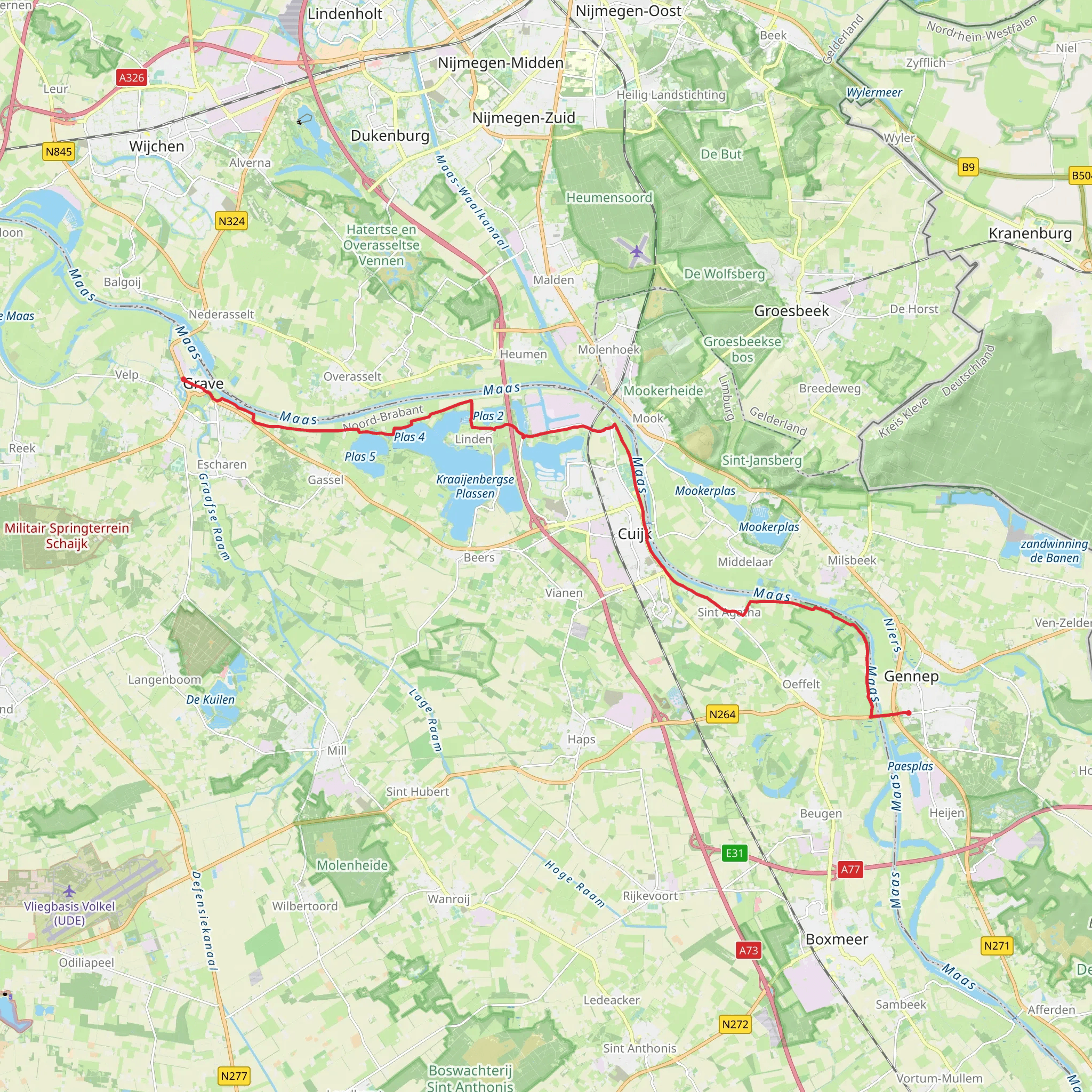
This is a classic lowland river-walk through the Maas (Meuse) valley: flat, open skies, long views over floodplains, and a steady rhythm of dikes, towpaths, and quiet lanes linking small Dutch towns. At around 23 km / 14.3 mi with roughly 0 m / 0 ft of climbing, it’s best planned as a point‑to‑point day hike with plenty of options to shorten if weather turns.
Getting to the start (Gennep)
By train + bus: The most straightforward approach is to travel by rail to Nijmegen or Venlo, then connect by regional bus to Gennep. In Gennep, aim for the town center near Markt (Market Square), Gennep—a practical “pin” for meeting, supplies, and starting on foot.
By car: Park in or near central Gennep (look for public parking around Markt, Gennep or near the historic center). Because this is a point‑to‑point route, it’s often easiest to leave a car at the finish in Grave (near the center by the riverfront) and shuttle back by bus/taxi, or use public transport for one end.
Navigation: Load the route in HiiKER before you go. Even on flat terrain, the density of dike paths, farm tracks, and small road crossings can make it easy to drift onto a parallel path.
What the walk feels like (surface, exposure, and pacing)
Expect mostly paved cycle paths, compacted gravel, and grassy dike tops, with occasional short stretches of quiet asphalt lanes. Because you’re in open river country, wind is the main “difficulty multiplier”—a calm day feels effortless; a headwind can make the same distance feel much longer.
Plan your pacing around 23 km / 14.3 mi: - Comfortable all‑day pace: 5–6 hours of walking time (not counting stops) - Add time for cafés, viewpoints, and any detours to riverbanks or town centers.
Footwear can be light hikers or trail runners in dry conditions; after rain, the grassy sections along dikes and field edges can turn slick and muddy.
From Gennep out into the Maas valley (0–7 km / 0–4.3 mi)
Leaving Gennep, you’ll quickly transition from town streets to the river landscape—broad floodplains, drainage channels, and long straight lines typical of managed Dutch waterways. The terrain is essentially level, so the early kilometers are ideal for settling into a steady cadence.
Landmarks and local character - Gennep sits in a region shaped by centuries of river management and borderland history. The Maas corridor has long been a strategic and commercial route, and many towns here developed around crossings, trade, and later defensive works. - You’ll likely pass small bridges, sluices, and pumping infrastructure—subtle but important features that keep the surrounding land workable.
What to look out for - Cyclists: Many dike paths double as popular cycle routes; keep right and expect fast overtakes. - Livestock: Cattle and sheep grazing is common in floodplain areas; give animals space and close any gates behind you.
Liefkeshoek and the quiet middle miles (7–16 km / 4.3–10 mi)
Around the Liefkeshoek area, the walk typically becomes more rural and spacious—fields, hedgerows, and watercourses with fewer buildings. This is the most “nature-forward” portion: you’re moving through a mosaic of farmland and riverine habitat.
Nature and wildlife
You’re in prime habitat for common Maas-valley species: - Birdlife is the headline: expect geese, ducks, coots, herons, and (in open fields) buzzards and kestrels. In spring and autumn migration periods, numbers can be noticeably higher. - Along wetter edges and reedier ditches, listen for warblers and watch for sudden movement in the margins—small mammals and amphibians are present but often hidden. - In warm months, bring insect protection; mosquitoes and midges can be persistent near still water and sheltered ditches.
Terrain and comfort notes
- Shade can be limited. On sunny days, this section feels hotter than the temperature suggests because of reflected light off water and pale paving.
- After heavy rain, the “green” options (grassy dike tops, field-edge tracks) can be softer underfoot than the paved alternatives—HiiKER is useful for confirming you’re on the intended line when multiple parallel tracks appear.
Approaching Grave: river views and historic edges (16–23 km / 10–14.3 mi)
As you near Grave, the landscape starts to feel more “settled” again—more buildings, more structured paths, and a stronger sense of arriving somewhere with a distinct historic identity.
Grave is known as a fortified river town, and the Maas has historically been both a lifeline and a defensive barrier here. Even if you don’t detour deeply into the center, you’ll notice the town’s relationship with the river: embankments, crossings, and the way streets and paths orient toward the water.
Finish logistics - The most convenient end point is typically near Grave town center (around the main square/riverfront area), where you’ll have access to cafés, shops, and bus connections. - If you’ve parked a car here, it’s an easy walk from the river-adjacent paths into town.
Practical planning: food
AI Planner
Days planned around your pace, with somewhere to stay each night.
Surfaces
Asphalt
Unknown
Paved
Grass
Gravel
Concrete
Sand
Comments and Reviews
User comments, reviews and discussions about the Gennep to Grave via Liefkeshoek, Netherlands.
average rating out of 5
0 rating(s)