
Download
3D Flyover
Add to list
More
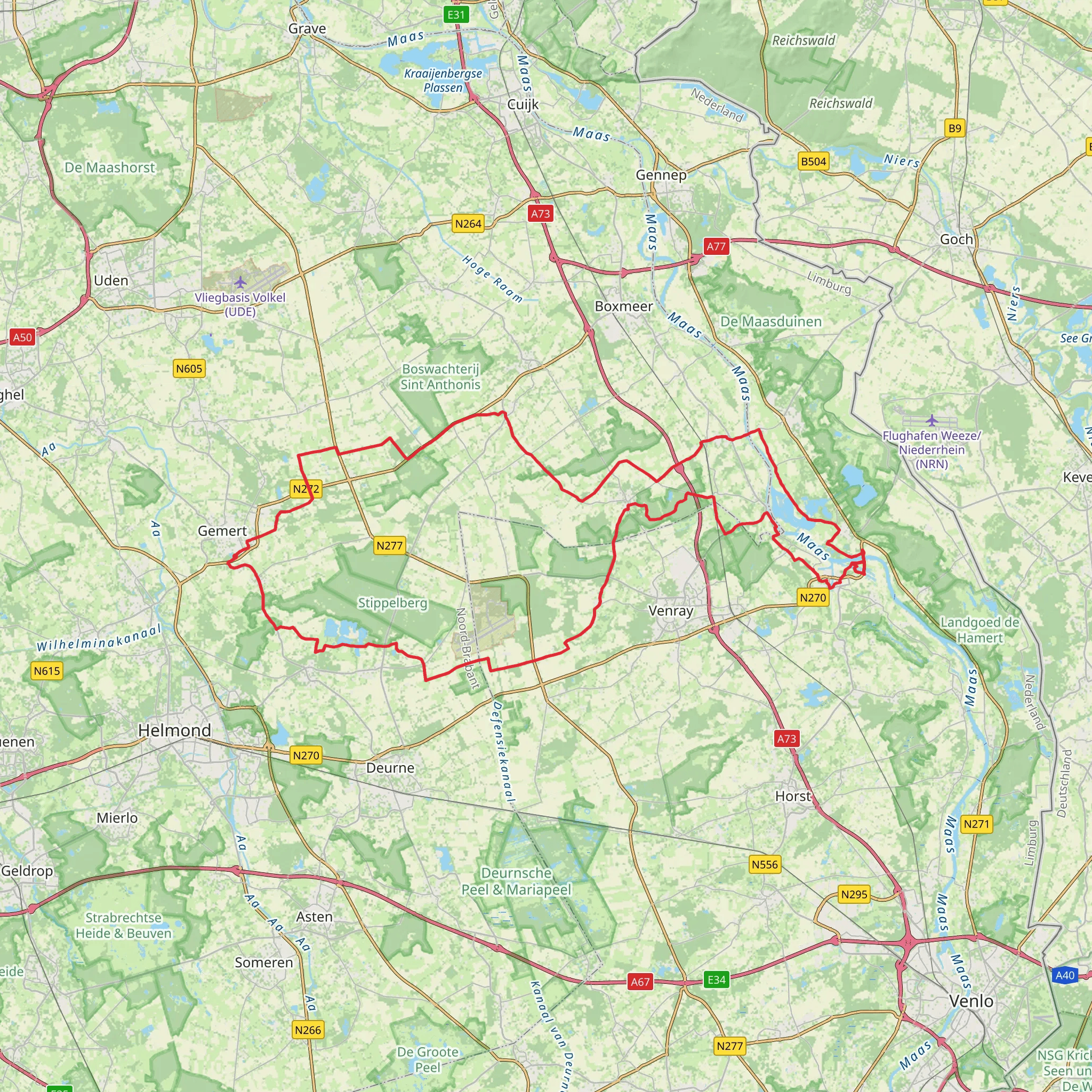
92.4 km
4 days
12 m
Multi Day
“A long, low-lying Dutch loop through pine-scented dunes, canals, and villages—best for steady endurance.”
This is a long, low-relief loop of roughly 92 km (57 miles) with ~0 m / ~0 ft of total climbing—more of an endurance day (or comfortable 2–3 day outing) than a “hill” hike. Expect a classic Dutch mix of pine-and-heath dune country, canal/harbor edges, farm lanes, and village connectors, with frequent opportunities to resupply.
Because your start point is listed only as “near” (no coordinates or town), I can’t reliably convert lon/lat to a nearest address or landmark yet. If you share the start coordinates (or the nearest village), I’ll pin it to the closest recognizable place (e.g., a station, church square, parking area, or named trailhead) and tailor the transport directions precisely.
Getting to the start (car + public transport)
By car (typical approach for this region): - Most long loops in the Overloonsche Duinen / Overloon area (North Brabant) are easiest by parking near a village edge where there’s all-day parking and quick access to sandy tracks. Common “anchor” places in the area are village centers, sports parks, or larger visitor car parks near nature reserves. - If you tell me the intended start village (or coordinates), I’ll suggest the most practical parking option and what to enter into navigation.
By public transport (typical approach): - The Netherlands’ bus network usually provides the last-mile connection from a rail station to villages around the dunes. A common pattern is train to a larger hub (e.g., Venray / Boxmeer area depending on your exact start), then bus to Overloon or nearby villages, then a short walk to the loop. - Share your start point and I’ll map the cleanest connection and the likely walking distance from the stop.
What the terrain feels like over 92 km
Even with negligible elevation gain, this route won’t feel “flat” underfoot the whole time: - Dune sands and pine-needle singletrack can be energy-sapping, especially if sections are loose or dry. - Hard-packed cycle paths, dike-top lanes, and farm roads will feel fast but can be repetitive—good for steady pacing. - Expect frequent junctions and parallel tracks in dune forests; this is where HiiKER is most useful for staying on the intended line when multiple sandy options look identical.
Plan your day around surfaces: - If you’re doing it in one push, the sandier dune segments are best tackled earlier while legs are fresh. - If you’re splitting it, aim to end a day near a village with lodging and food rather than deep in the dunes.
Nature, landscapes, and what to look for
Overloonsche Duinen is the headline environment: a patchwork of wind-shaped inland dunes, heath, and conifer plantations that were historically stabilized to reduce drifting sands. You’ll likely move through: - Pine and mixed woodland: sheltered, aromatic, and often quiet except for birds. - Heath and open sandy clearings: big skies, long sightlines, and the most “dune-like” feel. - Wet edges (ditches, small ponds, or low-lying seep areas): these can be subtle but add biodiversity.
Wildlife you may encounter (often more by sign than by sight): - Roe deer are common in wooded dune landscapes—most active at dawn/dusk. - Foxes and small mustelids are possible, especially near quieter edges. - Birdlife can be excellent: woodpeckers in mature stands; buzzards/kestrels over open heath; songbirds in scrub. - In warmer months, expect insects (including ticks in grassy/heathy margins). Long socks and periodic checks help.
Landmarks and human geography along the loop
With place names like Bakelse Plassen, Voorhaven, and Stiching in the title, the loop likely stitches together several distinct “chapters”: - Plassen (lakes/ponds) sections tend to be calmer, with reed edges and waterfowl potential. These are good spots for a longer break—just be mindful of soft verges and private shoreline boundaries. - Voorhaven (fore-harbor) implies a more built, working-waterfront feel—expect quays, industrial edges, moored boats, and wind exposure. These stretches can be surprisingly tiring in headwinds despite being flat. - Foundation (“Stichting”) references often point to land managed by a conservation or heritage organization. Where management is active, you may see grazing projects, fenced restoration plots, or signed nature corridors.
If your loop passes through or near Overloon, there’s notable regional history tied to World War II. The area is associated with heavy fighting in 1944 (the Battle of Overloon) and remembrance culture in the region. Even if the route doesn’t directly visit a museum site, you may notice: - Memorial markers, small monuments, or interpretive signs - A landscape that, while peaceful now, sits within a historically significant corridor of wartime movement and reconstruction
Navigation and pacing (especially important on a 92 km loop)
- Use HiiKER to keep a close eye on track splits in dune forest—many intersections are unsigned or signed for different networks (walking, cycling, horse routes).
- On long straight cycle paths, it’s easy to drift into autopilot and miss a turn onto a narrower connector. Set HiiKER alerts (or check at every junction) so you don’t donate extra kilometers late in
AI Planner
Days planned around your pace, with somewhere to stay each night.
Surfaces
Asphalt
Unknown
Concrete
Ground
Cobblestone
Paved
Comments and Reviews
User comments, reviews and discussions about the Bakelse Plassen, Overloonsche Duinen, Voorhaven and Stiching Loop, Netherlands.
average rating out of 5
0 rating(s)


