Download
3D Flyover
Add to list
More
35.6 km
2 days
33 m
Multi Day
“An expansive big-sky polder loop of dikes, reeds and sluices—flat, breezy, and quietly demanding.”
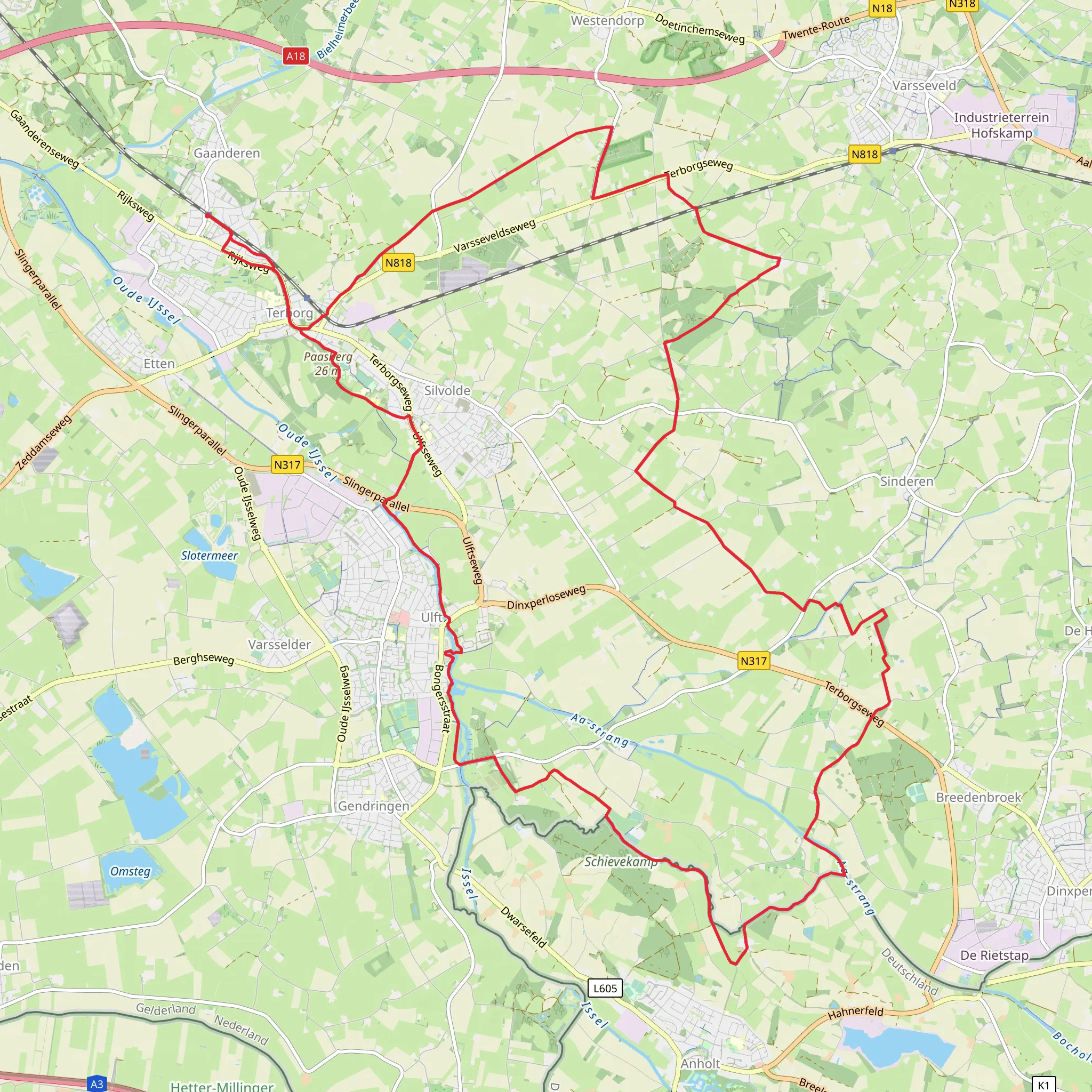
A flat, big-sky loop through classic Dutch polder country: long straight dikes, reed-lined canals, wide pastureland, and a steady rhythm of bridges, sluices, and small waterside settlements. With roughly 36 km / 22.4 mi and essentially 0 m / 0 ft of climbing, the challenge here isn’t steepness—it’s distance, wind exposure, and staying comfortable on hard, level surfaces for most of a day.
Getting to the start (car + public transport)
Because the start point is listed only as “near” (no coordinates or town provided), the most reliable way to pinpoint the exact trailhead is to open the route in HiiKER and use its start-point pin. Once you share the lon/lat (or a HiiKER link), I can convert it to the nearest street address or a recognizable landmark (for example, a specific sluice/lock complex, bridge, windmill, church, or rail/bus stop) and tailor the directions precisely.
By car (typical approach for polder loops): - Expect roadside pull-offs, small village car parks, or parking near a lock/bridge. In these landscapes, parking is often limited and shared with locals—arrive early if you’re starting near a popular waterside spot. - Watch for narrow dike roads with passing places; drive slowly and yield to farm traffic and cyclists.
By public transport (common pattern in the Netherlands): - These loops are often easiest by train/bus to a nearby town, then a short walk to the dike/canal network. - If the start is near a small hamlet, the last leg may be a regional bus with less frequent service—check the timetable for your return time so you’re not stranded after a long day.
If you provide the start coordinates, I’ll identify the closest station/stop and the most straightforward walking approach.
What the route feels like underfoot
You’ll likely alternate between: - Dike-top paths (open, breezy, panoramic) - Canal-side tracks (often gravel or compacted dirt) - Farm access lanes (paved or brick in places) - Occasional short village segments (quiet streets, bridges, and small harbors/sluices)
Even with “easy” terrain, plan for 6.5–9 hours depending on pace and breaks. The flat profile can tempt people to start too fast—steady pacing matters more than you’d think on a 36 km day.
Landmarks and the “water engineering” story
The names on this loop—Koeningspad and Oversluis—strongly suggest a route shaped by water management infrastructure: - An “oversluis” is typically a sluice/lock or overflow structure—expect a notable crossing where water levels are controlled between canals, polders, or waterways. - Dikes, sluices, and drainage canals are not just scenery here; they’re the reason the landscape exists in its current form. Much of the Netherlands’ polder countryside was made workable through centuries of reclamation, drainage, and flood control, with later modernization (pumping stations, reinforced dikes, improved locks) building on older systems.
On the ground, that history shows up as: - Lock gates and control houses (often small, utilitarian buildings) - Weirs and culverts under the path - Straight drainage channels laid out in a grid - Occasional older brickwork around bridges/sluices hinting at earlier construction phases
If your HiiKER route passes a named lock complex or pumping station, it’s often worth a short pause—these are the “cathedrals” of the polder.
Nature, wildlife, and what to look for
This is a human-shaped ecosystem, but it’s lively—especially along reedbeds and wet margins.
Birdlife (most likely highlights): - Geese and ducks in fields and canals year-round - Herons and egrets stalking ditches - Marsh and reedbed birds where vegetation is dense - Raptors (kestrels, buzzards) hovering over open pasture In spring and early summer, you may also see ground-nesting birds in open fields; stay strictly on the path and keep noise low near reed edges.
Mammals and smaller wildlife: - Hares and rabbits in field margins - Water voles/muskrats (depending on local control efforts) and plenty of amphibians near still water - In some regions, grazing cattle or sheep may be used for dike management—give them space and pass calmly.
Plants and landscape cues: - Reeds, sedges, and willow along wetter stretches - Open pasture with drainage ditches every few meters - Seasonal wildflowers on dike verges (where mowing regimes allow)
Key challenges on a “flat and easy” 36 km loop
Wind and exposure
Dikes and open fields mean little shelter. A moderate headwind can turn the second half into a grind. - Bring a windproof layer even on mild days. - Consider gloves in cooler seasons; wind chill is real on exposed embankments.
Surface fatigue
Flat doesn’t mean gentle on the body. Long stretches of firm track or pavement can stress feet, knees, and hips. - Cushioned trail shoes or light hikers work well. - Plan sock management (dry pair in the pack) and blister prevention.
Water
AI Planner
Days planned around your pace, with somewhere to stay each night.
Surfaces
Asphalt
Unknown
Ground
Concrete
Sand
Unpaved
Paved
Comments and Reviews
User comments, reviews and discussions about the Idinkweg, Koeningspad and Oversluis Loop, Netherlands.
average rating out of 5
0 rating(s)