Sprielderbos, Houtdorper en Speulderveld and Leuvenumse Bos via Leuvenumseweg and Poolseweg
Download
3D Flyover
Add to list
More
102.2 km
4 days
77 m
Multi Day
“A Veluwe woodland odyssey—sandy lanes, beech-shadowed “green tunnels,” and navigation that tests patience.”
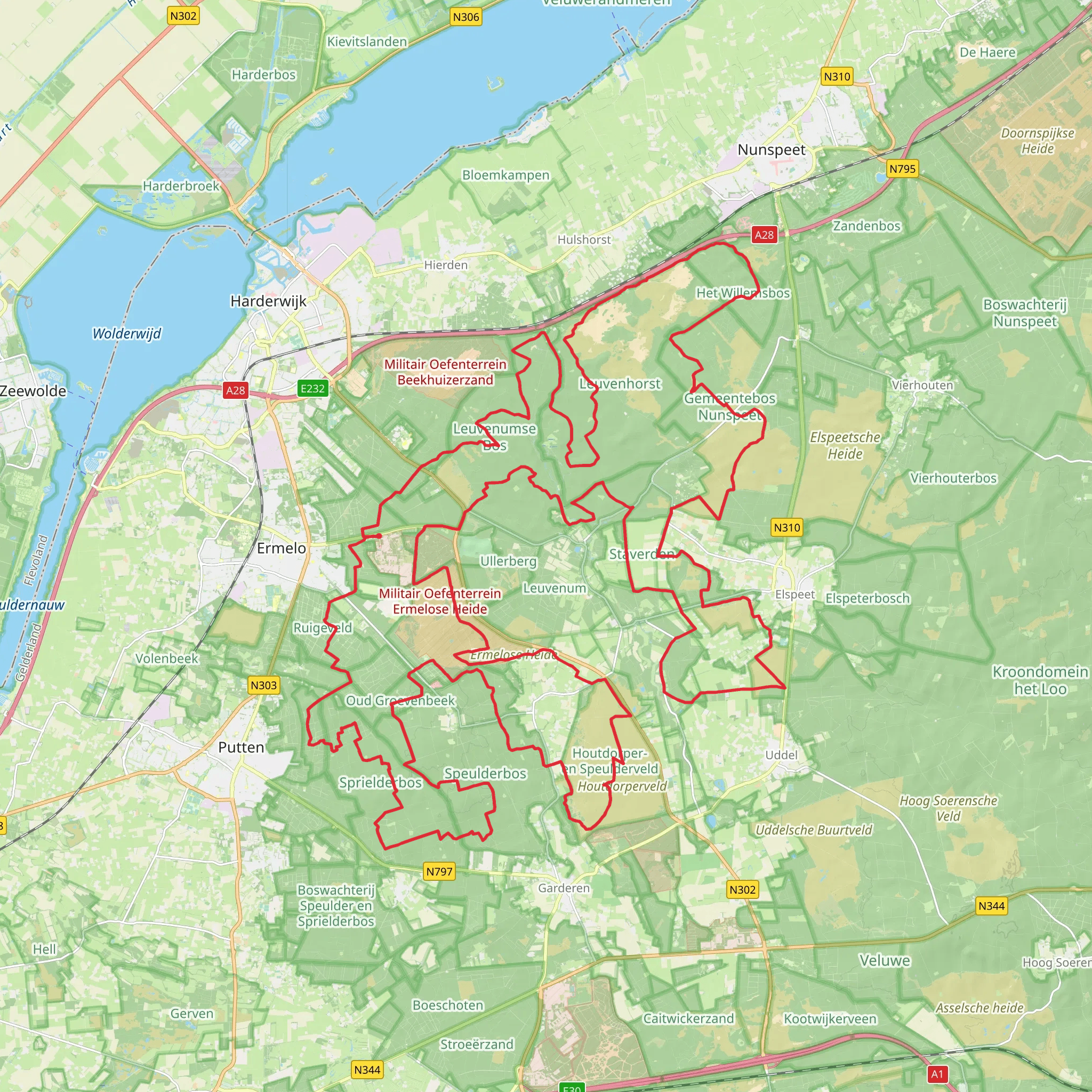
This is a long, low-relief loop/route through some of the Netherlands’ most classic Veluwe woodland: dense conifer and beech stands, wide sandy tracks, heath and drift-sand clearings, and quiet “production forest” lanes that make steady mileage straightforward. At roughly 102 km / 63 mi with only about 100 m / 330 ft of total ascent, the challenge is almost entirely time-on-feet, foot care, and staying oriented through a web of similar-looking forest roads rather than climbing.
Nearest start landmark / address (approx.)
With only “near” provided for the hike head, the most practical anchor for this route name is the road pair it references: Leuvenumseweg and Poolseweg. A sensible start point to plan around is the Leuvenumseweg–Poolseweg area near the hamlet of Leuvenum (municipality of Ermelo), on the Veluwe—close to the Leuvenumse Bos and within easy reach of Ermelo / Harderwijk for services. When you load the route in HiiKER, use the first waypoint/track start to confirm the exact roadside pull-off, trail gate, or parking bay.
Getting to the start (car + public transport)
By car
- Aim for Leuvenum (Ermelo), Gelderland and then navigate to Leuvenumseweg; from there, you can position yourself near the Poolseweg junction/area.
- Parking in this region is typically at forest car parks (bosparkings) or small roadside bays. Plan to arrive early if it’s a weekend or holiday—Veluwe trailheads can fill up.
By public transport
- The most common rail access points for this part of the Veluwe are Ermelo and Harderwijk stations. From either, you’ll usually need a bus + short walk, or a taxi, to reach the Leuvenumseweg/Poolseweg area efficiently.
- If you’re planning a multi-day hike, consider starting from the station side that best matches your lodging plan (Ermelo tends to be convenient for the southern/central Veluwe edges; Harderwijk for the western side). Use HiiKER to match the route start to the closest bus stop.
What the terrain is like (and why it still matters on an “easy” hike)
Even with minimal elevation gain, this route can feel demanding because: - Surface variety: long stretches of compacted forest road are fast, but you’ll also hit soft sand in places (especially near drift-sand/heath openings), which can slow pace and stress calves/Achilles. - Repetitive navigation: many junctions look alike—straight, wide tracks with subtle signage. Staying on the intended line is the main technical task. - Exposure changes: under canopy it can be cool and still; step into heath or open sand and wind/sun can be surprisingly strong.
Expect the “climbs” to be gentle rollers—old dunes and glacially influenced rises typical of the Veluwe—rarely more than a few metres at a time.
Route character and pacing (approximate breakdown)
At 102 km / 63 mi, most hikers treat this as either:
- a 2-day fastpack (about 51 km / 32 mi per day), or
- a 3-day hike (about 34 km / 21 mi per day), which is more comfortable if you want time for detours, wildlife pauses, and café stops.
Because the total ascent is only about 100 m / 330 ft, your pacing will be dictated by sand, junction density, and breaks, not hills.
Sprielderbos → Houtdorper & Speulderveld (roughly 25–40 km / 16–25 mi depending on exact line)
You’ll move through classic Veluwe forest structure: tall, straight conifers in managed blocks alternating with older mixed stands. The Sprielderbos area is known for its deep woodland feel and long, ruler-straight lanes—great for steady walking, but it can be mentally monotonous if you don’t plan micro-goals (next junction, next clearing, next rest spot).
As you transition toward Houtdorper en Speulderveld, the landscape typically opens: more heath edges, sandy patches, and a bigger sky. These open sections are where you’ll most notice: - wind chill in cooler months, - sun exposure in late spring/summer, - and soft sand that can add time.
Wildlife is often most active at the forest–heath boundary: keep an eye out for red deer, roe deer, and wild boar sign (hoof prints, rooting). Give boar a wide berth—especially if you see piglets—and keep food sealed.
Leuvenumse Bos (often the quiet, “green tunnel” middle)
The Leuvenumse Bos portion tends to feel calmer and more enclosed again—mossy verges, shaded tracks, and a more humid microclimate after rain. After wet weather, expect: - muddy wheel ruts on multi-use forestry roads, - slick patches where fine sand overlays hardpack, - and occasional standing water in low spots.
This is also where navigation can get tricky because multiple parallel tracks run in the same direction. Use HiiKER frequently at junctions rather than waiting until you’re unsure—small errors can become long, straight wrong turns.
Long return legs via Leuvenumseweg / Poolseweg corridors (
AI Planner
Days planned around your pace, with somewhere to stay each night.
Surfaces
Unknown
Sand
Asphalt
Dirt
Gravel
Unpaved
Grass
Ground
Paved
Concrete
Comments and Reviews
User comments, reviews and discussions about the Sprielderbos, Houtdorper en Speulderveld and Leuvenumse Bos via Leuvenumseweg and Poolseweg, Netherlands.
average rating out of 5
0 rating(s)