
Download
3D Flyover
Add to list
More
26.0 km
~5 hrs 14 min
21 m
Loop
“Drift through dancing beeches and sunlit heath, where flat paths reward attentive navigation.”
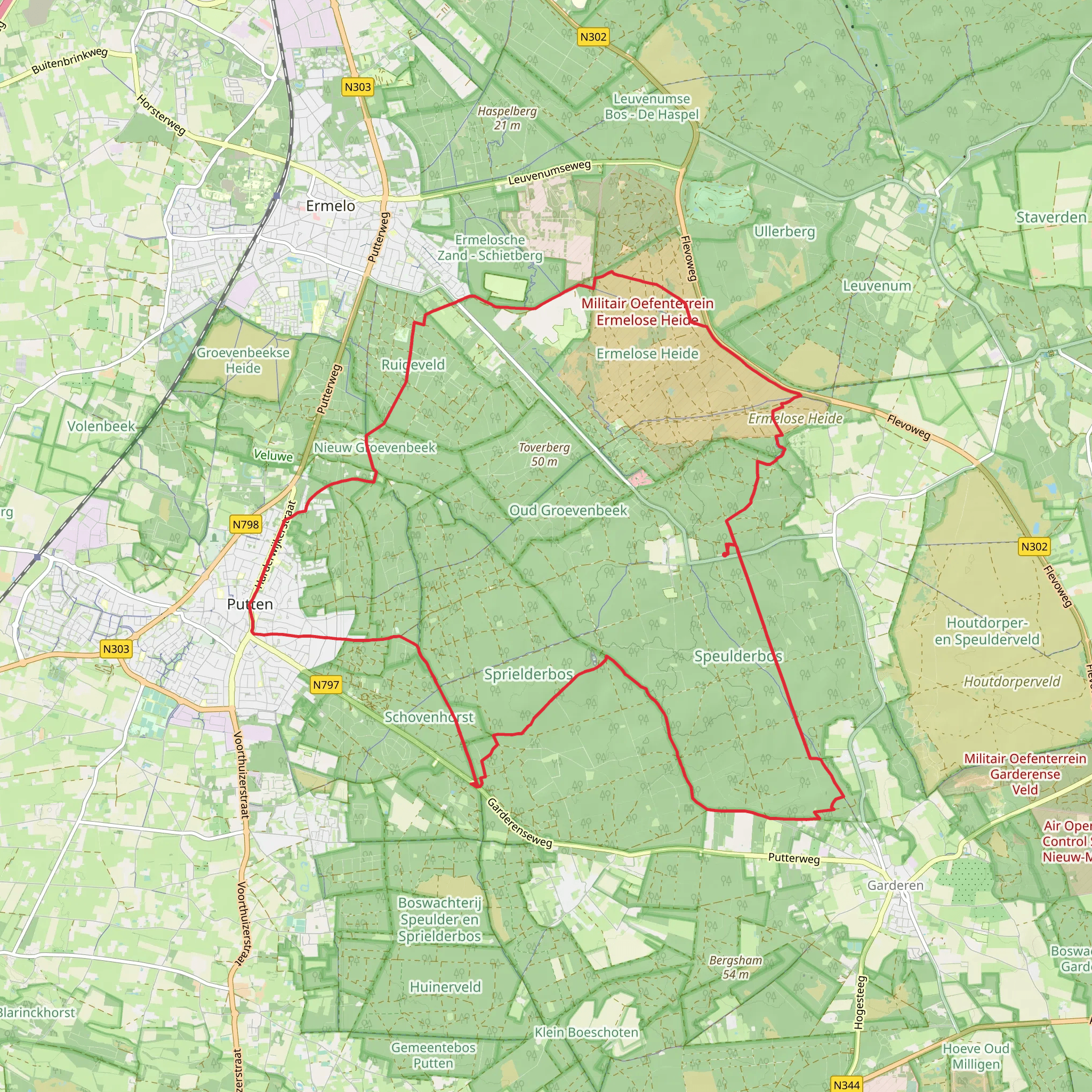
This is a long, flat Veluwe circuit of roughly 26 km (16.2 mi) with essentially 0 m (0 ft) of sustained climbing—more “rolling forest-and-heath wander” than a hill hike. Expect a steady rhythm of springy pine-needle paths, sandy tracks, and wide heathland lanes, with frequent junctions where it’s easy to drift onto the wrong forestry road if you’re not checking your line.
A practical, well-known place to anchor the start is Boshuis Drie (hamlet of Drie, near Speuld/Garderen on the Veluwe)—a historic Veluwe farmhouse-restaurant dating to 1765, commonly used as a walking hub in the Speulderbos area. (frankwandelt.nl)
Another excellent “hard” landmark on the loop is Schaapskooi Schapedrift, Postweg 50, 3852 PK Ermelo (Ermelosche Heide), with parking and a visitor focus right on the heath edge. (tripadvisor.com)
Getting to the start (car + public transport)
By car - If you start near Boshuis Drie, aim for the hamlet Drie (Veluwe). Parking is typically around the Drie/Boshuis area and nearby pull-ins; arrive early on weekends and during heather season. - If you prefer a more “formal” trailhead with a clear address, start/finish at Schaapskooi Schapedrift, Postweg 50, 3852 PK Ermelo, which is a major access point to the Ermelosche Heide. (tripadvisor.com)
By public transport - The most straightforward rail access is via Ermelo station, then a bus/taxi/bike connection toward the heath (the Schaapskooi is outside town). For a 26 km day, many hikers choose to arrive by train to Ermelo and then use a short taxi ride to either Postweg 50 (Schaapskooi) or the Drie/Speuld area, depending on where you want to begin.
What the route feels like underfoot
Over 26 km you’ll likely see three main “textures”:
- Ancient beech forest and mixed woodland in the Speulderbosch/Sprielderbosch complex: shaded, quiet, and often surprisingly dark under mature beech. The Speulderbos reserve is known for old beech stands, increasing deadwood, and occasional heavy limb drop from aging trees—something to keep in mind on windy days. (forestgeo.si.edu)
- Sandy forestry tracks: fast walking when dry; energy-sapping when loose. After rain, some sections firm up while others turn into soft sand pockets.
- Open heath (Ermelosche Heide): wide skies, long sightlines, and more exposure to wind and sun than the forest sections.
A sensible way to break down the 26 km loop
Because exact line choices vary (and Veluwe junction density is high), plan the day in chunks rather than obsessing over every turn. Use HiiKER to keep confirming you’re taking the intended track at each multi-way junction.
0–6 km (0–3.7 mi): Speulderbosch “dancing trees” and old woodland character
Early on, you’re in the heart of the Speulder- and Sprielderbos landscape—one of the oldest forest complexes in the Netherlands. The “dancing trees” reputation comes from the gnarled, twisting forms you’ll see in places: historically, straighter timber was harvested for building, leaving more contorted trees behind, creating that distinctive, sculptural look described on local Veluwe routes. (wandelzoekpagina.nl)
In damp weather, this section can feel almost primeval: mossy trunks, filtered light, and a quiet understory.
6–13 km (3.7–8.1 mi): Transition lanes, edges of farmland, and long forest roads
This middle portion often alternates between:
- straight, efficient forest roads (good for making time), and
- smaller, more characterful side paths that weave through older stands.
This is where navigation errors most commonly happen: multiple parallel tracks can run in the same direction. Keep an eye on HiiKER at every crossing, especially where a narrow footpath meets a broad forestry road.
**13–19 km (8.1–11.8
AI Planner
Days planned around your pace, with somewhere to stay each night.
Surfaces
Unknown
Sand
Asphalt
Gravel
Concrete
Ground
Dirt
Paved
Comments and Reviews
User comments, reviews and discussions about the Speulderbosch, Putterbosch and Ermelosche Heide Loop, Netherlands.
average rating out of 5
0 rating(s)


