
Download
3D Flyover
Add to list
More
61.7 km
3 days
132 m
Multi Day
“A long Veluwe loop of sandy lanes and arrow-straight forest tracks—quiet, steady, deceptively demanding.”
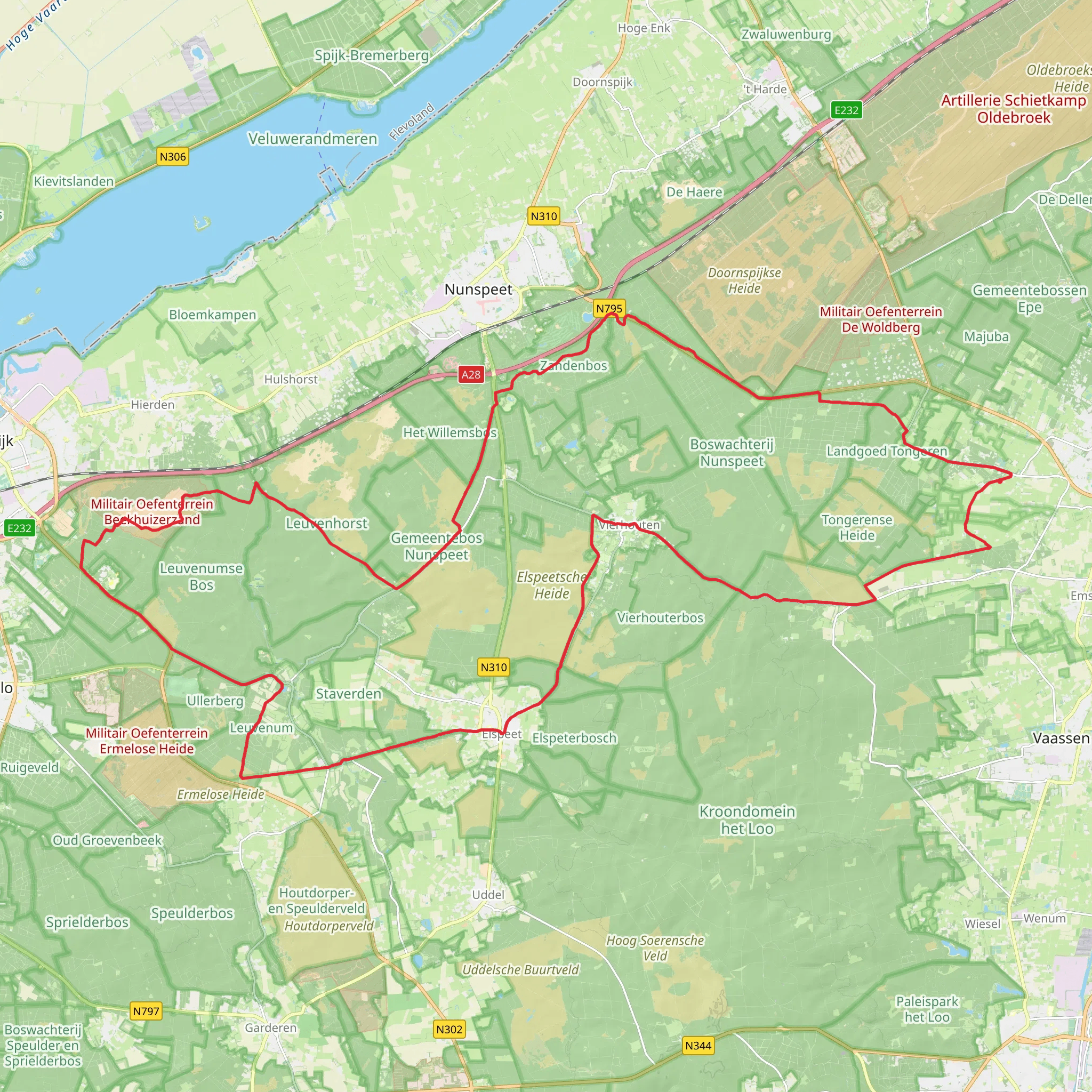
This is a long, low-relief loop of roughly 62 km (38.5 mi) with only about 100 m (330 ft) of total climbing, so it’s more about steady time on your feet than steep terrain. Expect a mix of quiet country lanes and long forest tracks through the Veluwe’s sandy soils, with frequent straightaways that can feel deceptively “easy” until the distance adds up. Plan for a full day for fast walkers, or split it into two days if you want time for cafés, detours, and wildlife watching.
Getting to the start (and what “near” likely means) - By car: These road names (Langeweg, Vierhouterweg, Staverdenseweg, Leuvenumseweg, Hiederweg) cluster around the Ermelo / Leuvenum / Staverden / Vierhouten area on the Veluwe (Gelderland, Netherlands). A practical, well-known place to aim for is Ermelo Station (Stationsstraat, Ermelo) or the Leuvenumse Bos / Leuvenum area (near the hamlet of Leuvenum, close to Ermelo). If you share the exact lon/lat, I can pin it to the nearest specific address/landmark. - By public transport: The most straightforward rail access is typically to Ermelo (regional trains). From Ermelo Station, you can walk or take a local bus/taxi toward Leuvenum or the forest access points depending on where you start the loop. If you’re starting closer to Vierhouten or Staverden, buses can be limited—check the day/time and be ready for a short taxi hop for the last few kilometers. - Parking: Look for signed forest car parks around Leuvenumse Bos or near Staverden (often small, unpaved pull-ins). Arrive early on weekends—this is a popular walking and cycling region.
What the terrain feels like Most of the route sits on gently rolling Veluwe ground—wide forestry roads, sandy tracks, and occasional paved connectors. With only ~100 m / 330 ft of gain spread across the day, you’ll rarely notice “climbs,” but you will notice: - Soft sand patches that slow pace and increase calf/ankle fatigue - Long straight forest corridors where wind and sun exposure can be more noticeable than the elevation - Seasonal mud in low spots after rain, especially where tracks are used by forestry vehicles
Because the loop is long, treat it like an endurance walk: comfortable footwear, blister strategy, and a realistic pace matter more than hill fitness.
Route flow and distance markers (approximate)
The exact sequence depends on your chosen start point, but the loop typically strings these roads/areas together in a broad circuit through forest and heath edges:
0–10 km (0–6.2 mi): Settling in on quiet lanes and forest entry You’ll likely begin on a calm road section (often lightly trafficked) before transitioning onto forest tracks. This is where you’ll find your rhythm—keep your pace conservative early. Elevation change is minimal, but the surface can alternate between firm gravel and looser sand.
10–25 km (6.2–15.5 mi): Deep Veluwe forest—long, runnable tracks Expect extended stretches of straight, wide paths through conifer and mixed woodland. These are easy to follow, but monotony can cause navigation lapses—keep HiiKER handy and confirm junctions, especially where multiple parallel tracks run close together.
25–40 km (15.5–24.9 mi): Heath/edge habitats and the Staverden–Leuvenum zone This middle portion often feels the most “Veluwe”: sandy soils, open patches, and a sense of space. If your loop passes near Staverden, you’re close to one of the Netherlands’ smallest “city” designations and an estate landscape with long historical ties to land management and hunting traditions. Even if you don’t detour into built-up areas, you’ll notice the estate-like geometry—straight lanes, managed woodland blocks, and occasional clearings.
40–62 km (24.9–38.5 mi): The long return—fatigue management The final third is where an “easy” route becomes demanding. Foot soreness and small gait changes are common on sand/gravel. If you’re behind schedule, this is the safest place to simplify: stay on the clearest main tracks and avoid optional detours.
Landmarks, nature, and wildlife to look out for This part of the Veluwe is known for managed forests, heathland fragments, and sandy tracks, with wildlife that’s often present but not always visible.
- Wildlife:
- Red deer and roe deer are among the signature mammals of the Veluwe; dawn/dusk are best.
- Wild boar can be present—give them space, especially if you see piglets.
- Birdlife includes woodland species and raptors; open edges can be good for scanning.
- Red deer and roe deer are among the signature mammals of the Veluwe; dawn/dusk are best.
- Vegetation and habitats:
- Mixed woodland with conifer stands and deciduous pockets
- Heath and open sandy areas in places, especially along edges and clearings
- Seasonal color changes can be dramatic: spring greens, summer heather tones, autumn leaf drop
- Mixed woodland with conifer stands and deciduous pockets
- Forestry activity: You may encounter logging or maintenance vehicles. Step well aside, and expect temporary track wear (ruts, churned sand).
Historical significance (what you’re walking through) The Veluwe landscape reflects centuries of **land use, estate
AI Planner
Days planned around your pace, with somewhere to stay each night.
Surfaces
Asphalt
Concrete
Unknown
Sand
Paved
Gravel
Wood
Comments and Reviews
User comments, reviews and discussions about the Langeweg, Vierhouterweg, Staverdenseweg, Leuvenumseweg and Hiederweg Loop, Netherlands.
average rating out of 5
0 rating(s)



