
Download
3D Flyover
Add to list
More
52.8 km
3 days
219 m
Multi Day
“A big-sky Euregio ramble of quiet lanes and farm tracks—more endurance than climbs, especially after rain.”
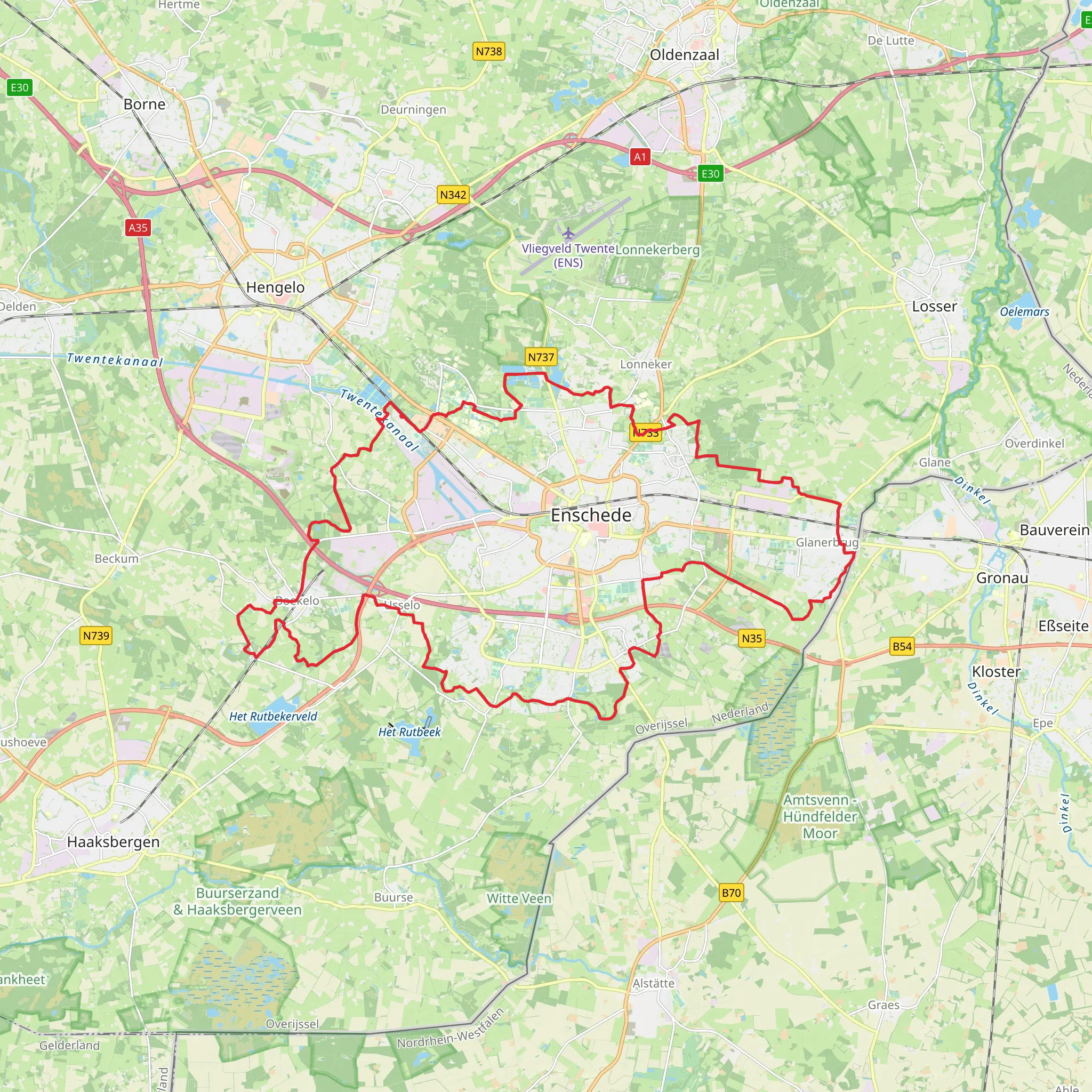
This is a long, mostly flat countryside loop of about 53 km (33 mi) with roughly 200 m (656 ft) of total ascent—more of an endurance day than a steep hike. Expect a mix of quiet farm lanes, field-edge tracks, and sections of regional walking routes typical of the Dutch–German border area (the “Euregio” theme). Underfoot is usually firm (paved lanes, compacted gravel, and dirt), but after rain the unpaved stretches can hold water and become slick in shaded spots.
Getting to the start (car + public transport)
Because the start point is listed only as “near” (no town name or coordinates), the best way to pin down the exact trailhead is to open the route in HiiKER and use the start marker to identify the nearest village/road junction. Once you have that, you can match it to the closest practical parking or transit stop.
- By car: In this region, starts are often at a small village center, a church square, or a signed trail parking pull-off near a farm road. Plan for limited formal parking—use marked bays and avoid blocking farm gates and field access.
- By public transport: Rural bus service can be infrequent, especially evenings and Sundays. Typically you’ll take a train to the nearest larger town, then a regional bus to a village stop. When you identify the start point in HiiKER, look for the nearest “Dorpsstraat / Kerk / Bahnhof / Bushalte”-type stop within 1–2 km (0.6–1.2 mi).
If you share the start coordinates (or a HiiKER link), I can convert them to the nearest known address/landmark and tailor the access plan precisely.
What the route feels like (terrain, pacing, and effort)
With only ~200 m (656 ft) of climbing spread across 53 km (33 mi), the elevation changes are gentle—small rises over dikes, bridges, and subtle undulations rather than hills. The main challenge is time-on-feet:
- Typical moving time: ~10–13 hours for most hikers depending on breaks and surface (pavement can be fast but harder on feet).
- Footwear: Light hikers or trail shoes work well; choose something comfortable for long stretches of hard surface.
- Weather exposure: Much of the loop is likely open farmland—wind can be a bigger factor than rain. In shoulder seasons, cold wind across fields can chill quickly.
Navigation and wayfinding
This is the kind of loop where paths can look similar—straight farm tracks, multiple junctions, and occasional “private” driveways that are actually public rights-of-way. Use HiiKER for: - Staying on the correct side of drainage canals and field boundaries - Confirming turns at T-junctions where signage may be sparse - Avoiding accidental detours onto farm-only access roads
Landmarks, landscape, and the “Euregio” character
The names Helweg and Euregioweg strongly suggest you’ll be walking along established local/regional routes that emphasize cross-border identity and shared cultural landscape. Expect:
- Agricultural mosaic: Pastures, crop fields, hedgerows, and drainage ditches/canals. You’ll often walk between fields with long sightlines and big skies.
- Small settlements and farmsteads: Brick farmhouses, barns, and occasional chapels or roadside crosses are common in this border region.
- Woodlots and shelterbelts: Shorter shaded sections break up the open stretches—these can be muddy after rain and may have leaf litter hiding ruts.
Nature and wildlife to look out for
Wildlife sightings depend on season and time of day, but this landscape often supports:
- Birdlife: Lapwings, geese, and other water-associated birds near ditches and wet meadows; raptors (buzzards/kestrels) hunting over fields.
- Mammals: Hares and roe deer are possible at field edges, especially early morning or near dusk.
- Insects: In warmer months, expect mosquitoes/gnats near standing water and canals; consider repellent.
If the loop passes any wetter nature reserves or reedbeds, you may also see herons/egrets and hear frogs in spring.
Historical context you’ll feel on the ground
Even without dramatic ruins, this region carries history in its borders, roads, and land use:
- Borderland (“Euregio”) identity: The Dutch–German border area has long been a zone of trade, shared dialects, and shifting administrative lines. Modern “Euregio” routes often highlight cooperation and cultural continuity across the border rather than separation.
- Old roads and “weg” corridors: Names like Helweg can indicate an older route corridor—historically, these were practical lines between villages, markets, and churches, later formalized into today’s lanes and walking paths.
- Water management landscape: The flatness isn’t “natural” in the casual sense—ditches, canals, and field geometry reflect centuries of drainage, farming, and land consolidation.
Practical planning: water, food, and resupply
On a 53 km (33 mi) rural loop, assume services are intermittent.
- Water: Carry enough for long gaps (often 2–3+ hours between reliable taps/shops). In cooler weather you can carry less, but wind exposure can still dehydrate you.
- Food: Plan a full day’s calories. If the route passes villages, bakeries and small supermarkets may close early; Sundays can be limited.
- Break spots: Look for village greens, churchyards (respectfully), canal-side benches, or the edge
AI Planner
Days planned around your pace, with somewhere to stay each night.
Surfaces
Asphalt
Unknown
Dirt
Grass
Sand
Unpaved
Wood
Ground
Concrete
Gravel
Paved
Comments and Reviews
User comments, reviews and discussions about the Broekmaatweg, Helweg and Euregioweg Loop, Netherlands.
average rating out of 5
0 rating(s)


