
Download
3D Flyover
Add to list
More
49.5 km
2 days
13 m
Multi Day
“A big-sky polder loop past Kinderdijk’s windmills—serene canals, stout dikes, and wind-tested endurance.”
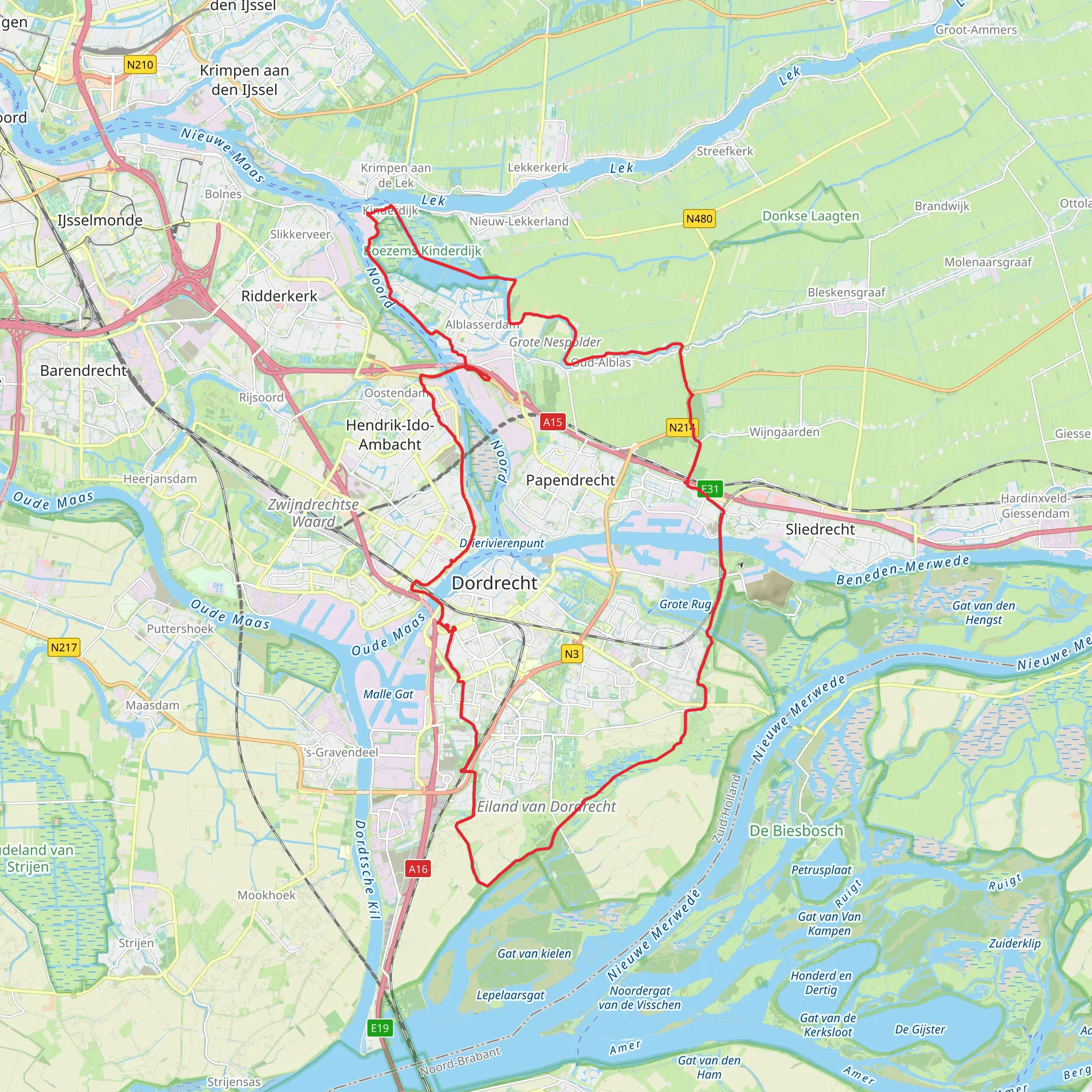
This is a long, flat, big-sky loop through classic Dutch polder country: arrow-straight dikes, mirror-calm canals, grazing pasture, and the dense windmill network that made Kinderdijk one of the world’s most iconic water-management landscapes. At ~49 km / ~30.4 mi with essentially 0 m / 0 ft of climbing, the challenge isn’t elevation—it’s time on feet, wind exposure, and staying comfortable on hard, level surfaces.
A practical start point is the main visitor entrance for the UNESCO site at World Heritage Kinderdijk, Nederwaard 1b, 2961 AS Kinderdijk (near Alblasserdam), South Holland. (kinderdijk.com)
Getting to the start (car + public transport)
- By car: Navigate to Nederwaard 1b, 2961 AS Kinderdijk. There’s a paid parking area next to the entrance, which is the simplest option for an early start on a 49 km day. (kinderdijk.com)
- By public transport: Kinderdijk is reachable year-round by public transport, and a popular approach is via Waterbus connections from Rotterdam or Dordrecht (with onward connections to Kinderdijk). Check the day’s timings before you commit, especially outside peak season. (kinderdijk.com)
What the route feels like underfoot
Expect a mix of paved dike-top paths, compacted gravel, and occasional narrow lanes between canals and fields. Because the terrain is so flat, you’ll likely settle into a steady rhythm—then notice the real variables: - Wind: Dikes are exposed. A headwind can make the second half feel much longer than the first. - Hard surfaces: Even “easy” terrain can be punishing over 49 km / 30+ mi. Cushioned footwear and blister prevention matter more than traction. - Narrow dikes + shared use: Many sections are shared with cyclists and local access traffic. Stay alert on bends and near bridges.
Use HiiKER to keep an eye on junction density around the windmill clusters and to confirm you’re on the correct dike when multiple parallel canals run in the same direction.
Landmarks and the windmill network (the “why” of this walk)
You’re walking through the Mill Network at Kinderdijk–Elshout, a landscape engineered to keep reclaimed land dry using a coordinated system of dikes, canals, reservoirs, and windmills—recognized as a UNESCO World Heritage Site (inscribed in 1997). (kinderdijk.com)
The most memorable stretch is where the route threads alongside the two main windmill lines:
- Nederwaard mills (brick) and Overwaard mills (thatched/wooden) form the famous paired rows. Historically, these mills worked as a system to lift water through stages from low polder to higher storage and onward to the river system. (en.wikipedia.org)
- Many of the landmark mills date to the 18th century—with the Nederwaard set built in 1738 and the Overwaard set built in 1740—which is why the architecture shifts subtly between the two lines. (en.wikipedia.org)
Because this is a loop of ~49 km / ~30.4 mi, you’ll likely pass the core windmill area early and/or late depending on direction. If you want the most atmospheric light and fewer crowds, plan to be near the main windmill corridors early morning or late afternoon.
Nature and wildlife to look for
This is a working water landscape, so wildlife is tied to canals, reed edges, wet pasture, and open sky: - Birdlife is the headline: expect waterfowl on the canals, waders in wet fields, and raptors scanning the open polder. Seasonal variation is big—migration and wintering periods can be especially lively in open agricultural wetlands. - Grazing livestock (often cattle and sheep) are common in the Alblasserwaard polder scenery; give them space and keep gates as you find them. - Insects and sun exposure: On still, warm days, canal edges can bring
AI Planner
Days planned around your pace, with somewhere to stay each night.
Surfaces
Asphalt
Unknown
Paved
Concrete
Grass
Gravel
Comments and Reviews
User comments, reviews and discussions about the West Kinderdijk and Nederwaard Loop, Netherlands.
average rating out of 5
0 rating(s)



