
Download
3D Flyover
Add to list
More
38.0 km
2 days
14 m
Multi Day
“A big-sky waterside loop of dikes and quays—flat, wind-shaped, and quietly demanding.”
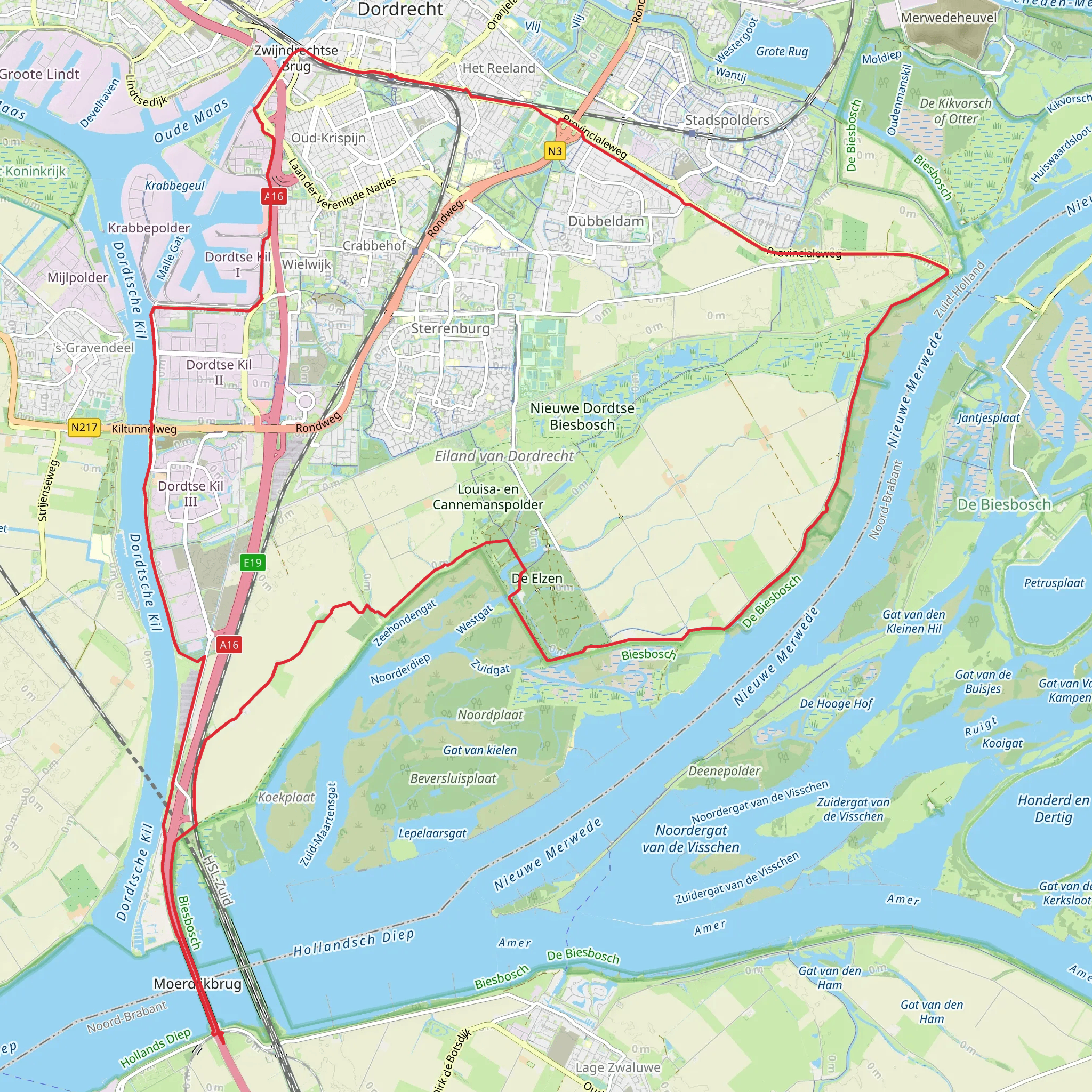
This is a long, flat, waterside loop of about 38 km (23.6 mi) with essentially 0 m (0 ft) of climbing—ideal for steady pacing, big-sky views, and a full day of easy walking on dikes, towpaths, quays, and paved multi-use paths. Expect a route shaped by water engineering: canals, harbors, bridges, and reclaimed lowland landscapes where the “terrain” challenge is more about wind exposure and distance than hills.
Getting to the start (public transport + car)
Because the start point is listed only as “near” (no coordinates or town provided), the most reliable way to plan is to anchor the start at the most obvious named places in the route: Wilhelminahaven (a harbor area) and Tussen de Bruggen (“between the bridges,” typically a central waterside corridor in Dutch towns). If you share a lon/lat (or the GPX), I can convert it to the nearest specific landmark/address and tailor the access instructions precisely.
For planning right now, use this approach: - By public transport: In the Netherlands, harbor/bridge districts like these are usually reachable via a nearby railway station plus a short walk or local bus. Aim for the nearest town’s main station, then walk toward the Wilhelminahaven waterfront (often signposted) to pick up the loop. - By car: Navigate to a public parking area near the Wilhelminahaven quay (look for signed “P” lots near the harbor basin). Harbor districts commonly have time-limited street parking; arriving early helps, especially on weekends.
If you tell me the municipality (or provide coordinates), I’ll pinpoint the nearest known address or prominent landmark for the trailhead and the best parking/transit stop.
What the route feels like underfoot
With negligible elevation gain, you’ll likely be on: - Paved paths along quays and canal edges (fast, consistent footing) - Dike-top tracks (often wide, open, and windy) - Bridge crossings and short urban connectors near “Tussen de Bruggen” - Occasional gravel or compacted dirt sections depending on local maintenance
Even on an “easy” profile, 38 km (23.6 mi) is a serious distance. Plan for a full-day outing: many hikers will take 7–10 hours depending on breaks and walking speed.
Navigation and wayfinding (HiiKER)
This is the kind of lowland loop where it’s easy to keep walking on the “right-looking” waterside path and still drift off-route at: - Bridge approaches (multiple ramps/underpasses) - Harbor basins (quays that dead-end at fences or working areas) - Canal junctions (parallel paths on both banks)
Load the route in HiiKER and keep an eye on: - Which bank you’re meant to follow after each bridge - Any short urban cut-throughs linking quay to towpath - Detours around port operations or temporary works
Landmarks you’ll notice along the way
The three named segments hint at a classic Dutch waterscape loop:
- Wilhelminahaven: “Wilhelmina Harbor” areas often date to late-19th/early-20th-century expansion—when canals, rail, and shipping drove industrial growth. Expect a mix of older harbor geometry (straight quays, basins) and modern redevelopment (apartments, cafés, marinas) depending on the town.
- Tussen de Bruggen: This usually indicates a central stretch where multiple bridges span a canal/river in close succession. It’s often one of the most “town-like” parts of the walk—good for resupply, water, and a mental reset mid-route.
- Viersprong: Literally “four-way junction.” In Dutch landscapes, that can refer to a crossroads of dikes, farm lanes, or canal-side routes. It’s a common place to accidentally take the wrong spur—another reason to check HiiKER at junctions.
Nature, scenery, and wildlife (lowland water country)
Even near towns, Dutch harbor-and-canal loops can be surprisingly rich in birdlife and waterside ecology.
What you’re likely to see - Waterfowl: mallards, coots, moorhens, geese, swans - Wading birds in shallows and wet fields: herons, egrets (seasonal variation) - Raptors over open polders: kestrels and buzzards are common in many regions - Fish activity in clear canal edges on calm days
Habitats - Canal margins with reeds and grasses - Polder fields and drainage ditches (classic reclaimed-land geometry) - Harbor edges where freshwater/brackish conditions can influence plant life (varies by location)
Weather exposure and comfort planning
Flat routes amplify the elements: - Wind is the main “difficulty multiplier.” Dike tops and open quays can feel much harder than the elevation profile suggests. - Sun exposure can be constant with little shade along water infrastructure. - Rain can make some towpaths slick, but most harbor/canal paths remain manageable.
Bring: - A light windproof layer - Sun protection (hat/sunscreen) - Enough water for long, exposed stretches (refill opportunities are usually best near the “between the bridges” town section)
Safety and things to look out for
- Cyclists: Many Dutch waterside paths are shared. Expect fast bikes—hold a predictable line and listen
AI Planner
Days planned around your pace, with somewhere to stay each night.
Surfaces
Asphalt
Unknown
Paved
Comments and Reviews
User comments, reviews and discussions about the Viersprong, Tussen de Bruggen and Wilhelminahaven Loop, Netherlands.
average rating out of 5
0 rating(s)


