
Download
3D Flyover
Add to list
More
20.1 km
~4 hrs 2 min
6 m
Loop
“A gentle Drenthe loop where heath blushes purple, pines hush the wind, and wetlands shimmer—best savoured unhurried.”
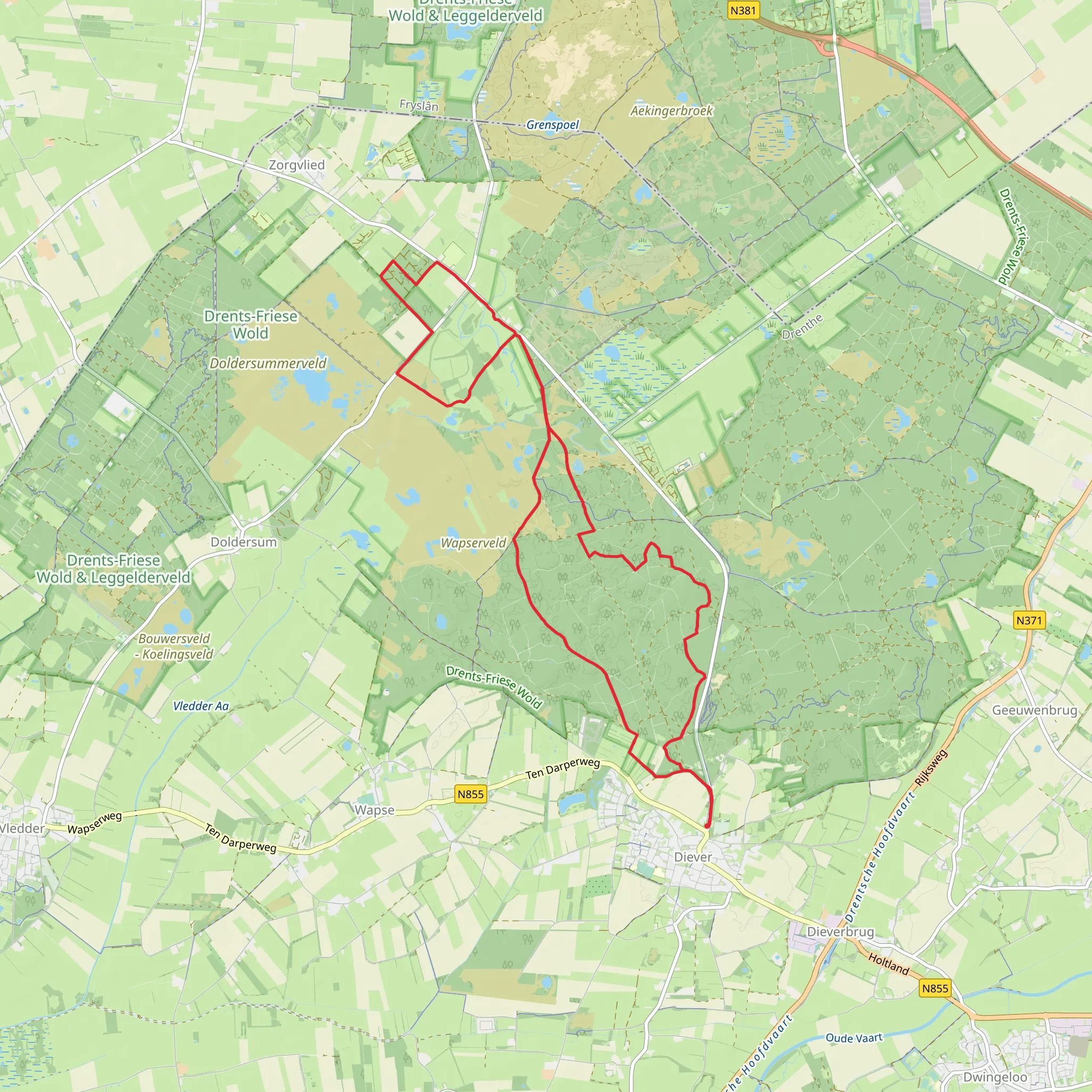
This is a classic, low-relief Drenthe circuit through heath, pine-and-oak woodland, and wetland edges—more about changing habitats and quiet cultural landscapes than climbing. Expect a mostly level walk of about 20 km / 12.4 mi with roughly 0 m / 0 ft of sustained ascent (you may still notice tiny undulations on sandy tracks and dike-like edges near wetter ground).
Getting to the start (and where “near” usually means for this loop)
This loop is most commonly started from the Diever / Dwingelderveld side, using one of the well-known access points near the village of Diever (Drenthe, Netherlands)—often around the recreation and trailhead areas by Bosweg / Oude Willem or the Dwingelderveld visitor-area parking on the Diever side. If you share a lon/lat for your preferred start, I can convert it to the nearest named place (parking area, road, or landmark) and tailor the directions precisely.
By car - Aim for Diever and follow local signs toward Dwingelderveld / Oude Willem / parking areas. Parking is typically at signed trailhead lots near the forest edge and reserve entrances. Arrive earlier on weekends—these are popular day-walking zones.
By public transport - The nearest practical rail hubs are usually Steenwijk or Meppel (both have frequent connections), then a regional bus toward Diever. From Diever village, you may need a short walk or local taxi/bike to reach the forest-edge trailheads depending on the exact start point.
What the terrain is like (and what that means for planning)
You’ll be on a mix of: - Wide sandy forestry tracks (fast, easy navigation, can be soft underfoot in dry spells) - Firm gravel or compacted paths near recreation areas - Narrower woodland footpaths where roots and pine needles can be slick after rain - Edges of wetland and small waters around Klein Wateren, where boardwalk-like sections or damp ground can appear seasonally
Because the route is essentially flat, pacing is straightforward: most hikers take 4.5–6 hours moving time for 20 km / 12.4 mi depending on stops and surface softness.
Route flow and key places you’ll notice
0–4 km / 0–2.5 mi: Woodland approach and sandy tracks You’ll typically begin in mixed woodland—pine plantations interspersed with older deciduous stands. The first few kilometers are ideal for settling into a rhythm on broad tracks. In dry weather, the sand can feel energy-sapping; in wet weather, the same tracks often firm up nicely.
4–10 km / 2.5–6.2 mi: Dieverveld heath and open-country feel
Dieverveld is where the landscape opens. Expect heathland (heather and grasses) with scattered birch and pine, plus long sightlines that make the area feel bigger than it is. This is one of the most “Drenthe” sections of the loop—quiet, spacious, and shaped by centuries of land use (grazing, sod-cutting, and later forestry management).
- Wildlife to watch for: roe deer at the heath edge, rabbits, and a lot of birdlife. In open heath, you may see buzzards and other raptors riding thermals.
- Seasonal highlight: late summer heather bloom can turn sections purple; in winter, the openness can feel windier and colder than the woods.
10–15 km / 6.2–9.3 mi: Klein Wateren and wetland edges “Klein Wateren” translates to “small waters,” and the character shifts accordingly—more moisture-loving vegetation, reedier margins, and a cooler feel in shaded damp pockets. Even though the elevation gain is negligible, this is where footing can change the most: - After rain, expect muddy patches and slick leaf litter. - In warmer months, mosquitoes and midges can be noticeable near still water—pack repellent if you’re sensitive.
This section is also excellent for quieter nature observation: amphibians, dragonflies in season, and water-associated birds. Keep voices low and you’ll often spot movement at the margins.
15–20 km / 9.3–12.4 mi: Landgoed Berkenheuvel and the return through managed estate woodland Landgoed Berkenheuvel brings a more “estate” feel—managed woodland, straighter lines in places, and a sense of curated landscape compared with the wilder heath. You’ll likely finish on efficient tracks that make the last kilometers pass quickly.
Navigation (keep it simple, keep it reliable)
The network of forestry roads and intersecting paths can be deceptively dense, especially where multiple sandy tracks look similar. Use HiiKER to: - Confirm you’re taking the correct branch at multi-track junctions - Check distance-to-go (helpful on a flat route where progress can feel uniform) - Re-route calmly if a section is temporarily wet or busy
Landmarks, nature, and what to look out for
- Heathland transitions: Watch for the sharp boundary where pine plantation gives way to open heath—these ecotones are often where deer appear.
- Wet pockets near Klein Wateren: Look for reeds, sedges, and darker, peaty soil; these areas can be surprisingly biodiverse.
- Forestry operations: Drenthe woodlands are actively managed. You may encounter temporary closures, stacked logs, or machinery tracks—detour respectfully and rejoin the route using HiiKER.
AI Planner
Days planned around your pace, with somewhere to stay each night.
Surfaces
Unknown
Concrete
Sand
Grass
Asphalt
Unpaved
Gravel
Paved
Comments and Reviews
User comments, reviews and discussions about the Dieverveld, Klein Wateren and Landgoed Berkenheuvel Loop, Netherlands.
average rating out of 5
0 rating(s)

