Download
3D Flyover
Add to list
More
35.1 km
2 days
77 m
Multi Day
“A long, flat countryside loop under vast skies—canals, hedgerows, and wind-tested farm lanes.”
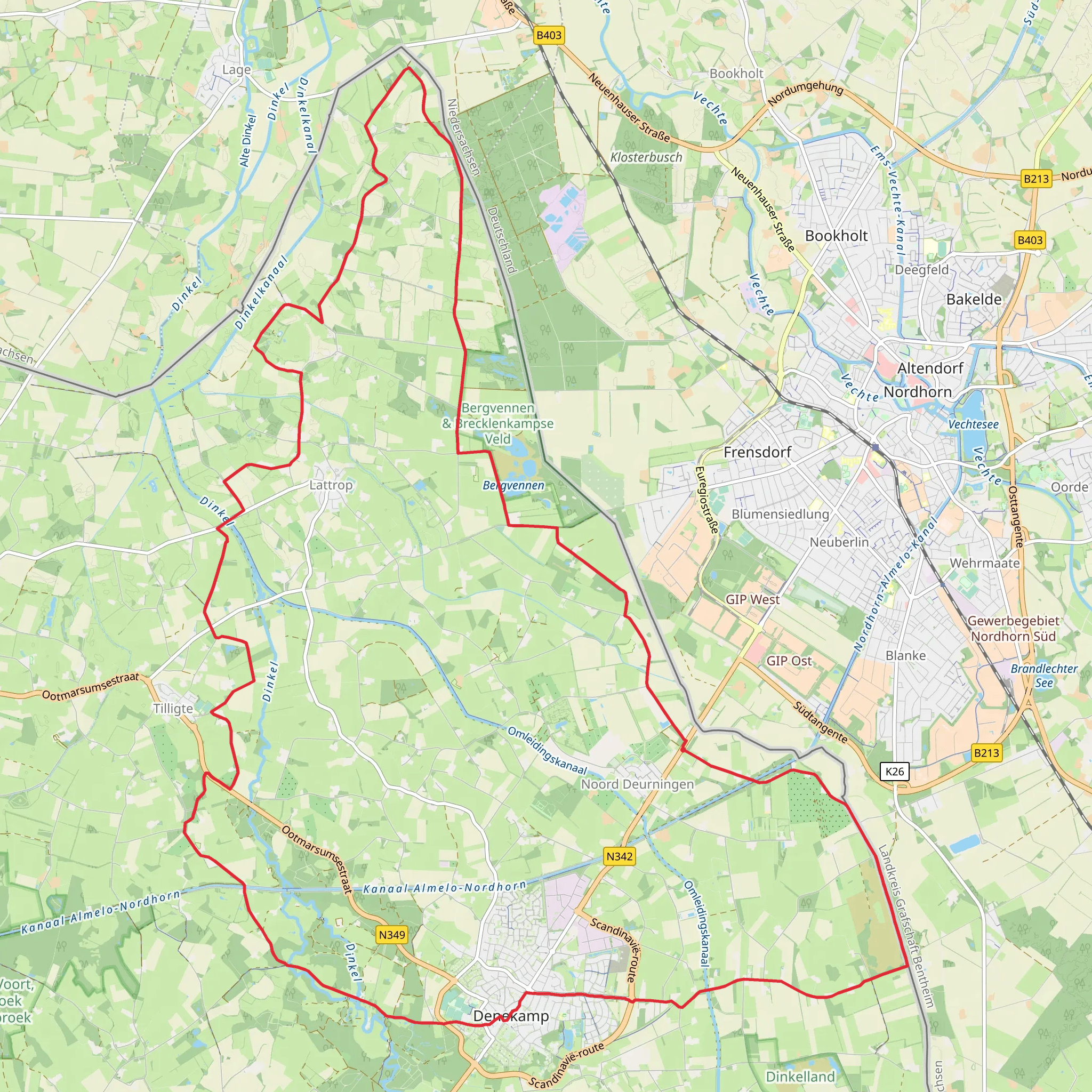
A long, mostly level countryside loop of about 35 km / 21.7 mi with only ~100 m / 330 ft of total climbing, this walk is all about big skies, drainage canals, hedgerows, and quiet farm lanes—ideal for steady pacing rather than steep effort. Expect a mix of paved cycle paths, compacted farm tracks, grassy verges, and short unpaved connectors that can turn soft after rain. Because the elevation change is modest, the main “difficulty” factors are distance, wind exposure, and underfoot conditions on agricultural tracks.
Getting to the start (car + public transport)
Because the start point you provided is incomplete (“near …”), the most reliable way to plan is to anchor your start at a recognizable local hub once you drop a pin in HiiKER. If your start is indeed near the names in the route (Bergvennenweg / Westenveldweg / Vrijdijk), you’re typically in the Drenthe/Overijssel border countryside (northeastern Netherlands), where access is usually via small villages and regional bus lines.
- By car: Plan to park at a village center car park, a sports field, or a trailhead pull-in along a quiet lane near your chosen start. In this region, parking is often informal but still posted—watch for “Verboden te parkeren” (no parking) signs and keep farm gates clear.
- By public transport: The usual pattern is train to a larger town (regional rail hub), then a bus to a village stop near the loop. In rural Drenthe/Overijssel, buses can be infrequent outside commute hours and on Sundays—check the day-of-week timetable before committing. Once you share the start coordinates (lon/lat), I can translate them to the nearest named stop, road, or landmark and give a precise approach.
What the route feels like underfoot
You’ll likely spend much of the day on quiet agricultural infrastructure: narrow lanes, dike-top paths beside canals, and long straight segments between fields. The walking is mechanically easy—no sustained climbs—but the route can feel “big” because of the continuous forward progress and limited shade.
- Surface mix: Expect hard surfaces (paved cycleways/lanes) interspersed with farm tracks. After wet weather, tractor ruts can hold water and the edges can be slick.
- Wind exposure: With open fields and drainage corridors, wind can be a bigger energy drain than the elevation profile suggests—plan layers accordingly.
- Navigation: The landscape can be repetitive (straight lanes, similar junctions). Load the route in HiiKER and keep an eye on turns where a farm track meets a paved lane at odd angles.
Distance + pacing plan (approximate)
For a 35 km / 21.7 mi easy-grade loop, most hikers do best by breaking it into clear chunks:
- 0–10 km (0–6.2 mi): Settle into a sustainable pace. This is where you’ll appreciate the flat profile—avoid starting too fast.
- 10–22 km (6.2–13.7 mi): The “middle miles” where the scenery can feel uniform. Plan a deliberate snack/water rhythm (every 45–60 minutes).
- 22–35 km (13.7–21.7 mi): Fatigue shows up in feet and hips more than lungs. If there are any softer tracks late in the day, they can feel surprisingly taxing.
With only ~100 m / 330 ft of gain total, any rises are likely dike crests, bridge approaches, or gentle undulations rather than hills.
Landmarks, landscape character, and what to notice
The place-names in your loop strongly suggest a classic veen (peat) and reclaimed farmland setting—an engineered landscape shaped by drainage, canals, and centuries of land management.
- Canals, ditches, and dikes: These are not just scenery; they’re the backbone of how the land works. You’ll often walk parallel to watercourses that keep fields workable. Bridges and culverts become natural “checkpoints” for navigation.
- Field mosaics and shelterbelts: Look for lines of trees and hedges that break the wind—these often mark property boundaries or older field patterns.
- Wet pockets and boggy remnants: Even in heavily managed areas, you can find wetter corners—reedbeds, sedge patches, and small ponds—especially near “vennen” (fens/ponds). These can be excellent for birdlife.
Wildlife you’re likely to encounter
This kind of lowland route is often better for birds and small mammals than for large, dramatic wildlife.
- Birds: Expect geese, ducks, coots, herons, and depending on season, lapwings, oystercatchers, and other waders in open fields. Raptors (buzzards/kestrels) often hunt along verges.
- Amphibians: In wetter stretches, frogs and newts are common—watch your footing on narrow, damp edges.
- Insects: In warm months, canals and wet meadows can mean mosquitoes and midges, especially in still air near dusk.
Historical significance of the region (what the names hint at)
In the northeastern Netherlands, many routes like this pass through landscapes shaped by: - Peat extraction and reclamation: “Vennen” and peatland references often point to areas that were once wetter and were later drained or cut for peat, then converted to agriculture. - **Water management
AI Planner
Days planned around your pace, with somewhere to stay each night.
Surfaces
Asphalt
Unknown
Concrete
Paved
Unpaved
Cobblestone
Wood
Sand
Gravel
Comments and Reviews
User comments, reviews and discussions about the Bergvennenweg, Westenveldweg and Vrijdijk Loop, Netherlands.
average rating out of 5
0 rating(s)